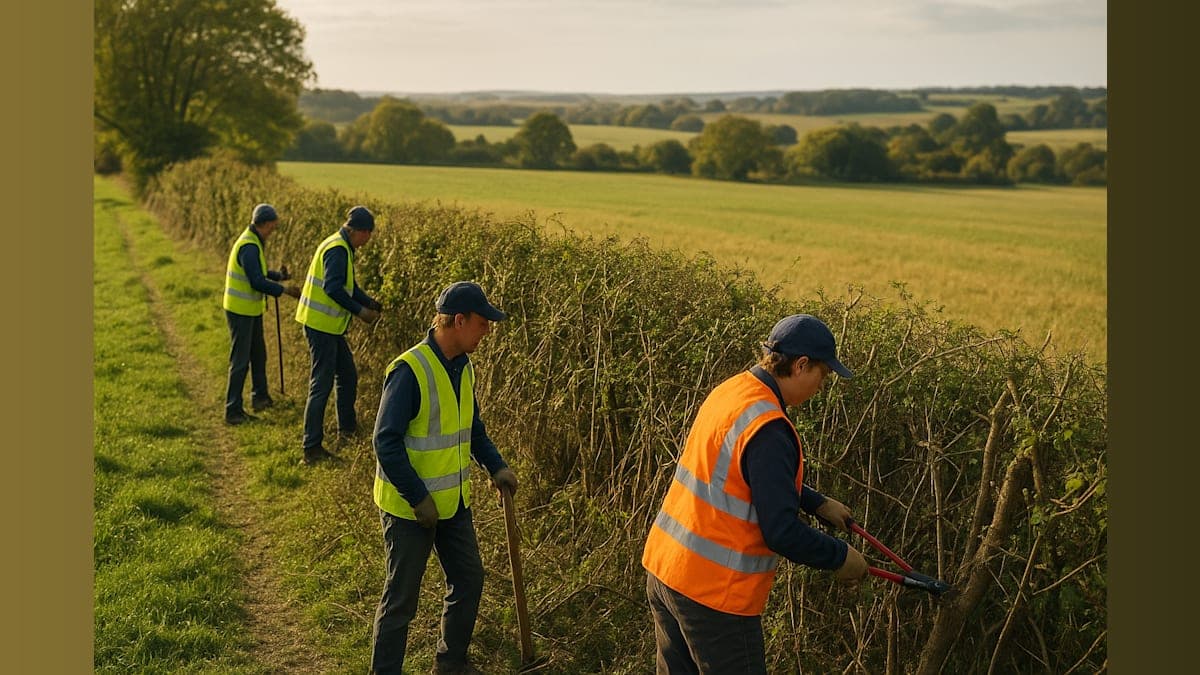
A remarkable conservation achievement has taken shape across Hampshire, where volunteers and traditional hedgerow specialists have completed an ambitious three-year project to create an unbroken 15-mile corridor of living hedgerows. The Hampshire Hedge now stretches from South Downs National Park to New Forest National Park, establishing a critical wildlife highway through one of England's most densely populated regions.
The project represents far more than aesthetic landscaping. Scientific research has demonstrated that hedgerows function as essential habitat corridors, providing sanctuary and passage for approximately 2,000 species throughout the year. From small mammals such as mice and hedgehogs to diverse populations of insects and birds, these traditional landscape features serve as natural highways enabling wildlife movement across otherwise fragmented terrain.
The Campaign to Protect Rural England organized the initiative through its Hedgerows Heroes program, securing support from multiple conservation organizations and funding from the National Lottery Heritage Fund. The collaborative effort brought together expertise in traditional hedge-laying techniques with modern conservation science to address the challenge of habitat connectivity in southern England.
Alison Johnston, a councilwoman responsible for countryside affairs at Test Valley Borough Council, emphasized the multifaceted importance of the project. She stated that hedgerows represent a defining feature of the regional landscape while playing vital roles in supporting wildlife populations, addressing climate change impacts, and maintaining the vitality of rural countryside.
The completion of the third and final year of hedge laying was commemorated at Broadlands estate during an event called Hedgefest, which simultaneously celebrated the Campaign to Protect Rural England's centennial anniversary. The gathering brought together participants who contributed their skills and labor to the project, demonstrating the power of partnership-based conservation work.
Vanessa Rowlands, Chair of the South Downs National Park Authority, described the concept of physically and environmentally linking the two national parks as genuinely inspiring. She noted that establishing a closer connection with New Forest had long been an objective, and the hedgerow corridor achieves this goal through tangible infrastructure that benefits wildlife populations.
The Hampshire Hedge addresses a fundamental challenge in modern conservation: maintaining ecological connectivity in landscapes increasingly fragmented by human development. In regions with high population density, wildlife corridors become essential lifelines, allowing species to move between protected areas, access diverse habitats, and maintain genetic diversity within populations.
Traditional hedgerows, despite their relatively narrow width, create disproportionately valuable habitat. They provide food sources, nesting sites, shelter from predators and weather, and safe passage through otherwise inhospitable terrain. The continuous nature of the Hampshire Hedge maximizes these benefits, creating an uninterrupted pathway that wildlife can utilize without exposure to the dangers of crossing open agricultural land or developed areas.
The project also preserves traditional land management skills. Hedge-laying, an ancient craft involving partially cutting and weaving living stems to create dense, stock-proof barriers, requires specialized knowledge passed down through generations. By engaging experts in this traditional technique, the Hampshire Hedge project simultaneously advances conservation goals and maintains cultural heritage.
The success of this initiative may provide a template for similar projects across England and beyond, demonstrating that large-scale habitat connectivity can be achieved through coordinated volunteer effort, traditional ecological knowledge, and strategic partnerships between governmental bodies and conservation organizations. As biodiversity loss accelerates globally, such practical interventions offer hope that human communities can actively restore and enhance ecological function within working landscapes.