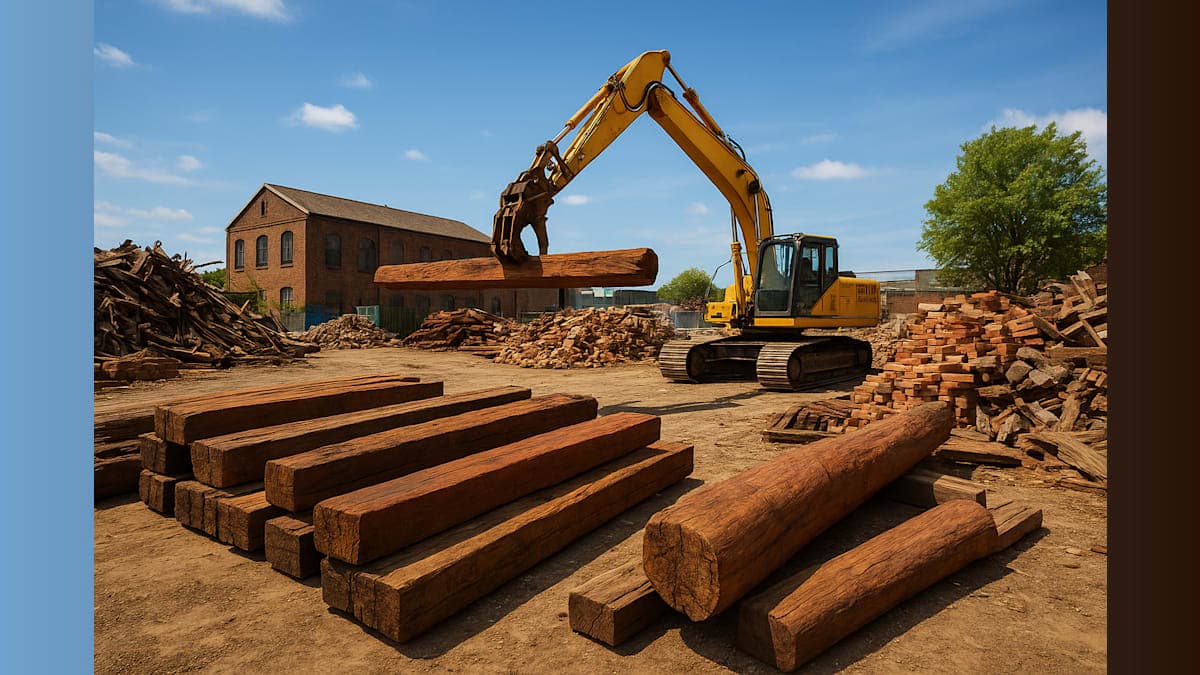
A groundbreaking salvage operation in London is preventing valuable building materials from ending up in landfills, instead channeling wood, brick, glass, porcelain, and steel back into the construction economy. The initiative represents a significant shift in how one of the world's most historic cities manages its architectural resources.
Yes Make, founded by Joel De Mowbray, operates from Tipping Point East, a five-acre industrial site in the Newham borough that promotes circular construction. The facility stands as the largest of its kind not only in London but in the entire United Kingdom, positioning the capital at the forefront of sustainable construction practices.
"We're creating a regenerative supply chain for the city we love," De Mowbray told the Guardian. "Turning things that would otherwise go to waste into objects that have cultural potential."
The operation emerged from what De Mowbray describes as an epiphany of street logic, born from frustration with bureaucratic obstacles. Working in partnership with Material Cultures, the organization secured space in London's notoriously expensive real estate market to establish a comprehensive salvage yard.
The scale of waste in the construction sector underscores the urgency of such initiatives. More than half of the United Kingdom's waste originates from the construction industry, according to the Guardian. While some recycling occurs, De Mowbray found the volume of discarded materials unacceptable, particularly given the quality of what was being lost.
Among the rescued materials was a 105-year-old sequoia tree from the Linford Arboretum. Rather than allowing it to become waste, Yes Make transported the tree to Tipping Point East and organized an educational workshop with the National Saw Mills organization, teaching participants how to use a portable saw mill to convert old-growth timber into usable lumber.
London's architectural evolution has created a unique opportunity for salvage operations. As the city balances modernization with preservation, high-quality imported and exotic woods—mahogany, teak, and afromasia among them—become available for recovery. De Mowbray has positioned his organization to capture these materials before they disappear.
The practical application of salvaged materials demonstrates their continued viability. Yes Make recently completed work on the new HEJ Coffee Roastery on Old Kent Road, delivering a custom structure constructed from reclaimed Douglas fir and oak salvaged from the London Docklands.
"Designed to frame the roasting space and invite the public in, this piece holds stories of the tides and the city alike," the organization wrote on Instagram, highlighting how salvaged materials carry historical narratives into new contexts.
Beyond specialty woodwork, Tipping Point East refurbishes and certifies construction materials for bulk sale to contractors. The economic advantage proves substantial, with some materials available at one-tenth the cost of new stock, making sustainable construction financially attractive.
The London operation joins a growing movement of salvage initiatives. In Savannah, Georgia, Re:purpose Savannah operates as a nonprofit organization that systematically deconstructs condemned buildings to recover bricks, timber, door frames, and metalwork. The organization sells these materials through its own lumber yard, where salvaged components receive minimal restoration to address decay while preserving their character.
The success of Tipping Point East suggests a viable model for urban resource management, one that honors architectural heritage while addressing environmental concerns. By intercepting materials before they reach landfills, Yes Make and Material Cultures are demonstrating that waste reduction and cultural preservation can advance simultaneously, creating economic value while reducing the environmental footprint of construction in one of the world's most densely built cities.