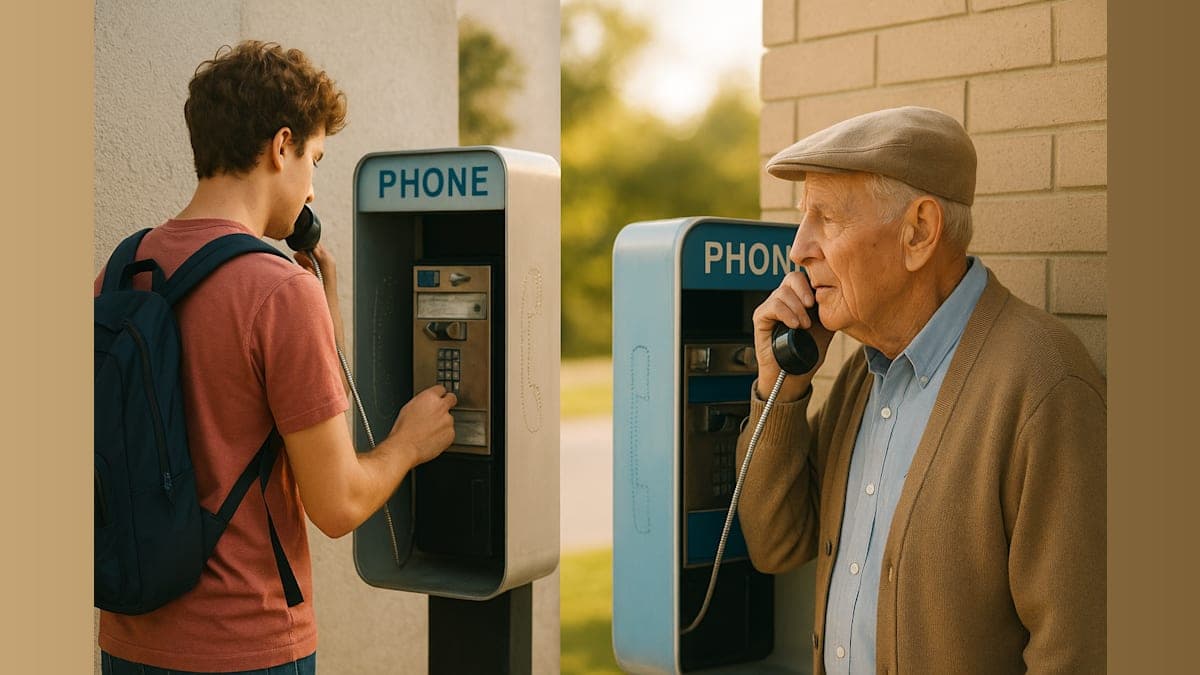
A bright yellow payphone has appeared outside Pavement Coffee House on the Boston University campus, bearing an unusual invitation: "Call a Boomer." The vintage communication device represents one half of an ambitious social experiment designed to address loneliness across generations.
More than 2,000 miles away in Reno, Nevada, an identical payphone sits in the common area of a Volunteers of America affordable senior housing community. Its sticker reads "Call a Zoomer." Together, these two phones create an instant connection between the demographics experiencing the highest rates of social isolation: young adults and seniors.
Matter Neuroscience, an organization that describes itself as an emotional fitness club backed by science and supported by community, orchestrated the project. The concept operates with elegant simplicity. When a student picks up the Boston phone, it automatically dials the recreation area in the Nevada senior community. When a senior lifts the receiver in Reno, the call connects directly to the payphone outside the coffee shop.
The experiment has already produced compelling interactions that challenge conventional assumptions about generational divides. In one conversation that attracted 18 million views on Instagram, a senior named April asked a college student named Charlotte for life advice—a reversal of traditional roles. Charlotte's response proved unexpectedly ironic: she suggested people should disconnect from their phones and spend more time outside meeting others face-to-face.
The exchange illustrates the shared wisdom and common ground that exists between generations, despite popular narratives emphasizing their differences. Both young adults navigating early independence and seniors facing increased isolation grapple with similar challenges around connection and community.
Matter Neuroscience sourced the payphones through Facebook Marketplace, demonstrating that innovative solutions need not require substantial financial investment. The organization has conducted similar experiments previously, including payphones labeled "Call a Democrat" and "Call a Republican" to facilitate dialogue across political divides.
The Boston University installation serves as a physical reminder that meaningful human connection can occur through deliberate design and willingness to engage across differences. For students passing the yellow box outside Pavement Coffee House, picking up the receiver offers an opportunity to combat their own isolation while simultaneously addressing the loneliness experienced by seniors in communities far from campus.
The project underscores a broader public health concern: social isolation affects mental and physical wellbeing across all age groups. By creating low-barrier opportunities for intergenerational dialogue, initiatives like this payphone experiment provide practical interventions that benefit both participants.
As the phones continue operating, they stand as testaments to the possibility of bridging divides through simple, human conversation—one unexpected call at a time.