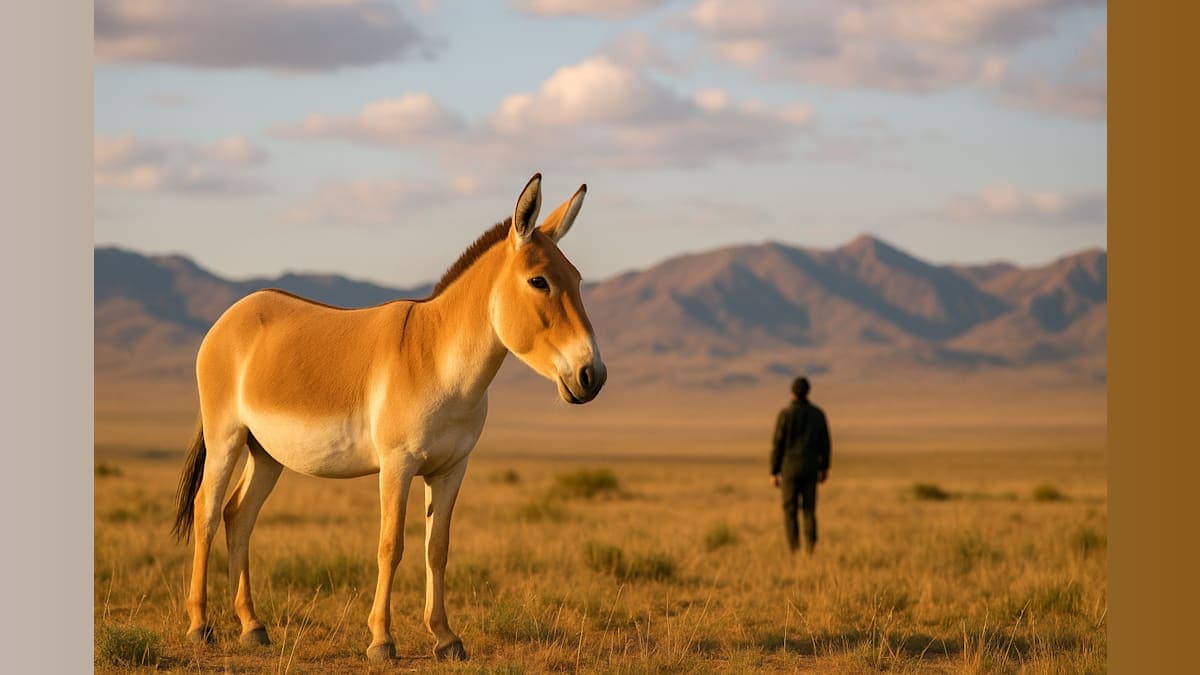
A remarkable conservation success story is unfolding on the Mongolian steppes, where the Asiatic wild ass has returned to eastern Mongolia after an absence spanning more than 65 years. The species, known locally as the khulan (Equus hemionus), is now showing clear signs of re-establishing a population in the region, according to findings published this month in the journal Oryx.
For decades, fencing along the Trans-Mongolian Railway has restricted the movement of khulan and other migratory species, effectively isolating populations and preventing access to ancestral grazing lands. The barrier created by this infrastructure had profound consequences for wildlife connectivity across one of the world's most expansive steppe ecosystems.
Recent collaborative efforts between the Wildlife Conservation Society, the Mongolian government, and private partners within the country have begun to reverse this fragmentation. The initiative has involved removing fencing along several stretches of the railway and establishing a monitored safe passage zone near the China–Mongolia border last May, also free of fencing.
The interventions are proving successful. Monitoring data reveals that crossings have occurred in recent years, and follow-up surveys have recorded hundreds of khulan on the eastern side of the railway. This evidence suggests the animals are not merely passing through but are beginning to re-establish permanent populations in the region.
"Documenting khulan crossing this long-standing barrier and beginning to re-establish in their former range represents an extraordinary conservation breakthrough," said Buuveibaatar Bayarbaatar, a senior scientist at the Wildlife Conservation Society who led the study. "It demonstrates that restoring connectivity in fragmented landscapes can support population recovery for wide-ranging species."
The Mongolian Gobi currently supports the world's largest khulan population, with approximately 91,000 animals representing more than 84 percent of the global total. Despite these numbers, the species faces ongoing threats from habitat fragmentation, competition with livestock, illegal hunting, and climate change.
As one of the most wide-ranging terrestrial mammals, the khulan requires extensive connectivity across the landscape to move between seasonal grazing areas and water sources in the highly variable and arid environment of the Mongolian steppes. Maintaining these movement corridors is critical not only for the species itself but also for the broader functioning and resilience of Mongolia's steppe ecosystem.
Justine Shanti Alexander, WCS Mongolia Country Director, emphasized the collaborative nature of the achievement. "The return of khulan to eastern Mongolia reflects years of collaborative work with provincial authorities, border protection agencies, and railway managers, as well as careful testing of temporary fence gaps that showed wildlife could cross safely without increasing train collisions," Alexander said.
The success of this project demonstrates the importance of working across multiple sectors and jurisdictions to address wildlife conservation challenges. The careful testing of temporary fence gaps proved essential in demonstrating that wildlife crossings could be implemented without compromising railway safety or increasing collision risks.
Looking forward, plans are advancing for a new local protected area east of the railway to support long-term habitat security and facilitate continued khulan recolonization. This development would provide additional safeguards for the returning populations and help ensure the sustainability of the conservation gains.
The initiative aligns with broader conservation efforts in Mongolia. The country currently protects 13 percent of its land and water, but a recent agreement with the Nature Conservancy aims to increase that figure to 30 percent, matching an international conservation standard.
The return of the khulan to eastern Mongolia represents more than just the recovery of a single species. It serves as a powerful example of how targeted conservation interventions, combined with multi-stakeholder collaboration, can reverse decades of habitat fragmentation and restore ecological connectivity across vast landscapes. As climate change and human development continue to fragment wildlife habitats globally, the lessons learned from this project may prove valuable for conservation efforts far beyond the Mongolian steppes.