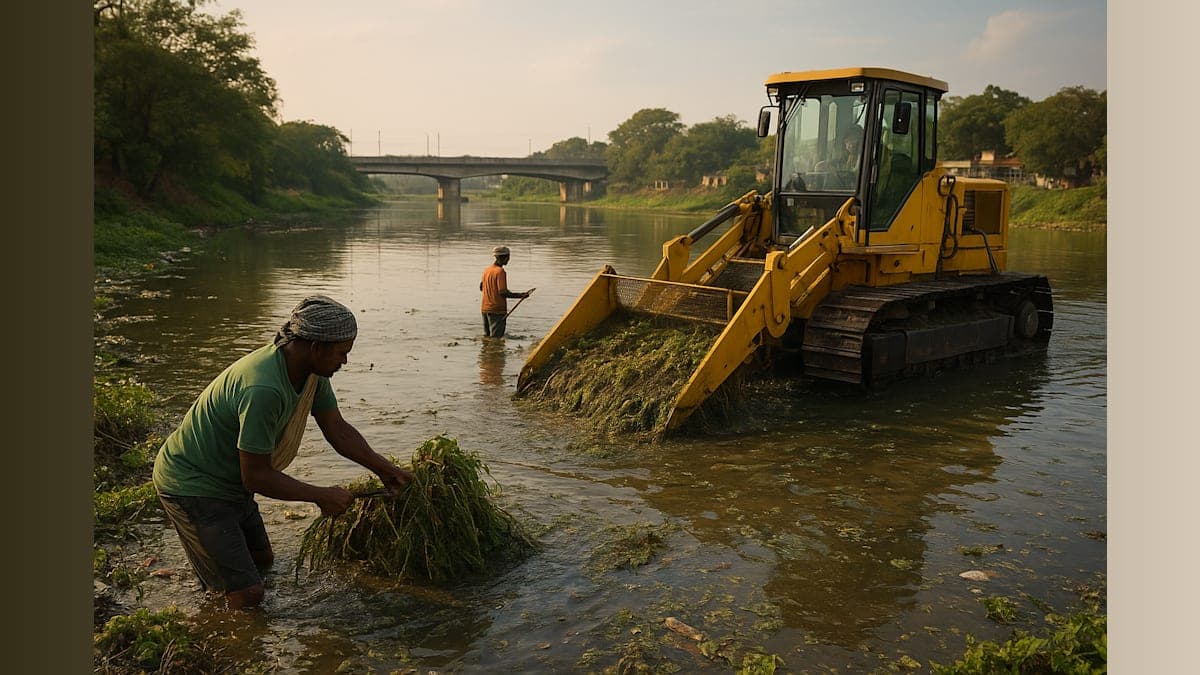
For twenty years, workers like Ajay Singh performed work that most would consider unthinkable. They waded into rivers choked with sewage and sharp debris, pulling waste by hand, their bodies absorbing the constant risk of cuts, infection, and chemical exposure. This was the reality of river cleaning before mechanization transformed the industry.
The shift from manual labor to systematic restoration began when Gaurav Chopra made an unexpected career pivot. Leaving corporate consulting behind, Chopra joined his uncles to work on Dal Lake. What he discovered there would define the next two decades of his professional life.
"Literally every city had a lake or a drain that was screaming to be cleaned," Chopra observed. This realization became the foundation for expanding his family-run company's operations across 25 states throughout India.
The company's approach represents a fundamental reimagining of river maintenance. Rather than relying on manual labor and sporadic intervention, the operation deploys machines that systematically remove silt, weeds, and floating waste. Critically, every hour of work is tracked to ensure rivers remain maintained over time rather than simply cleared in isolated efforts.
This methodology reflects a philosophical shift in environmental restoration. The work is not characterized by grand proclamations or dramatic rescue missions. Instead, it embodies patient discipline and the unglamorous commitment to showing up year after year to tend what was abandoned.
The results manifest in quiet but meaningful ways. Migratory birds have reappeared over Prayagraj's Sangam. Children play again along Bengaluru's lake banks. Kumar, whose full perspective on the restoration work captures its local impact, offered a simple observation: "the river feels clean again, like it is part of our lives once more."
The transformation of India's waterways from neglected dumping grounds to functioning ecosystems demonstrates that environmental restoration requires sustained commitment rather than intermittent intervention. What began as one contract has evolved into a comprehensive argument for maintenance as an ongoing practice.
The scope of work remains substantial. Cleaning a 1,376-kilometer river demands not only technological capability but also organizational persistence. The family-run company's expansion across 25 states indicates both the scale of India's water pollution challenges and the viability of systematic solutions.
For workers like Ajay Singh, who spent years performing hazardous manual labor, the mechanization represents more than operational efficiency. It signifies recognition that river restoration must be sustainable for both ecosystems and the people who maintain them. The shift from dangerous hand-pulling of waste to tracked, systematic cleaning protects workers while improving outcomes.
The lesson emerging from two decades of work is clear: restoration is not a singular event but an ongoing relationship with natural systems. Rivers do not remain clean through occasional attention. They require the discipline of continuous care, the commitment to return season after season, and the recognition that environmental health depends on sustained human effort rather than momentary intervention.