
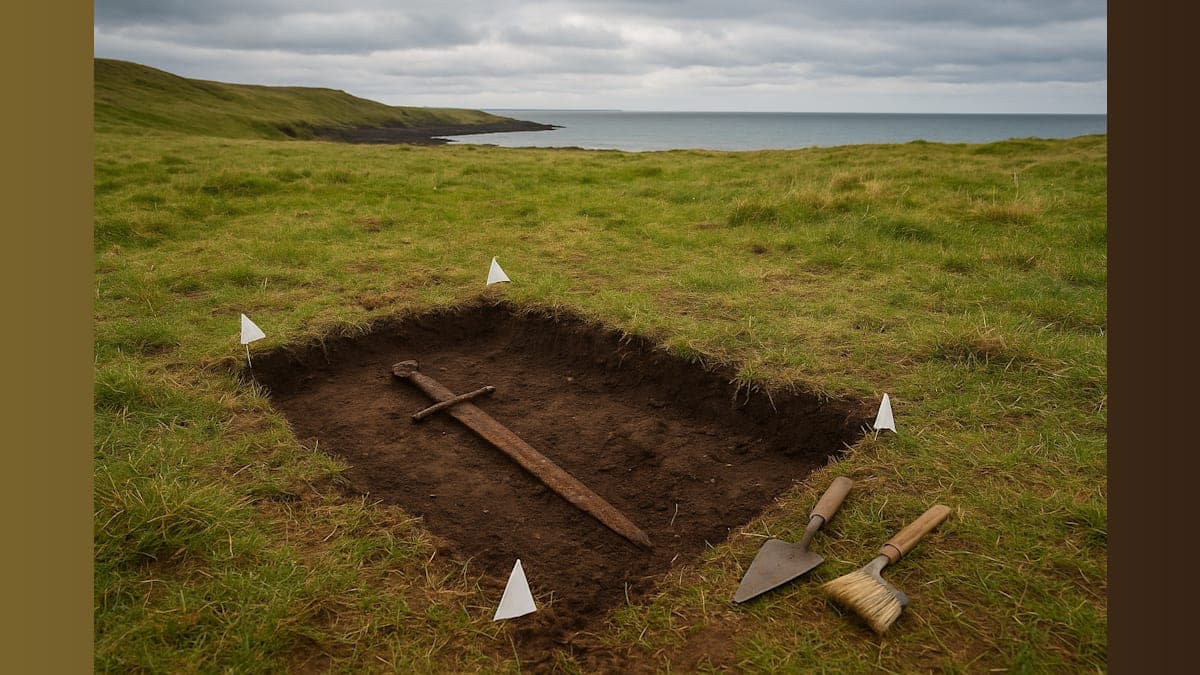
A routine school field trip in Norway turned into a remarkable archaeological discovery when six-year-old Henrik spotted what appeared to be a rusty piece of metal protruding from the ground. The object turned out to be an ancient iron sword that had been buried for approximately 1,300 years.
Henrik and his classmates were visiting Gran, located in the Hadeland region of Norway. The area's name translates to "warrior land" and has yielded numerous significant archaeological finds over the years. What might have been dismissed by adults as potentially dangerous debris became one of the region's latest historical treasures.
After Henrik showed the discovery to teachers and chaperones, school officials promptly contacted cultural authorities. Experts confirmed the artifact's historical significance, identifying it as a scramseax, also spelled scramasax. This single-edged iron sword was designed with sharpness on only one side, a deliberate choice that concentrated weight behind the blade to enhance its cutting power.
The weapon's origins remain somewhat uncertain. While it may have been forged in Norway, archaeological evidence suggests it could also have been manufactured in France. The earliest possible date for the sword places it before the traditional Viking Age, during the Merovingian Period, adding complexity to understanding its provenance and the warrior who once wielded it.
The sword has been transferred to the Museum of Cultural History (Kulturhistorisk Museum) in Oslo, where preservation specialists will work to stabilize and study the artifact. The find represents an important addition to the understanding of early medieval warfare and craftsmanship in Scandinavia.
The discovery also highlights an important historical distinction. In medieval Scandinavia, the term Viking functioned as both a noun and a verb, describing the act of sailing abroad with intentions to raid, trade, or both. A warrior who remained at home and did not venture to sea was not referred to as a Viking. Icelandic family sagas sometimes describe characters as "going Viking," emphasizing the activity rather than a permanent identity.
Given this historical context, while the sword undoubtedly belonged to someone experienced in combat, its owner may not have technically been a Viking in the traditional sense. Nevertheless, the weapon offers a tangible connection to an era of warriors and seafarers whose influence shaped European history.
For young Henrik, the field trip became an unforgettable experience that few adults, let alone children, ever encounter. His curiosity and willingness to investigate what others might have overlooked led to a discovery that will contribute to scholarly understanding of early medieval Scandinavia for years to come.