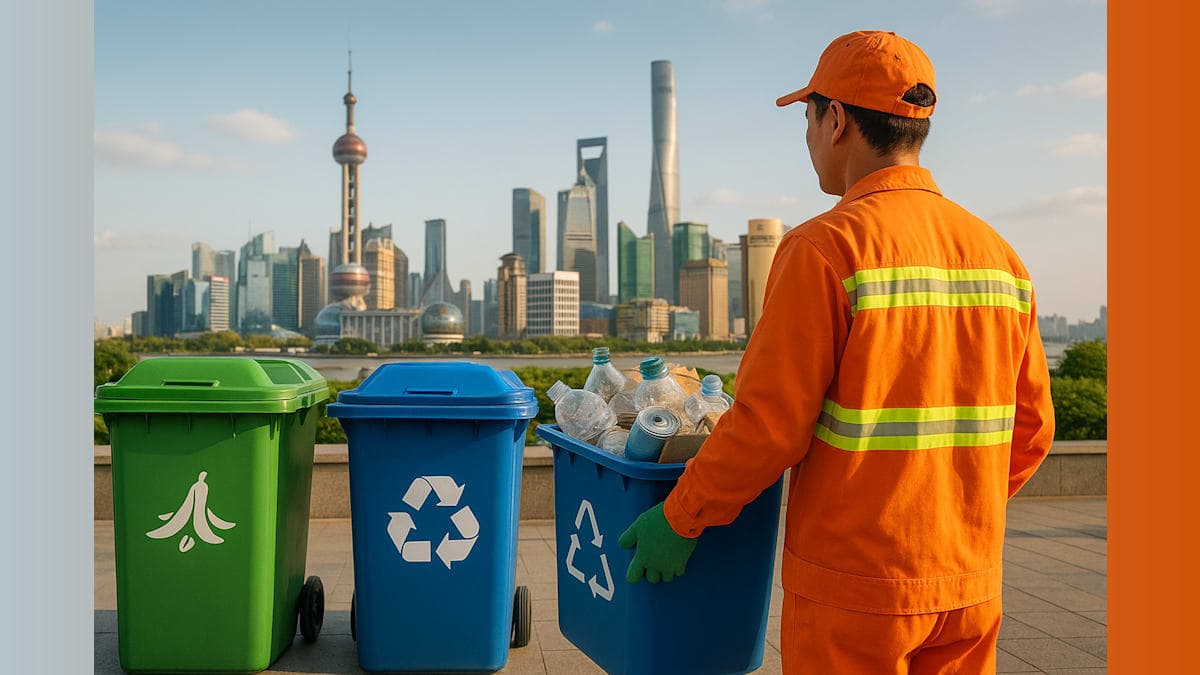
Shanghai, a Chinese megalopolis of 25 million residents, has demonstrated that large-scale urban waste management transformation is achievable through sustained investment and community engagement. Six years after launching an intensive waste reduction initiative in 2019, the city has achieved a 98% recycling rate for solid industrial waste and increased household recycling rates by 10 percentage points.
The scale of this achievement becomes clear when considering the baseline: in 2019, Shanghai generated 26,000 metric tons of waste daily. Today, between 35 and 45% of all household waste reaches proper collection facilities—a figure that may appear modest compared to some European nations but represents a significant accomplishment for a city large enough to accommodate the Romanian capital of Bucharest eleven times over.
Industrial Innovation Drives Recycling Success
The industrial sector has emerged as the standout performer in Shanghai's waste management revolution. Companies like CSMET, a new materials enterprise located in the city's Jinshan district, exemplify the circular economy approach that has driven these results. The firm combines aluminum cuttings from manufacturing operations with household aluminum waste to produce new aluminum products.
Chen Nan, vice-president of CSMET, articulated the company's philosophy: "We practice the concept of 'solid waste in, resources out,' turning waste aluminum into new resources." The company processes 130,000 tons of aluminum scraps and recycled items annually, preventing an estimated 36 million tons of carbon dioxide and equivalent emissions.
Localized Solutions for Urban Challenges
Shanghai authorities have recognized that managing waste in a city more than three times the area of Houston, Texas requires decentralized operations. Rather than relying solely on centralized facilities, the city has implemented neighborhood-level programs to reduce logistical strain.
In the Hongkou district, a pilot composting operation converts 220 pounds of organic household waste daily into fertilizer through microbial digestion. Lei Guoxing, a local community leader, explained the program's educational value to China Daily: "Now, with kitchen waste being transformed into fertilizer for plants at their doorsteps, residents can directly experience how waste is turned into treasure… reinforcing their habit of waste sorting."
Enforcement and Infrastructure Changes
The 2019 rollout included significant enforcement measures. Fines for improperly sorted waste increased tenfold for businesses, while residential waste deemed incorrectly sorted was left uncollected at curbside—a visible reminder of compliance requirements.
The city established four straightforward waste categories: recyclables, hazardous waste, organic waste, and residual waste. New bins and collection vehicles were commissioned to support this classification system. Additional regulations banned single-use, nonrecyclable items including disposable slippers in hotels and disposable tea cups in offices.
Turning Urban Pollution Into Resources
The restrictions on disposable products created market opportunities for companies producing eco-friendly alternatives. Bluepha, one such enterprise, has developed an innovative solution to a particularly challenging urban pollution problem: used kitchen oil, commonly known as "gutter oil" from street food vendors.
The company uses this waste oil as a carbon source to produce polyhydroxyalkanoates, or PHAs, which serve as the raw material for disposable tableware including take-away containers and flatware. This process replaces petroleum-based products with waste-derived alternatives. Each metric ton of kitchen waste oil yields 0.67 to 0.8 tons of PHA, generating approximately $4,360 in value—four times the return from converting the oil to biodiesel.
According to China Daily, Bluepha claims that replacing one ton of traditional plastic with one ton of PHA reduces pollutant emissions by 1.54 tons. The company's products have gained international traction, including adoption by TMS, McDonald's global packaging supplier.
National Recognition for Urban Achievement
Shanghai's comprehensive approach has earned recognition at the national level. Out of a possible score of 100 on China's national waste management assessment, Shanghai achieved 86.9—the highest rating for a city of its size in the country.
The city's success demonstrates that even megacities can implement effective waste management systems through a combination of infrastructure investment, regulatory enforcement, community education, and support for innovative businesses. As urban populations continue to grow globally, Shanghai's model offers valuable lessons for other metropolitan areas grappling with waste management challenges.