
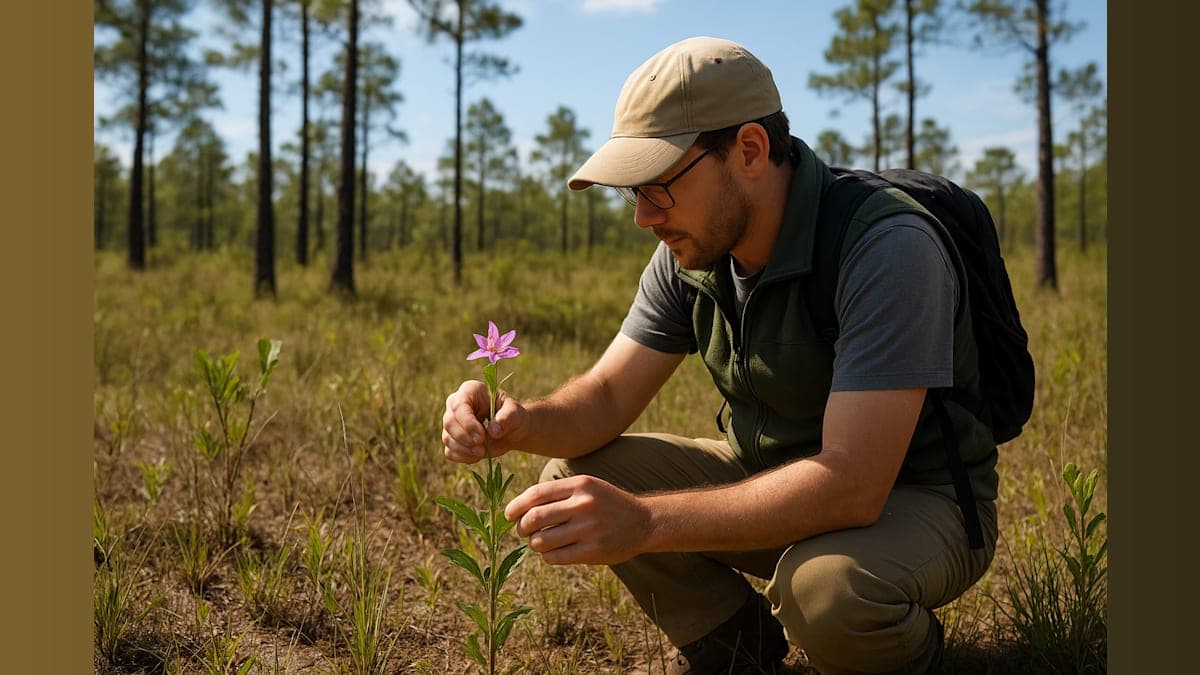
A wildflower that has grown in New Jersey's Pine Barrens for thousands of years has finally received scientific recognition as a species found nowhere else on the planet. The discovery by Temple University researcher Sasha Eisenman represents a rare botanical find in a region that scientists have studied extensively for generations.
The plant, formally named Triantha × novacaesariensis in research published in Phytotaxa, features clusters of thin, strap-like leaves and white six-petaled flowers that rise above surrounding grasses. For years, botanists had mistakenly classified it as Triantha racemosa, a species typically found much farther south, or suspected it to be a hybrid of Triantha racemosa and Triantha glutinosa.
"It's very special, very rare (and) only exists in this one place in the entire world," said Eisenman, an associate professor in horticulture at Temple University. "To really identify something as new and unique is pretty rare these days."
The discovery holds particular significance given its location. The Pine Barrens National Reserve stretches across nearly a million acres in southern New Jersey and ranks among the region's most ecologically distinctive landscapes. The area harbors rare habitats and plant life that have drawn scientific attention for decades, making the identification of an entirely new species all the more remarkable in such well-studied terrain.
Eisenman's research combined multiple scientific approaches to reach his conclusion. He analyzed genetics, conducted extensive fieldwork, and examined historical plant records. The study included plant samples preserved for long-term study from across the United States and Canada, comparing them with field samples from New Jersey and related populations in Maine, New York, New Brunswick, New Jersey, Alabama, Georgia, and Florida.
The investigation revealed that all three New Jersey plants carry a unique genetic signature and possess distinct physical traits that differentiate them from one another. The two previously known species are also geographically isolated from the newly named wildflower, with the nearest known populations of T. glutinosa and T. racemosa located hundreds of miles away.
"There's genetic differences, there's structural and morphological differences, and there's also isolation," Eisenman explained. The evidence suggests the New Jersey plants likely originated long ago when the two species intermingled but have persisted independently for thousands of years. "It's been a stable population or group of populations for a long time. It's not just a chance accident."
The formal identification carries significant conservation implications. With an official scientific name and recognition as a distinct species, the wildflower now has a stronger foundation for protection efforts by researchers and land managers.
"It's really important to have a name on a plant in order for it to be conserved and protected," Eisenman said. "Until it's been identified as unique and named with a unique identification, it doesn't have as much opportunity for protection and stewardship."
The project spanned more than a decade and benefited from collaboration with a wide network of researchers, herbarium curators, and conservation partners across the United States and Canada. For Eisenman, who studies both naturally occurring and cultivated plants, the discovery reflects his longstanding interest in plant life and his broader commitment to sustainability.
The next phase involves determining how New Jersey will protect this rare botanical treasure. For a plant confined to one of the state's most distinctive natural landscapes, formal recognition could prove essential to its long-term survival. The discovery underscores that even in thoroughly studied regions, nature still holds surprises waiting to be revealed through careful scientific investigation.