
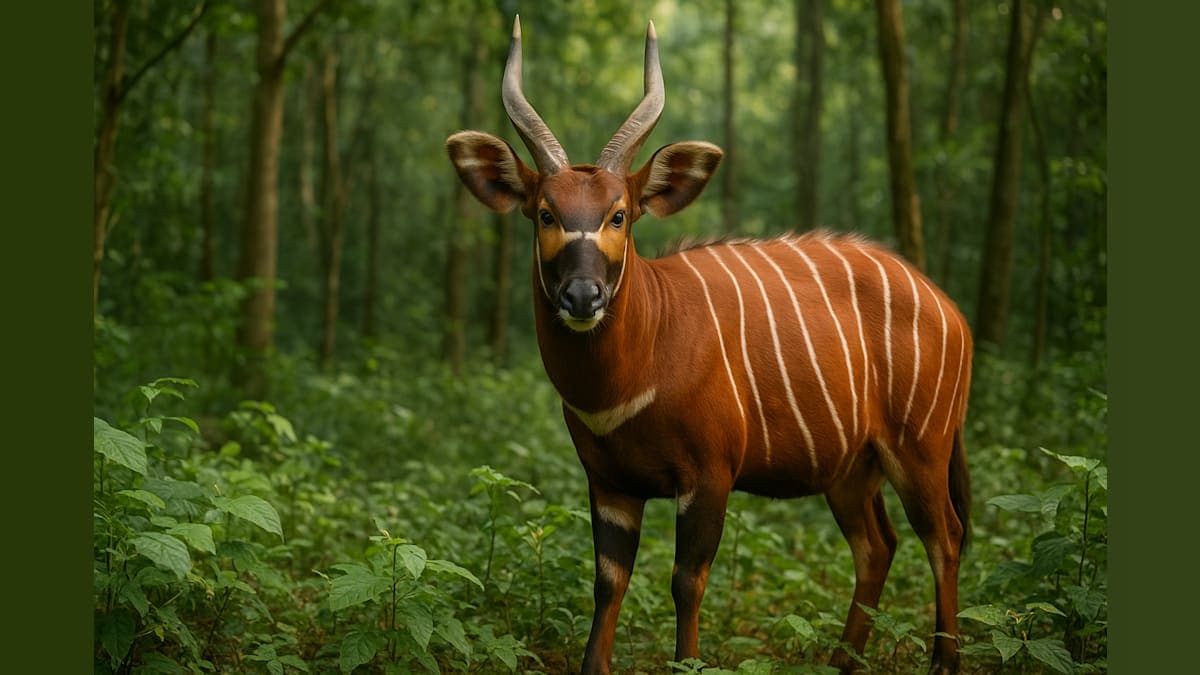
Conservationists have documented the return of mountain bongos to a Kenyan forest region where the species was presumed extinct, marking a significant development in efforts to preserve one of Africa's rarest antelopes.
Trail camera photographs captured in Maasai Mau, a remnant forest fragment approximately 200 kilometers from the Aberdare mountains, reveal the presence of at least three individual bongos: a mature male, a young male, and a young female. The discovery represents the first confirmed sighting of the species in this area in more than half a decade.
"The excitement in camp was unbelievable when we first looked through the photos," said Oscar Dyer, Director of Operations for the Mountain Bongo Project. "Seeing a bongo here again is incredibly exciting—and it reinforces our determination to continue searching, protecting this forest, and finding evidence of more bongos in the area."
The mountain bongo population has experienced a precipitous decline over recent decades. For more than five years, conservationists feared the wild population had contracted to a single isolated range in the Aberdare mountains. A high-technology artificial intelligence survey conducted last year by Chester Zoo, working alongside Kenyan wildlife officials, estimated only 28 bongos remained in the Aberdares stronghold. The Mountain Bongo Project subsequently confirmed the population could number as many as 40 individuals.
The mature male documented in the recent trail camera footage was likely first identified in 2018 by Dr. Tommaso Sandri of Chester Zoo, a member of the Mountain Bongo Project Advisory Council. Dr. Sandri had previously suggested that if this individual had remained undetected for years, other bongos might also persist in the area. Subsequent camera deployments validated this hypothesis, revealing the presence of two additional animals.
"This is huge news," Dr. Sandri said. "Unlike Aberdares, Maasai Mau is not a national park, and the reappearance of bongo may focus organizations on increasing broader protections."
The discovery represents years of persistent fieldwork by Mountain Bongo Project rangers operating in some of Kenya's most inaccessible terrain. These rangers, who are Maasai people, utilize traditional knowledge of the local ecosystem to monitor and protect the species. Mountain bongos, the largest forest antelope in Africa, are notoriously difficult to track due to their extreme rarity and elusive behavior.
The conservation picture extends beyond wild populations. Approximately 900 bongos currently reside in zoos and sanctuaries worldwide, including facilities operated by the Mount Kenya Wildlife Conservancy. Recent translocation efforts have brought four European-born males from zoos to the Kenya sanctuary population, a measure designed to preserve genetic diversity for the species.
"The Mau population represents a significant genetic pool for mountain bongos and it is therefore vital for long-term conservation," said Robert Aruho, who heads the Mount Kenya Wildlife Conservancy.
Mountain bongos historically faced threats from game hunting and collectors. Contemporary pressures stem primarily from habitat destruction driven by logging and agricultural expansion. The species favors areas with rich volcanic soil and reliable water supplies—precisely the type of land in high demand for farming operations.
Conservation organizations are exploring whether captive-bred bongos from facilities such as Chester Zoo and the Mount Kenya Wildlife Conservancy could be reintroduced to bolster wild populations to sustainable levels. The Mountain Bongo Project continues its work protecting the animals still roaming free in Kenya's forests.
"The mountain bongo is not beyond saving, but it does need us to act together," Dyer said. "Collaboration between organizations like MBP, Chester Zoo, and our partners brings hope and is turning knowledge, protection, and persistence into real impact on the ground. With sustained support, we can ensure wild bongos continue to live in Kenya's forests."
Dr. Sandri emphasized the broader significance of the species' survival. "Their presence makes the forest more magical," he said, "and the world would be poorer for their loss."