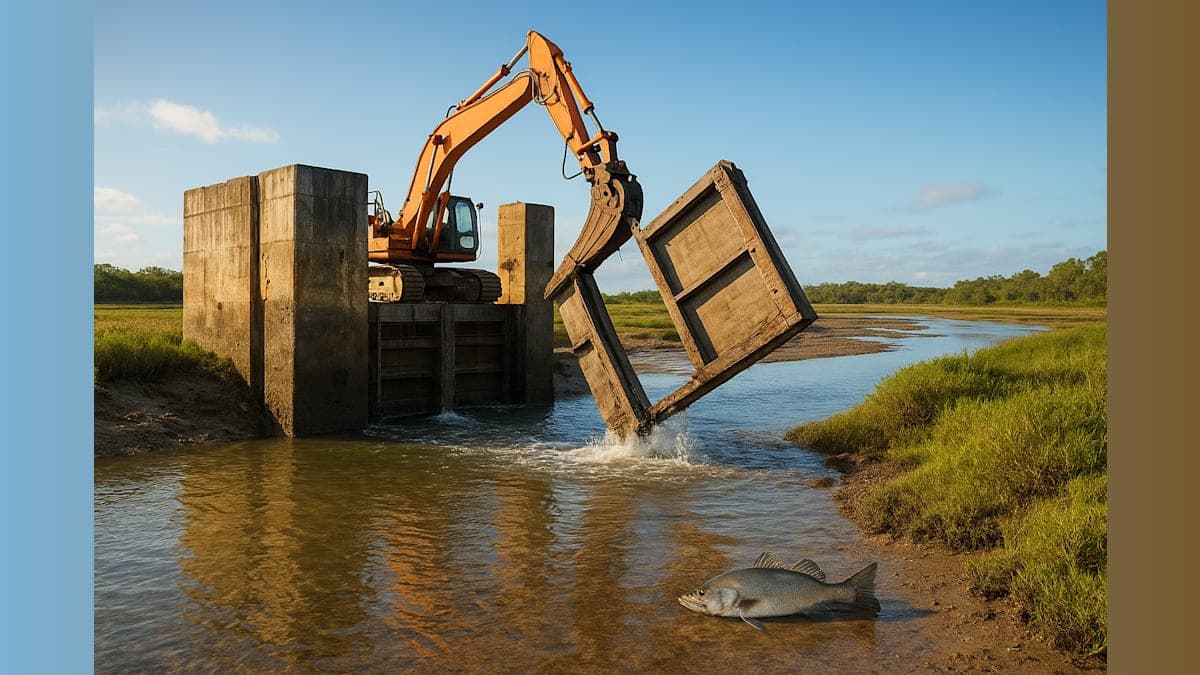
A remarkable environmental restoration project in Queensland, Australia, demonstrates how reversing decades-old engineering decisions can breathe new life into degraded coastal ecosystems. Near Mackay, conservation groups and landowners are systematically removing tidal gates and embankments constructed 50 to 60 years ago, allowing salt water to reclaim lands that were artificially converted for agricultural use.
The initiative represents a fundamental shift in environmental management philosophy. Infrastructure once built at considerable expense to exclude ocean tides is now being dismantled as scientific understanding has evolved regarding the critical importance of salt marsh and estuarine ecosystems to coastal biodiversity.
Christopher Rek, a 60-year-old rancher whose property has been transformed by the project, articulated the changing perspective with striking clarity. "Mackay's getting built in and the animals are running out of space," Rek explained. "I stole from nature by using all my cows and now it's time to give the land back and let nature do its thing."
The restoration effort involves a coalition of organizations including Greening Australia, the Yuwi Indigenous Corporation, water management company Catchment Solutions, and the state fisheries authority. Catchment Solutions approached Rek to request permission to remove tidal gates that had prevented salt water from entering his property, initiating a transformation that has already yielded measurable ecological benefits.
Fisheries ecologist Matt Moore, working alongside Rek, has documented juvenile barramundi utilizing the newly reestablished waterways. These brackish channels serve as critical corridors that enable salt-tolerant species to migrate between ocean and interior environments in search of spawning nurseries—a natural function that existed before European settlement but was eliminated by agricultural development.
The ecological benefits extend beyond fish populations to include vegetation restoration. Mangroves, globally significant trees that require saline conditions, had been outcompeted by Hymenachne, an introduced grass species originally brought to Queensland as cattle fodder. This invasive plant is now classified as a weed of national significance, but the return of salt water has proven remarkably effective at controlling its spread.
At Cape Palmerston National Park, a 45-foot-long channel excavated through an artificial embankment has already eliminated 80 percent of the Hymenachne in the surrounding area. The embankment itself measured 180 feet in length and had blocked high tides from entering a substantial area at the southern boundary of Yuwi traditional owners' native title lands.
Queensland Parks and Wildlife Service partnered with Greening Australia to assist the Yuwi in excavating the channel, an undertaking that carried profound cultural significance. Local elders attended the restoration event, describing it as "a very special and spiritual moment" as their ancestral waters were reconnected.
The scope of potential restoration work remains substantial. Mackay alone contains between 500 and 600 tidal gates, with thousands more distributed throughout Queensland. Each represents an opportunity to restore natural tidal flows and the ecosystems they support.
This Queensland initiative aligns with a broader international movement toward removing barriers to natural water movement. Dam removals and waterway restorations are increasingly recognized as benefiting both ecological systems and human industries that depend on healthy aquatic environments. The success stories emerging from projects like Rek's transformed pastureland and the Yuwi's reconnection with traditional waters provide compelling evidence for continuing and expanding these restoration efforts throughout the region and beyond.