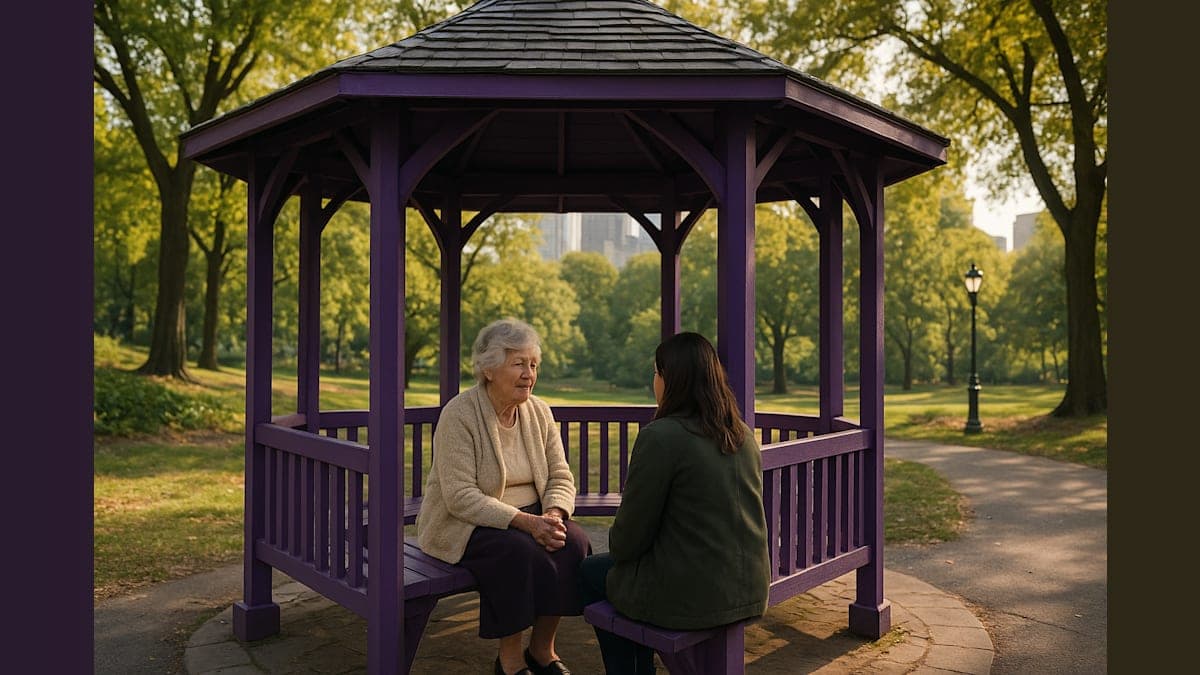
In an era of professional therapy and digital connection, a simple purple stand in Central Park has become an unlikely refuge for New Yorkers seeking something increasingly rare: someone who will simply listen.
The Grandma Stand, as it has come to be known, traces its origins to Seattle, where Mike Matthews watched his grandmother live alone, brimming with love but lacking outlets to share it. His solution defied conventional wisdom: he established what resembled a lemonade stand where strangers could sit and talk with her. The concept proved transformative. People shared stories of breakups, job losses, and the ordinary heartaches that accompany daily life.
When Matthews' grandmother died at 102, he refused to let the project end with her. He painted a stand purple—his grandmother's favorite color—and recruited a rotation of grandmothers to continue the work. The stand eventually made its way to New York City, where it now operates in Central Park.
The response has been remarkable. People form lines to share their stories with these volunteer grandmothers, who offer neither therapy credentials nor prescribed solutions. A man who typically avoids conversation shares thoughts he has kept silent for years. A young woman working through boundary issues reflects aloud that "people do what you allow them to do." A ten-year-old strategizes about reinstating tag at recess.
The stand's effectiveness lies in what Matthews describes as the "disarming nature" of grandmothers—their intuitive understanding of when to ask questions and when to offer a hug. These women possess no formal training in counseling, yet they provide something clinical settings often cannot: unconditional presence without judgment or agenda.
The project has evolved into what observers call a disarming public sanctuary, revealing a fundamental truth about urban life: countless individuals navigate their days carrying stories they need to tell. The purple booth in Central Park demonstrates that sometimes the ideal confidant is not a licensed professional or close friend, but rather a grandmother-figure in a purple stand who knows the value of listening.
In a city of millions, where isolation paradoxically thrives amid density, The Grandma Stand offers a counterintuitive remedy: structured vulnerability with a stranger. The lines that form outside the purple booth suggest Matthews has tapped into something essential—a hunger for human connection that transcends the transactional nature of modern urban existence.