A half-century after its final coal shipment, an abandoned mine in England has become an unexpected sanctuary for wildlife, offering a striking example of nature's resilience in reclaiming industrial landscapes.
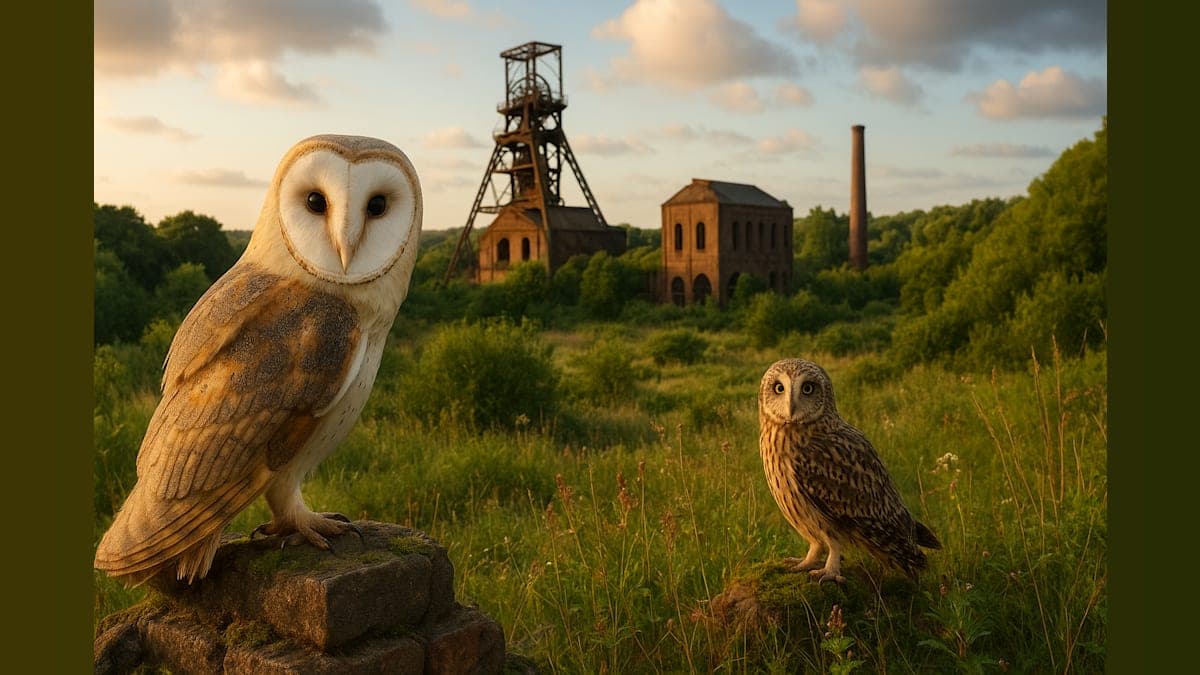
The Chatterley Whitfield mine in Staffordshire, England, ceased coal production in 1976. Today, the site tells a dramatically different story, with barn owls and short-eared owls nesting among the rusting towers and derelict buildings that once housed one of Britain's most productive collieries.
Photographer Andrew Mason, whose father John worked at the mine during the 1960s, has documented this remarkable transformation. His recent images capture the stark beauty of white barn owls gliding past iconic pit head wheels—the massive structures once used to lower miners into the earth—now standing silent against the sky.
"The colliery is a living example of rewilding. You can literally see nature taking it back from the industrialized world," Mason said. "There are barn owls living in the high buildings which are great as look-out posts to spot prey."
Working with permission from Stoke-on-Trent's City Council, which maintains responsibility for the property, Mason established a photography blind within the former colliery. This vantage point allowed him to observe the site's new inhabitants without disturbing their activities.
The transformation extends beyond the owls. Mason discovered wild strawberries growing on old coal slag heaps, a testament to nature's ability to colonize even the most inhospitable terrain. He plans to install trail cameras to document badgers and foxes also known to inhabit the abandoned mine.
"One of the strangest things I saw was wild strawberries growing on old bits of coal slag heap," Mason noted. "It was quite fascinating to see how nature was taking over."
The site holds considerable historical significance. Chatterley Whitfield was the largest coal mine in the region and achieved a milestone as the first colliery in the United Kingdom to produce one million tons of coal in a single year. The property features 15 listed buildings and appears on Historic England's heritage register.
After officially closing on March 25, 1977, the mine reopened two years later as a mining museum, attracting tens of thousands of visitors annually. However, the museum ceased operations permanently in 1993, leaving the structures to the elements and, ultimately, to wildlife.
Mason reflected on the haunting beauty of his photographs, particularly one panoramic image showing a solitary barn owl in flight against the backdrop of rusting industrial towers. "There really is a strange beauty in the juxtaposition of the ghostly white owl of the night flying amongst these old industrial buildings that are still standing," he observed.
The Chatterley Whitfield site represents a growing phenomenon of industrial rewilding, where abandoned human infrastructure becomes habitat for species adapting to human-altered landscapes. As wildflowers push through concrete and owls nest in buildings designed for coal processing, the former mine stands as a living monument to both industrial heritage and ecological recovery.