A remarkable archaeological discovery in Luxor has unveiled a burial chamber that remained sealed for at least 2,600 years, containing the remains of a specialized caste of female temple singers who played a crucial role in ancient Egyptian religious ceremonies.
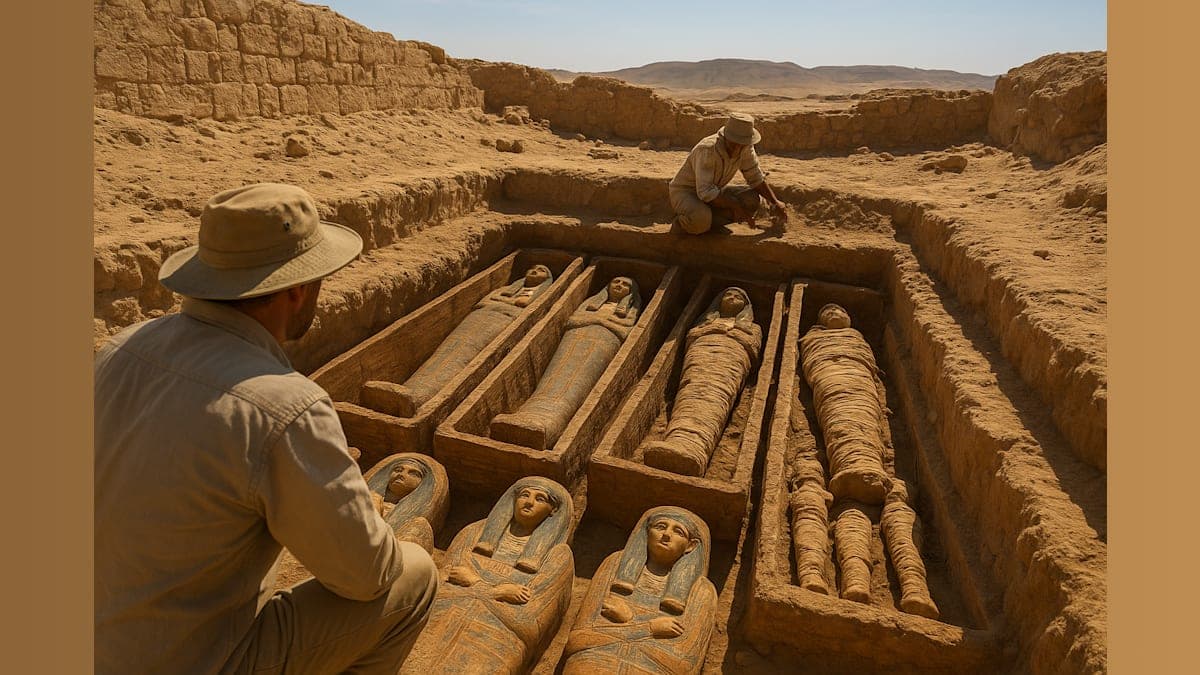
The excavation, conducted by the Egyptian Ministry of Tourism and Antiquities in collaboration with the Zahi Hawas Foundation for Archaeology and Heritage, uncovered 22 coffins and 8 mummies in the southwestern sector of the Asasif necropolis. The tomb chamber was carved directly into bedrock, and the coffins were meticulously arranged in 10 horizontal rows alongside various funerary objects.
The repeated inscription "Singer of Amun" found on the coffins indicates that this burial chamber served as a dedicated resting place for women who held special religious positions. These singers performed sacred songs at festivals and during religious rites at the ancient temple of Karnak, where the powerful deity Amun was worshiped. Such female officials would have enjoyed considerable religious and social privilege alongside their temple responsibilities.
Among the most significant finds were 8 sealed jars arranged within a large ceramic vessel, still bearing their original clay seals. Researchers described these vessels as an "information goldmine" because they may contain organic remains such as funerary oils and resins, or potentially biological material from the mummies themselves. The sealed nature of these jars presents a rare opportunity for scientists to analyze materials that have remained undisturbed for millennia.
Preservation efforts are currently underway to protect the fragile artifacts, particularly the flaking pigments and splintering wood of the coffins. Initial dating analysis suggests the burials span approximately 400 years during Egypt's Third Intermediate Period, roughly between 1070 and 664 BCE. The artifacts are scheduled to undergo state-of-the-art conservation and laboratory analysis.
The excavators noted that evidence documenting how female officials lived and died among Egypt's religious castes is "rare," making this discovery particularly valuable for understanding ancient Egyptian society. The careful arrangement of the coffins, positioned to maximize space and accommodate as many deceased as possible, suggests they were likely moved to this location from their original burial sites, though the motives for this relocation remain unknown.
Mr. Sharif Fathi, Minister of Tourism and Archaeology, emphasized the significance of the find in a statement, noting that "this discovery is a new addition to the record of outstanding archaeological discoveries that Egypt is witnessing and reflects what archaeological research works have received from the full and continuous support of the Egyptian state."
Luxor, sometimes described as the world's largest open-air museum, continues to yield extraordinary archaeological discoveries. The city's ancient necropolises have proven to be inexhaustible sources of information about Egyptian civilization, with excavations regularly uncovering new insights into the religious, social, and cultural practices of one of history's most fascinating civilizations.