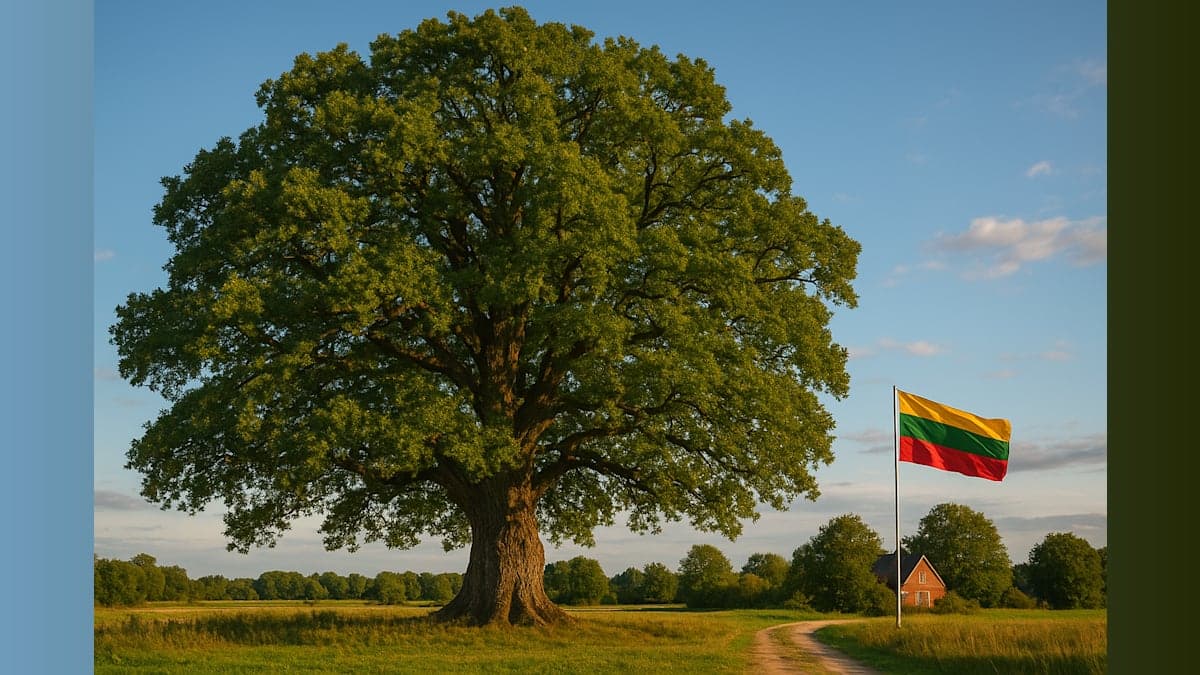
In late March, the European Tree of the Year contest awarded Lithuania's 400-year-old Laukiai Oak first place, marking a significant shift in a competition that has celebrated Poland's arboreal champions for four consecutive years. The ancient Quercus robur, known locally as the Oak of Laukiai, triumphed after more than 200,000 votes were cast across 12 participating nations.
The victory represents more than a simple popularity contest. This centuries-old oak has become a symbol of community resilience and continuity in the small Rukai village, where six generations have now grown up in its shadow. The tree's incredible canopy and eye-watering golden colors in autumn provided visual appeal, but it was the manner in which the oak ties the farming community together that ultimately resonated with voters across the continent.
Until recently, the Oak of Laukiai stood almost forgotten, known only to residents of the small village. A year ago, however, the local community undertook restoration efforts around the tree and organized a celebration in its honor. The event featured music and costume, bringing people together and reminding them of the oak's quiet strength—a gathering that would prove instrumental in building support for the tree's eventual European recognition.
The competition proved remarkably close this year. According to Petr Skrivanek, Coordinator of the European Tree of the Year, the ranking remained uncertain until the very last moment. The contest attracted substantial attention across Europe, with the website recording approximately 1.5 million visits during the voting period.
Among the notable contenders, a 150-year-old wild apple tree in Slovakia secured second place. Poland's entry—a remarkable white elm growing almost horizontally over a waterway, whose branches have each become trees in themselves—also competed for the title that the nation had claimed for the previous four years.
This year marked a significant change in the contest's structure. Organizers implemented a new "tree point" system designed to prevent the competition from devolving into a simple question of which nation could mobilize the largest number of voters. The previous bulk vote system had consistently favored Poland, which had dominated the contest for four consecutive years.
The European Tree of the Year competition draws from national contests held in participating countries, with each nation's winner advancing to the continent-wide edition. The competition has proven fierce, with even established tree conservation nations struggling to place highly. The United Kingdom's 2025 national winner—the Argyle Street Ash—managed only 12th place in the European contest, demonstrating the caliber of trees competing for recognition.
The success of the Oak of Laukiai underscores a growing appreciation for the cultural and ecological significance of heritage trees. These living monuments serve as anchors for communities, connecting present generations to their past while providing ecological benefits that extend far beyond their immediate surroundings. The Lithuanian oak's victory demonstrates that even trees from small, rural communities can capture international attention when their stories are properly told and their value to local residents is clearly articulated.