
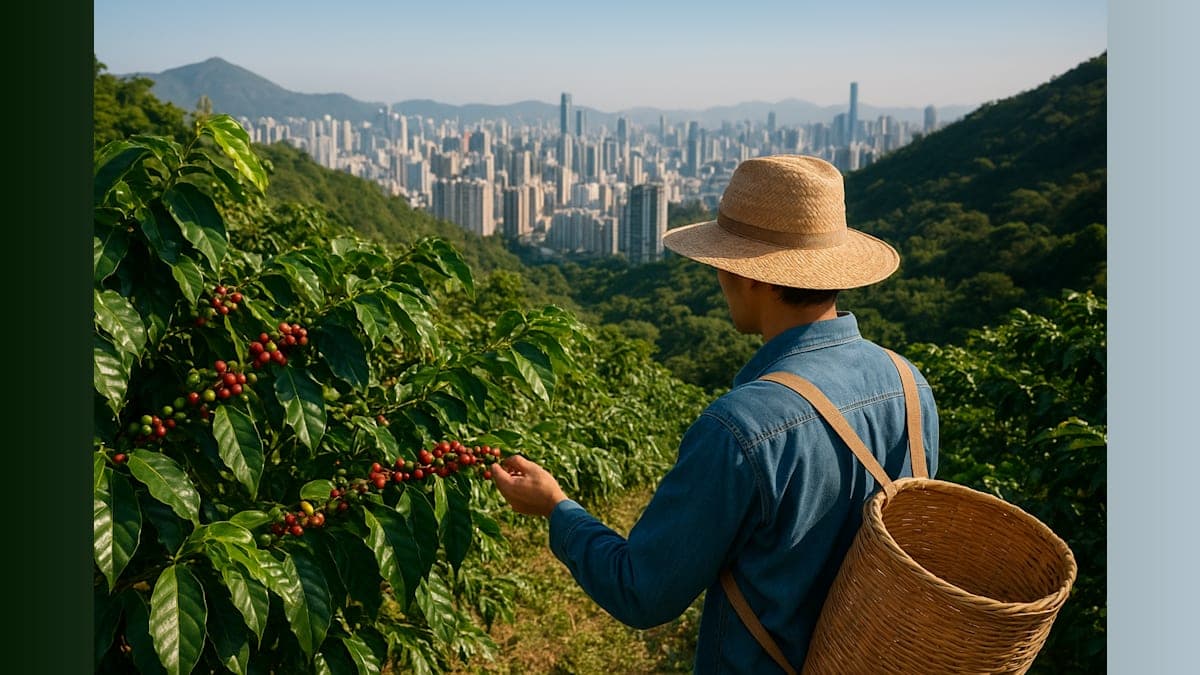
In the heart of the world's most densely populated city, an unlikely agricultural revolution is taking root. Coffee farmers on Hong Kong's Lantau Island are successfully cultivating Arabica beans, challenging conventional wisdom about where premium coffee can grow and creating a source of local pride in a place where nearly everything arrives from elsewhere.
The endeavor centers on LCC Roastery and its owner, Ringo Lam, a former technology entrepreneur who transformed a gift of 100 coffee seeds from Panama into a thriving cooperative. Approximately 80 of those original seeds sprouted on Lantau Island, the only location in Hong Kong that could reasonably be described as rural. What began as a personal experiment has evolved into the Lantau Coffee Co-Op, now encompassing 25 farmers and 400 coffee shrubs across the territory.
The operation faces significant geographical challenges. Premium Arabica coffee typically requires high-altitude growing conditions, yet Hong Kong's highest point measures less than 1,000 meters. Despite this limitation, the archipelago's position 22 degrees north of the Equator provides ideal latitude for coffee cultivation. Last year, the cooperative achieved its largest harvest to date: 10 kilograms of coffee beans from the 400 shrubs.
Katie Chick, assistant director at the University of HK's Center for Civil Society and Governance, manages one of the cooperative's coffee farms on Hong Kong itself. Her operation maintains 800 trees that yield approximately 50 kilograms of coffee beans. Chick and Lam regularly convene with other growers to refine cultivation techniques, experimenting with various washing methods that might stimulate plant changes resulting in more complex flavor profiles.
The coffee produced on Lantau Island lacks the depth and nuance characteristic of high-altitude Arabica, according to reports, but remains smooth and enjoyable. The cooperative's members view this not as a limitation but as an opportunity for innovation and community building. The project has expanded beyond simple agriculture into social enterprise and education.
Individual growers have discovered creative applications for their farms. One farmer operates her coffee plantation as a gardening therapy service, providing therapeutic benefits through agricultural work. Another enters the locally-grown coffee in tasting competitions throughout Hong Kong's 700 coffee shops, demonstrating that coffee cultivation is possible within the city-state's boundaries.
Lam has developed workshops focused on producing Lantau beans for roasting, offering Hong Kong residents direct experience with the labor-intensive process behind their daily beverage. These educational programs expose participants to the physical demands of coffee production, from cultivation through processing.
The initiative represents more than agricultural experimentation. In a territory where land scarcity makes large-scale coffee production impossible, the Lantau Coffee Co-Op serves as a connection point between consumers and agricultural origins. Lam acknowledged the scale limitations but emphasized the educational and cultural value of the project.
"We won't have enough land to [grow coffee at scale], but at least after going through this workshop and exercise, they will be more connected to the origin," Lam explained.
The success of the Lantau Coffee Co-Op demonstrates that even in the world's most densely populated urban environment, agricultural innovation remains possible. The cooperative has created a product of genuine local value while fostering community engagement and environmental awareness. As the operation continues to expand and refine its techniques, it stands as evidence that passion and creativity can overcome seemingly insurmountable geographical constraints.