
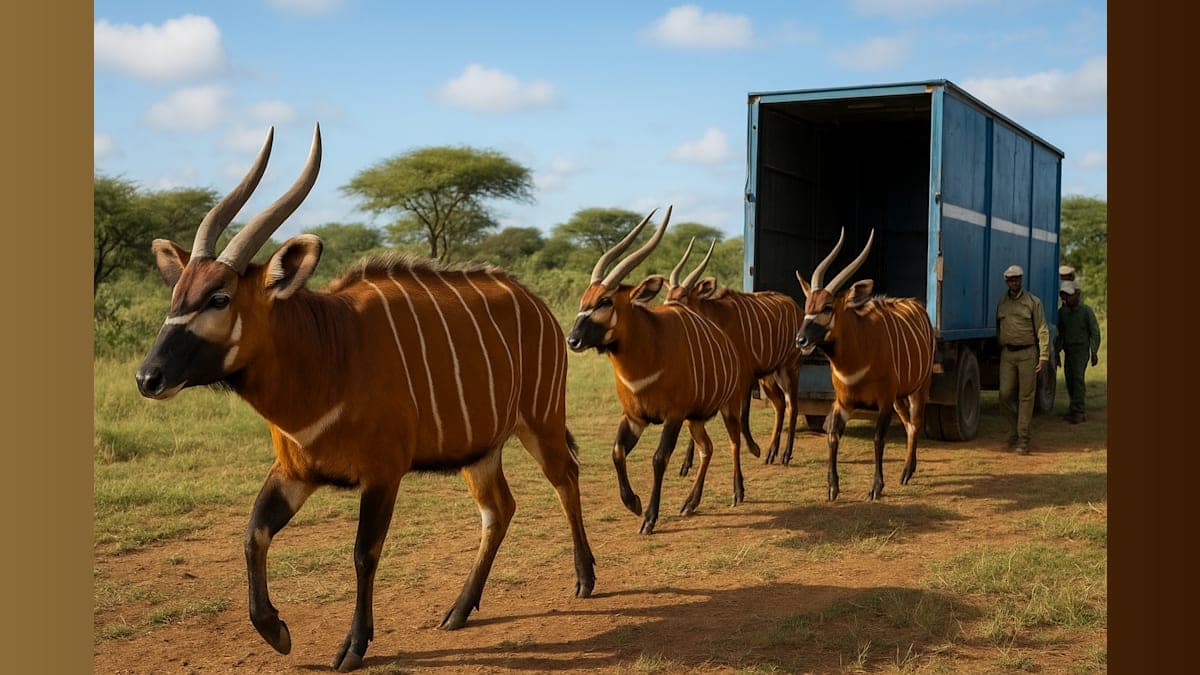
Four mountain bongos, recognized as Africa's rarest species of antelope, have successfully completed a transcontinental journey to Kenya, marking a significant advancement in international efforts to prevent the species from sliding into extinction. The animals arrived on April 28, 2026, following a meticulously coordinated translocation spanning more than 4,000 miles from European breeding facilities.
The historic transfer represents a critical intervention for a species teetering on the brink of disappearance. Fewer than 50 mountain bongos currently survive in their natural habitat, making every individual essential to the species' long-term viability. The four male bongos were bred specifically as part of an international conservation breeding program coordinated across European zoological institutions.
Found exclusively in Kenya, the mountain bongo presents a striking appearance with its rust red coat adorned with bold white vertical stripes and distinctive long spiral horns. Conservation experts attribute the dramatic population decline to a convergence of threats including poaching, habitat loss, disease transmission, and habitat fragmentation that has isolated remaining populations.
The translocation initiative brought together expertise from Chester Zoo, the Kenya Wildlife Service, and the European Association of Zoos and Aquaria (EAZA). Dr. Nick Davis of Chester Zoo, who coordinates the conservation breeding program for the mountain bongo in European zoos, emphasized the collaborative nature of the achievement.
"This transfer is the result of years of planning—and is a shining example," Dr. Davis stated. "Through expert human care, international collaboration, and a shared commitment to conserving the species in their natural range, we can help secure the long-term future for the mountain bongo."
Prior to their departure, the four male mountain bongos underwent rigorous veterinary examinations and preparations at Safari Park Dvůr Králové in the Czech Republic. The animals then boarded a KLM cargo plane, accompanied by two dedicated keepers who ensured their welfare throughout the journey. Upon arrival, Kenya's Cabinet Secretary for Tourism and Wildlife officiated a formal welcome ceremony.
Dr. Erustus Kanga, Director-General of Kenya Wildlife Services, addressed the ceremony and outlined the strategic importance of the new arrivals. The four animals will strengthen the genetic diversity of existing bongo populations, a critical factor in maintaining species resilience and adaptability.
"Our focus is not only on increasing numbers, but on restoring functional populations capable of thriving independently in secure habitats across the country," Dr. Kanga explained. The approach represents a science-based, long-term vision that extends beyond simple population numbers to emphasize ecosystem functionality and self-sustaining wild populations.
The Mount Kenya Wildlife Conservancy has demonstrated remarkable success since launching its bongo conservation program in 2004. The initiative began with 18 animals already present on site, supplemented by an additional 18 individuals imported from various zoos in the United States. Through dedicated breeding programs, habitat management, and targeted conservation interventions, the Conservancy has nearly doubled its bongo population.
Today, the Conservancy maintains over 100 mountain bongos, representing the largest population of the species in Africa. The population has successfully adapted to the Mount Kenya ecosystem and continues to breed consistently, providing a foundation for future rewilding efforts.
In 2022, the Conservancy established the Mawingu Sanctuary within the Mount Kenya Forest Reserve, a location that falls within the mountain bongo's former natural range and connects to Mount Kenya National Park. The sanctuary provides a protected environment where bongos can breed and gradually acclimate to wild conditions before full release. More than 20 individuals have already been released into the sanctuary, representing tangible progress toward the ultimate goal of restoring self-sustaining wild populations.
The arrival of the four male bongos reinforces the existing population and enhances breeding capacity, providing opportunities to expand breeding herds and accelerate progress toward species recovery. Conservation officials view this milestone as bringing the mountain bongo measurably closer to a future where the species once again thrives independently in its natural habitat.
The successful translocation demonstrates the potential of international cooperation in addressing biodiversity loss. By combining the resources and expertise of European zoological institutions with on-the-ground conservation efforts in Kenya, the program illustrates how coordinated action can reverse the trajectory of species decline and create pathways toward recovery for even the most critically endangered animals.