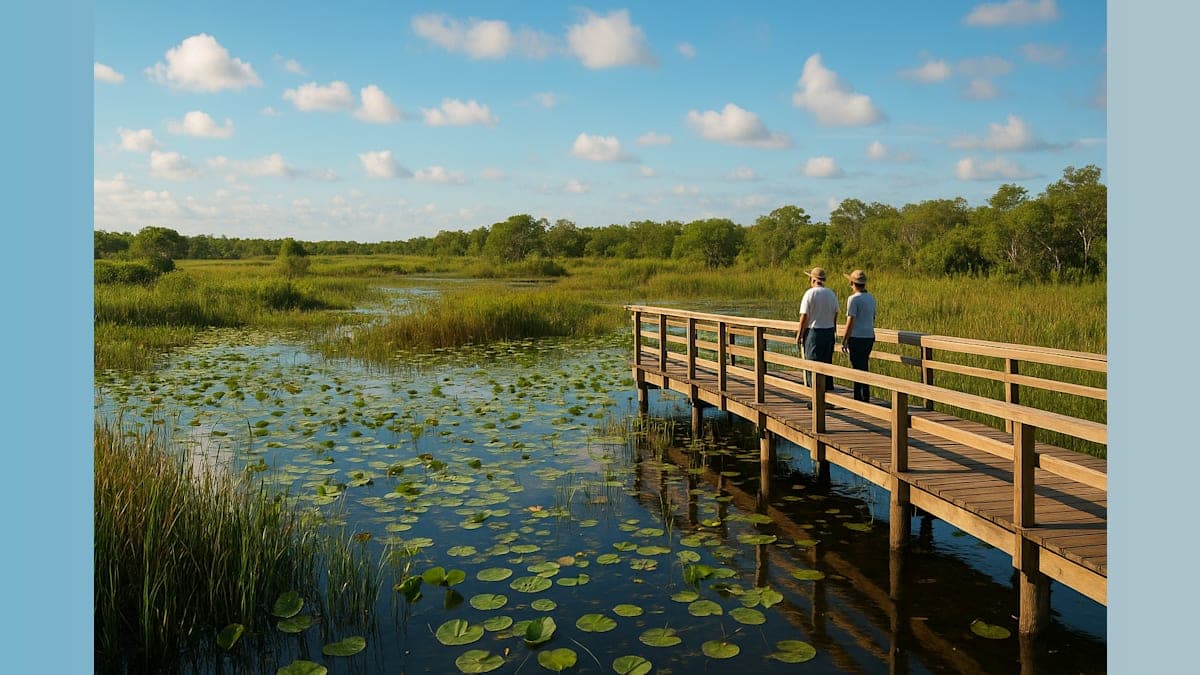
A massive section of the Florida Everglades that was drained decades ago in a failed attempt to create suburban housing has been successfully restored to a functioning wetland ecosystem after more than two decades of intensive conservation work.
Picayune Strand, a large rectangular wetland area located northwest of Everglades National Park, northeast of Thousand Islands Nat. Wildlife Refuge, and west of Florida Panther Nat. Wildlife Refuge, represents one of the most significant environmental restoration achievements in South Florida history. The project has brought the ecosystem to approximately 90 percent restoration, according to ecologist Michael Duever, who has been monitoring the effort.
The restoration reverses damage inflicted in the 1950s when real estate company Gulf American purchased the land as part of an ambitious plan to create Golden Gate Estates, which was intended to become the largest suburban housing development in the United States. The company constructed four large canals to drain the wetland and built causeways topped with roads using excavated earth and stone.
The development scheme ultimately failed due to persistent flooding problems. Picayune Strand sits at an average elevation two feet lower than the Golden Gate Estate land to the north, making it virtually impossible to prevent water accumulation. Gulf American eventually went bankrupt, leaving behind a scarred landscape and scattered property parcels.
Conservation efforts began in earnest in 1985, when organizations started the painstaking process of purchasing privately held parcels throughout the area. By 2004, all land had been consolidated into a unified conservation package. The project became one of the first initiatives pursued under the Everglades Restoration Plan of 2000.
The restoration work focused on reestablishing the natural hydrology of the Everglades, which is characterized by sheet flow—water moving across the landscape in the same direction at a uniform, slow pace through what has been described as a river of grass. The Everglades Foundation, the Conservancy of Southwest Florida, and the US Army Corps. of Engineers led the effort to dismantle the infrastructure that had disrupted this natural water movement.
Workers tore up the roads and causeways, returning the materials to fill in the canals from which they had originally been excavated. This process restored the ability of water to flow naturally across the landscape, recreating the year-round flooding that defines healthy Everglades habitat.
"Picayune is as good a place in South Florida that there is, in terms of getting it back to what it was before," Duever told Yale News. "We're feeling that we're in the range of 90 plus-or-minus percent of restoration."
The project required some compromises to accommodate residents who still live in the area. Three pumping stations remain operational along the northern boundary, pulling rainwater from closed canals and releasing it into large basins that distribute water in multiple directions. This system means water levels sometimes run higher or lower than natural conditions would dictate, accounting for the remaining 10 percent of incomplete restoration.
Native vegetation has returned substantially to the restored wetland. While not all plant species have reestablished in ideal patterns, the continuous water bodies now prevent upland plants from spreading southward. Native species that require persistent wetness, including a wild sunflower species, have begun returning to the area.
The ecological benefits extend to endangered wildlife. The restored habitat is expected to support populations of the red-cockaded woodpecker and the Florida panther. Research has already documented increased insect abundance, which benefits the bonneted bat, Florida's largest bat species with a wingspan exceeding one foot.
Stephen Davis, chief science officer at the Everglades Foundation, views the Picayune Strand project as representative of broader restoration possibilities. "I kind of view Picayune Strand as a microcosm of the entire [Everglades] plan," Davis told Yale.
The success at Picayune Strand demonstrates that even severely altered ecosystems can be returned to functional natural states through sustained conservation effort, collaborative partnerships, and strategic engineering. The project stands as a model for large-scale environmental restoration initiatives across the country.