
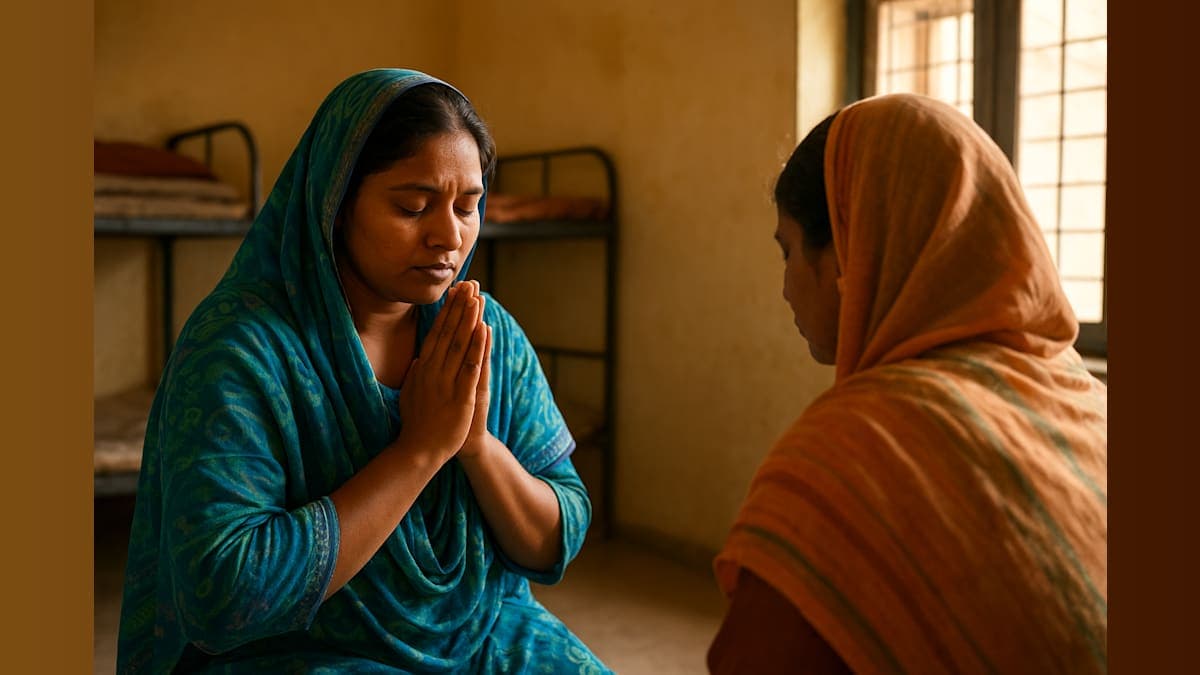
In a modest women's shelter in Gujarat, India, an extraordinary moment unfolded that challenges conventional understanding of generosity and compassion. Trupti Pandya, who works to reunite displaced women with their families, witnessed something that transcended the administrative work of tracing villages and making phone calls—she observed the profound capacity of the human heart to expand even in the midst of personal suffering.
Pandya's work involves painstaking detective work: tracing villages on Google Earth, piecing together fragments of memory and maps, and making countless phone calls to reconnect women with the families and homes from which they have been separated. On this particular day, several residents watched quietly as she worked through the details of another woman's case, learning to ask questions and bearing witness to the slow unraveling of stories marked by displacement and loss.
Then came the moment that stopped Pandya in her tracks. One of the residents—a woman who herself remained displaced from her own family and home—folded her hands and spoke softly: "We will pray that she reaches home."
The statement raises a profound question: How does someone in the midst of their own exile still find the capacity to wish another well? This woman, lacking resolution to her own circumstances, offered something more valuable than material resources. She offered hope, solidarity, and the extension of her own heart toward another's suffering.
The incident illuminates a truth that no training manual or professional protocol can teach. In that cramped room, something arose unbidden—a quiet choosing of compassion over contraction, of openness over bitterness. The woman's prayer represented not naivety or denial of her own pain, but rather a deliberate act of emotional generosity.
This moment suggests that the most significant work occurring in such shelters may not be the paperwork or the successful reunions, important as those are. Rather, it may be the discovery that even amid profound personal loss, the heart retains its capacity to expand. Suffering, this woman demonstrated, does not have to result in emotional closure or self-absorption.
The displaced woman's prayer offers a counternarrative to the assumption that one must first have abundance before giving to others. She gave what she ostensibly did not have—security, resolution, a home—yet in another sense, she gave exactly what she possessed: empathy born of shared experience, understanding forged through common suffering, and the recognition that another's pain deserves acknowledgment even when one's own remains unresolved.
For those working in social services, humanitarian aid, or community support, this incident provides a powerful reminder that transformation occurs not only through logistical solutions but through the cultivation of human connection. The residents watching Pandya work were learning more than how to navigate bureaucratic systems—they were witnessing and participating in a community of mutual care.
The woman's simple prayer—"We will pray that she reaches home"—stands as evidence that compassion need not wait for personal circumstances to improve. It demonstrates that the choice to remain open-hearted in the face of adversity represents its own form of resilience, one that may prove as essential to human survival as any material resource.