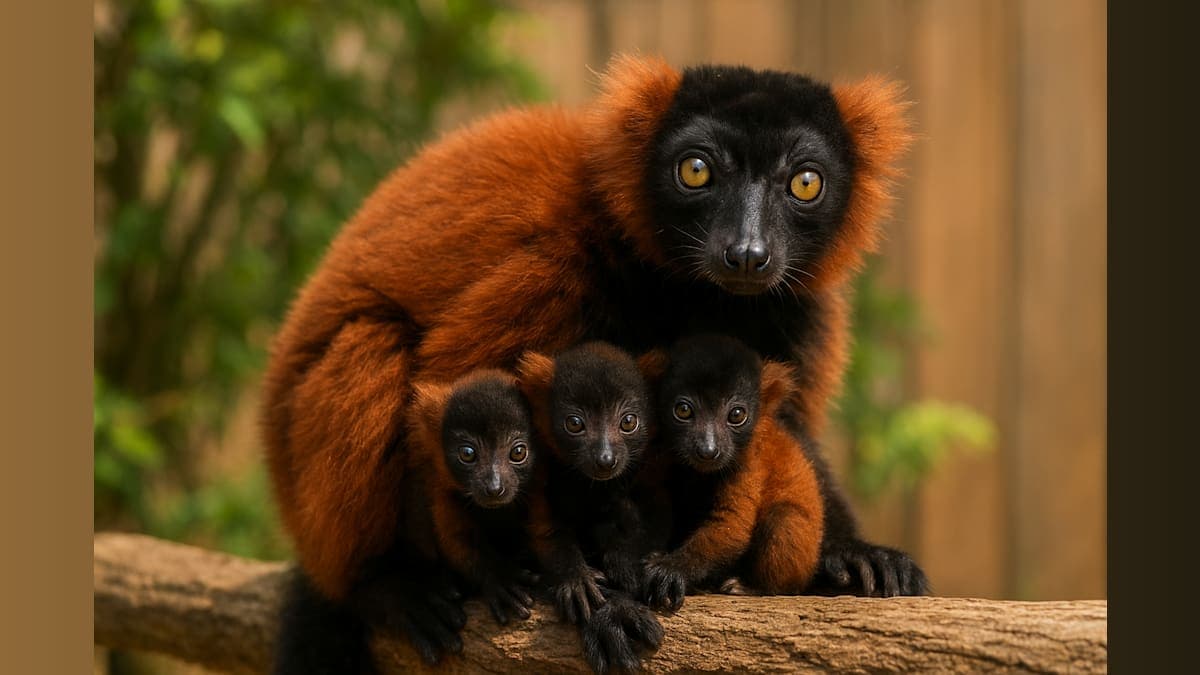
Wild Adventures Theme Park in Valdosta has announced the birth of three critically endangered red ruffed lemur triplets, demonstrating the vital role captive breeding programs play in species conservation. The triplets, named Taylor, Red, and Marjorie, were born on April 25 to resident parents Val and Doug.
This marks the third consecutive year the breeding pair has successfully produced offspring at the Georgia facility, with Val giving birth annually since 2023. The new arrivals join their older siblings Swiper, Raven, Beans, and Dennis, creating a thriving family group that park officials report is adjusting well together.
The red ruffed lemur represents one of nature's most remarkable primates. Weighing approximately 9.5 pounds, these animals hold the distinction of being among the largest living lemur species and serve as the world's largest pollinators. Their fuzzy noses are uniquely adapted to collect and transfer pollen as they feed on fruit and nectar, making them essential to their native ecosystem.
These lemurs also exhibit unusual reproductive characteristics for primates. Females can give birth to litters of up to six offspring at once, demonstrating exceptional fecundity among their taxonomic order. Additionally, red ruffed lemurs are the only diurnal primate species known to leave their infants in nests while foraging, a behavior that distinguishes them from most primates whose young cling to their mothers during movement.
The births carry significant conservation implications. The International Union for Conservation of Nature lists the red ruffed lemur as Critically Endangered, with an estimated 10,000 individuals remaining in rapidly disappearing forests at the northern tip of Madagascar. The approximately 590 red ruffed lemurs currently living in captivity worldwide represent a crucial insurance population should habitat restoration efforts succeed.
Successful breeding pairs like Val and Doug provide hope that genetic diversity can be maintained in captivity, ensuring viable populations exist to potentially reintroduce to protected habitats in the future. Each birth in a managed care setting contributes valuable data about reproductive biology and husbandry practices that can inform conservation strategies.
Park spokesman Asher Raymond indicated that visitors will soon have the opportunity to observe the triplets. The family resides in a habitat located near the Giraffe Overlook, where guests can witness the young lemurs as they develop alongside their parents and siblings.
The consistent breeding success at Wild Adventures Theme Park underscores the effectiveness of well-managed captive programs in supporting endangered species recovery. As Madagascar's forests face ongoing threats from deforestation and habitat fragmentation, facilities like Wild Adventures serve as vital repositories of genetic material and breeding expertise that may prove essential to the species' long-term survival.