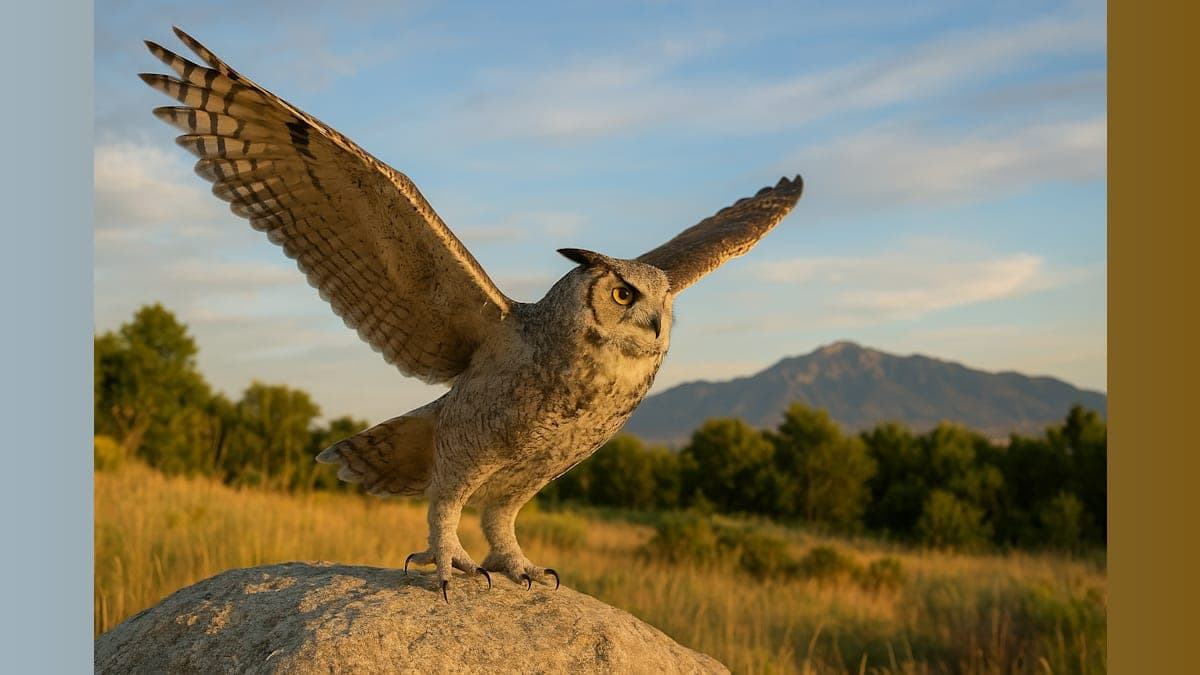
A great horned owl found covered in concrete has flown to freedom after six months of intensive care at a Utah sanctuary, marking a significant achievement in wildlife rehabilitation.
The remarkable rescue began in October when a good Samaritan discovered the young owl in a concrete mixer and contacted the Best Friends Animal Society headquarters in Kanab, located 80 miles away. After staff removed the concrete, the team at the nonprofit's wildlife refuge, Wild Friends, confronted an unexpected challenge: the owl required new feathers to achieve silent flight, which is a necessity in the wild.
The rehabilitation team initially waited for the owl to molt naturally, a process that would have replaced the damaged feathers. However, when the spring molt did not progress as predicted, the Wild Friends team made the decision to pursue an alternative approach they had never attempted before.
The procedure, known as imping, requires using donor feathers and adhesive to replace raptor feathers. To prepare for this unprecedented surgery at their facility, the team completed specialized training. Fortunately, they secured a donation from a wildlife rescue group in Northern Utah where a great horned owl of similar size had passed away, providing the necessary feathers for the transplant.
Supervisor Bart Richwalski meticulously tracked the owl's feather patterns in preparation for the procedure. "We looked at his feathers every few weeks so we knew which ones would have to be done, snipping damaged shafts in advance," Richwalski explained.
The imping finally took place on May 1, with Best Friends staff veterinarian Kelsey Paras joining three members of the Wild Friends team for the 90-minute procedure. The donor feathers were laid out to replicate each wing, allowing the team to line up the replacement feather, cut it to the necessary length and adhere it while the owl was under anesthesia. Ultimately, 10 primary and one second feather were replaced in the owl's right wing, while the left wing did not require any replacements.
"The first few feathers were extremely nerve-wracking, but as we got into the groove, the imping became more comfortable, and everything went smoothly," Richwalski said.
The team noted that the new feathers will come out naturally during future molts. "He'll lose a couple of our imp feathers each year until he replaces that entire wing," they explained.
Following the successful surgery, the owl underwent testing inside the Wild Friends' large aviary to ensure silent flight had been achieved. Once the owl was observed flying to the highest perch, Richwalski measured the sound of its wingbeat using a decibel reader. He determined that the owl's flight was quiet enough for safe release.
The moment of release proved emotional for the rehabilitation team. As the aviary roof slowly retracted, the owl hovered briefly before gaining speed, then flying straight up and out into the wild. For Richwalski, who had cared for the owl since picking him up in St. George, the moment represented the culmination of months of dedicated effort.
"I don't know that my heart was beating until I saw him leave. I was beside myself, knowing that after all this time, he was healthy and back in the wild. It was such a good feeling," Richwalski said.
The owl's remarkable journey has resonated throughout the organization. "Best Friends Animal Society believes that every animal has intrinsic value and the care that our team took with this owl really reflects that belief," said Judah Battista, the Society's Chief Sanctuary Officer. "I'm so proud of the Wild Friends team for their incredibly hard work to get this owl to freedom."
The successful rehabilitation demonstrates the commitment of wildlife professionals to preserving individual animals and advancing veterinary techniques that can benefit future rescues across the region.