
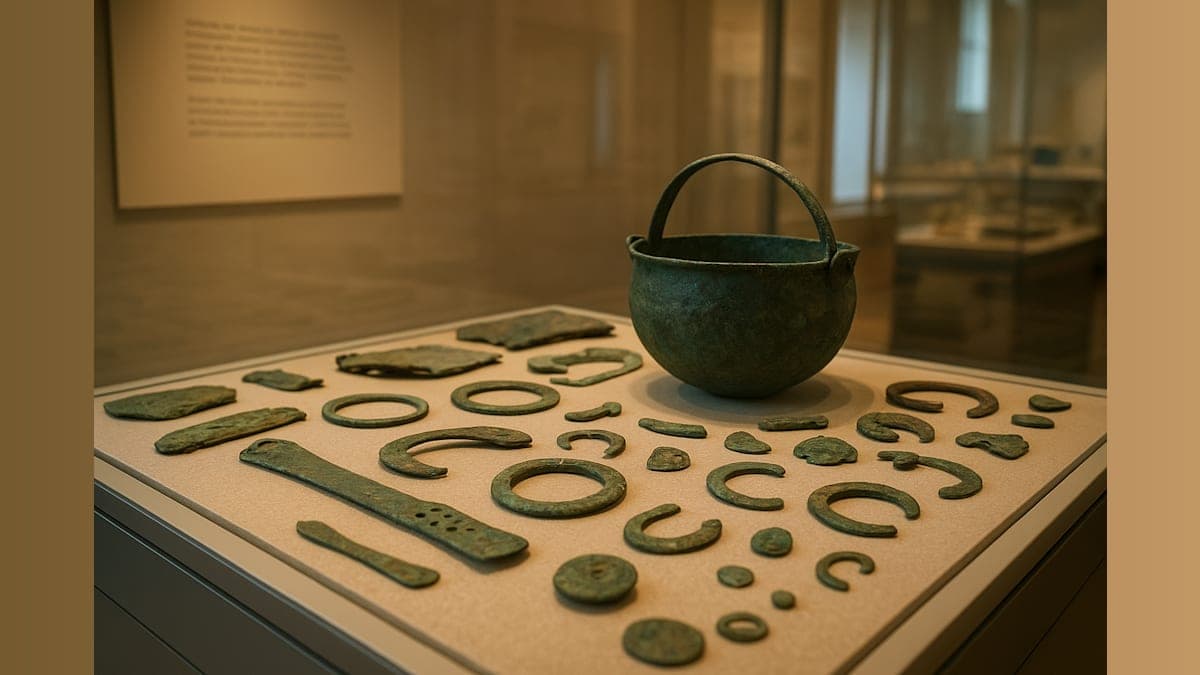
The largest collection of Iron Age artifacts ever discovered in Britain is finally revealing its secrets to the public, five years after an unnamed metal detector enthusiast made the extraordinary find in a field near Melsonby, Yorkshire in 2021.
The Yorkshire Museum has opened a groundbreaking exhibition entitled "Chariots, Treasure and Power: Secrets of the Melsonby Hoard," marking the first public display of artifacts that are fundamentally reshaping understanding of Iron Age Britain. The discovery has proven that what historians once dismissed as a "rural backwater" in northern England was actually a center of wealth, technology, and international trade.
The significance of the find cannot be overstated. Tom Moore, Durham's head of archaeology at the University of Durham, expressed the team's astonishment when they first arrived at the site. "Finding a hoard or collection of ten objects is unusual, it's exciting, but finding something of this scale is just unprecedented," Moore told the Guardian's Mark Brown in 2025. "We were just lost for words."
The metal detector operator deserves considerable credit for immediately alerting archaeologists rather than attempting to excavate the site independently, a decision that preserved invaluable contextual information and allowed for proper scientific analysis.
The Melsonby hoard comprises two distinct groupings of artifacts. The first consists of an extensive collection of chariot components and horse tackle, including bridles and bits that bear striking resemblance to modern equestrian equipment. Among these items, archaeologists discovered 28 iron wagon tire bands stacked together, along with lynchpins and elements of yokes and reins.
These components appear to constitute the first evidence of a four-horse-drawn wagon or carriage in Iron Age Britain, representing a significant technological advancement for the period. The discovery challenges previous assumptions that such sophisticated vehicles were exclusive to southern Britain or continental Europe.
The second grouping, dubbed "the Block," presents a more enigmatic puzzle. This mass of iron and copper-alloy artifacts was apparently thrown into a large pit fire, then extracted while still hot, covered with a sheet, and buried nearby. The resulting fusion created a dense amalgamation of objects that remains largely mysterious even after conservators at the University of Durham transported it to Southampton for detailed CT scanning.
Visible on the exterior of the Block are iron spear points, harness pieces, and wagon parts, but the interior contents continue to elude complete identification. The deliberate burning and burial of these valuable items raises intriguing questions about ritual practices and the circumstances surrounding the hoard's deposition.
Perhaps the most compelling artifacts within the collection are those suggesting extensive trade networks reaching across Britain and into continental Europe, possibly including the Roman world. These items include a large ornamented cauldron, a wine-mixing bowl, blue glass beads, and a mirror.
Professor Moore highlighted the exceptional nature of the wine-mixing bowl. "The bowl... is really interesting because it is a very unusual type: not something you'd find in Northern Britain," he explained. "Its decoration combines both Mediterranean and British Iron age styles. It also has elaborate decoration of coral, so whoever owned something like that has probably got a network across Britain and across into Europe and even the Roman world."
The geographic context of the discovery adds another layer of historical significance. The nearest contemporary settlement to the burial site was Stanwick, a fort inhabited by the Brigantes tribe. This group was notably ruled at one point by Cartimandua, documented as the first female sovereign in British history.
The hoard fundamentally challenges the persistent cultural and economic divide between northern and southern England that has characterized both ancient and modern perceptions. Historians had long assumed that such wealth and technological sophistication were concentrated in southern Britain during the Iron Age. The Melsonby discovery definitively disproves this assumption, revealing that northern communities possessed comparable resources, trade connections, and technological capabilities.
The Yorkshire Museum's exhibition represents only the initial stages of research into this transformational discovery. According to the museum's description, "Chariots, Treasure and Power marks the initial stages of research on the hoard, outlining the current understandings of Iron Age Britain and exploring life before the arrival of the Romans, and asking the questions, why was the hoard buried, why were the objects burnt and destroyed and who might have owned these lavish items."
These questions promise to occupy archaeologists and historians for years to come. The deliberate destruction and burial of such valuable items suggests complex ritual or political motivations that remain subject to scholarly debate. Whether the hoard represents a votive offering, the spoils of conflict, or a cache hidden during times of upheaval remains uncertain.
The two-year preservation process undertaken by the University of Durham was essential to stabilizing the artifacts and preparing them for study and display. The meticulous work required to separate, clean, and conserve items that had been buried for approximately two millennia demonstrates the sophisticated techniques available to modern archaeological science.
For visitors to the Yorkshire Museum, the exhibition offers a rare opportunity to witness artifacts that are rewriting the historical narrative of Iron Age Britain. The display provides tangible evidence of the sophistication, wealth, and international connections of communities that existed in northern England more than two thousand years ago, long before Roman conquest would transform the island's political and cultural landscape.