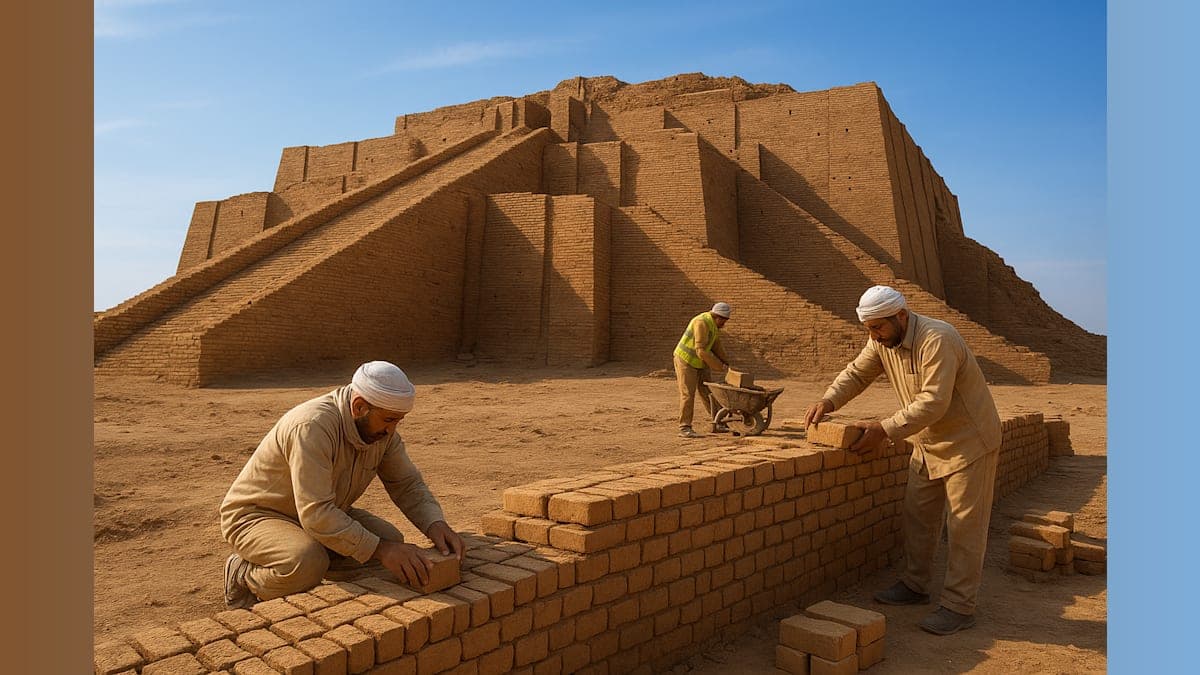
The Iraqi government has initiated substantial preservation work on one of humanity's oldest architectural achievements, the Ziggurat of Ur, employing meticulous techniques to ensure authenticity in protecting this ancient monument from environmental degradation.
The ziggurat, a UNESCO World Heritage Site and one of the most recognizable examples of Sumerian architecture, stands at extreme risk from erosion and climate-related damage. The preservation effort represents a commitment to safeguarding cultural heritage through scientifically informed restoration methods rather than modern shortcuts.
Constructed in the 21st century BCE, the ziggurat originally measured 210 feet in length and 148 feet in width, potentially reaching 98 feet in height, though scientists remain uncertain about its exact original stature. Built from air-dried mudbrick and bitumen, the structure functioned as a temple dedicated to Namma, the moon god who served as the patron deity of Ur.
The ancient city of Ur itself ranks among the oldest known urban settlements, with the earliest Sumerian habitation dating to 3,800 BCE. The city's initial street plan encompassed approximately 18 hectares but expanded nine-fold during its most powerful dynastic period, reflecting its significance as a major center of ancient civilization.
The current preservation work follows two previous restoration efforts. The Neo-Babylonian King Nabonidus undertook restoration in the 6th century BCE, while the deposed Iraqi leader Saddam Hussein conducted more recent preservation work that created the monumental facade and staircases visible today, though these additions do not cover all original brick layers.
The Iraqi government has allocated approximately $382,000 for the new conservation initiative, which focuses on protecting the exposed upper sections of the original ziggurat. What distinguishes this effort from many global preservation projects is the commitment to authentic materials and traditional construction methods.
Archaeologist Khadim Hassoun Honaein, a senior member of the conservation team, explained the rigorous approach to material selection. "For the paving bricks, a sample was taken from the ziggurat and a replica of the original was made containing the same chemical materials and physical properties," Honaein stated. "Regarding the mud, it was handmade on site in Ur and the clay was taken from an environment similar to that of the Ur ancient city."
This methodology contrasts sharply with preservation approaches employed at some heritage sites worldwide, where low and middle-income countries have occasionally incorporated modern, mass-produced materials that lack historical authenticity. The Ur preservation team has deliberately chosen a more painstaking path that honors the monument's original construction techniques.
The northern side of the ziggurat has proven exceptionally vulnerable to wind and sand erosion in recent decades, making it a principal target for the preservation work. The changing climate has accelerated deterioration, creating urgency around protective measures that can withstand environmental pressures while maintaining historical integrity.
The preservation effort represents more than structural maintenance; it embodies a broader commitment to protecting cultural heritage for future generations. By replicating ancient materials and construction methods, the project ensures that the Ziggurat of Ur will continue to stand as an authentic testament to Sumerian architectural achievement and the dawn of urban civilization.