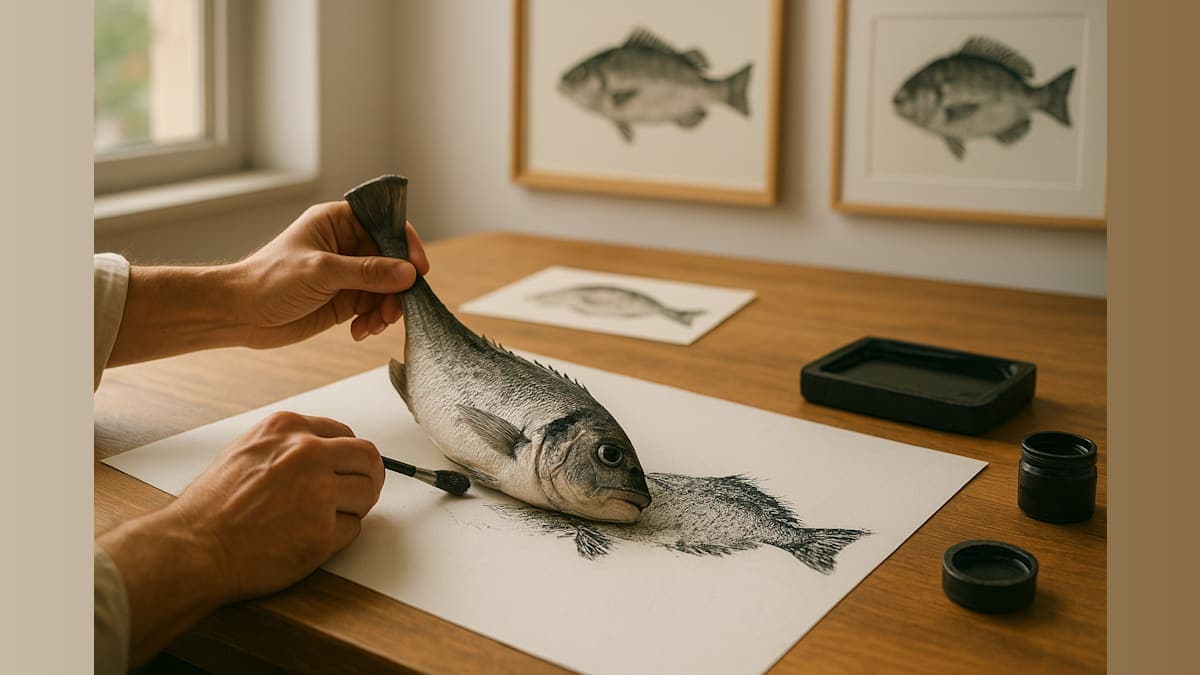
What began as a practical tool for Japanese fishermen to record their notable catches has blossomed into a sophisticated art form practiced across continents. Gyotaku, the art of fish printing, traces its origins to 19th-century Japan, where fishermen would coat their catches in sumi ink and press them onto washi paper to create permanent records for sale or documentation purposes.
The technique embodies quintessentially Japanese characteristics: a deep cultural appreciation for fish, meticulous attention to detail, and an unwillingness to approach any craft without complete dedication. Those early fishermen gradually refined their methods, eventually transitioning from monochrome ink to vibrant color paints, laying the groundwork for what would become a recognized artistic discipline with distinct schools, techniques, and methodologies.
The Technical Demands of Fish Printing
Creating a gyotaku print requires extensive preparation. Fish arrive covered in slime and contain various fluids that threaten to compromise the delicate rice paper traditionally used in the process. Artists must meticulously remove the slime and plug openings to prevent water leakage before any printing can commence.
Two primary methods have emerged within the practice. Direct gyotaku follows a straightforward approach: the fish is dried, ink or paint is applied to its surface, and washi paper is pressed against it. This technique produces an image in reverse. The indirect method involves placing paper or cloth over the fish and securing it to a board with rice paste, allowing artists to create prints that appear in their correct orientation.
Both approaches permit the fish to be consumed afterward, and both require the eye to be painted separately, as pigment will not adhere to the fish's eye. Contemporary practitioners have developed sophisticated coloring techniques that capture the iridescent quality of scales and the varying pigment density that occurs during different life stages.
Keisuke Matsunaga, grandson of a renowned gyotaku master, explained to Japan Times that pigment application operates under strict time constraints. Artists must complete the process within approximately 30 minutes before moisture from the fish begins to degrade the work. The discipline maintains a rigid standard: only the eye may be added after the initial print. Any additional touch-ups cross the boundary from printing into painting, fundamentally altering the nature of the work.
A Global Artistic Movement
Gyotaku has established itself far beyond Japan, with thriving communities of practitioners in Australia, Italy, America, Hawaii, Brazil, and numerous other locations. The art form has adapted to local contexts while maintaining its core principles and techniques.
In the coastal Italian region of Liguria, Elena Di Capita has pioneered the expansion of gyotaku throughout Europe. She describes herself as "the artist that brought it to Italy," speaking to Good News Network. Her work centers primarily on schools of anchovies, the most economically and culturally significant fish in her region. Di Capita has pushed the boundaries of traditional gyotaku by combining different biological environments and creating large-scale compositions characterized by dynamic movement.
Her practice incorporates a poignant element of environmental consciousness. Di Capita works extensively with bycatch, the term for fish caught unintentionally during commercial fishing operations. These creatures, she notes, effectively "died for nothing." Through her gyotaku compositions, she creates what she terms metaphorical geographies, imbuing these accidental deaths with meaning and serving as tribute to their loss.
"My work with them is about giving them dignity. It's a way to celebrate life," she told the Times.
In the United States, gyotaku has found an accessible niche in educational settings. Aquariums and elementary school classrooms frequently incorporate the practice, as its fundamental techniques prove simple enough for children to execute successfully while introducing them to both artistic expression and marine biology.
The evolution of gyotaku from utilitarian documentation to recognized fine art demonstrates how traditional practices can transcend their original purposes when approached with dedication and creativity. As the art form continues to spread globally, it carries with it the Japanese principles of precision, respect for nature, and the pursuit of mastery that characterized those 19th-century fishermen who first pressed ink-covered fish to paper.