
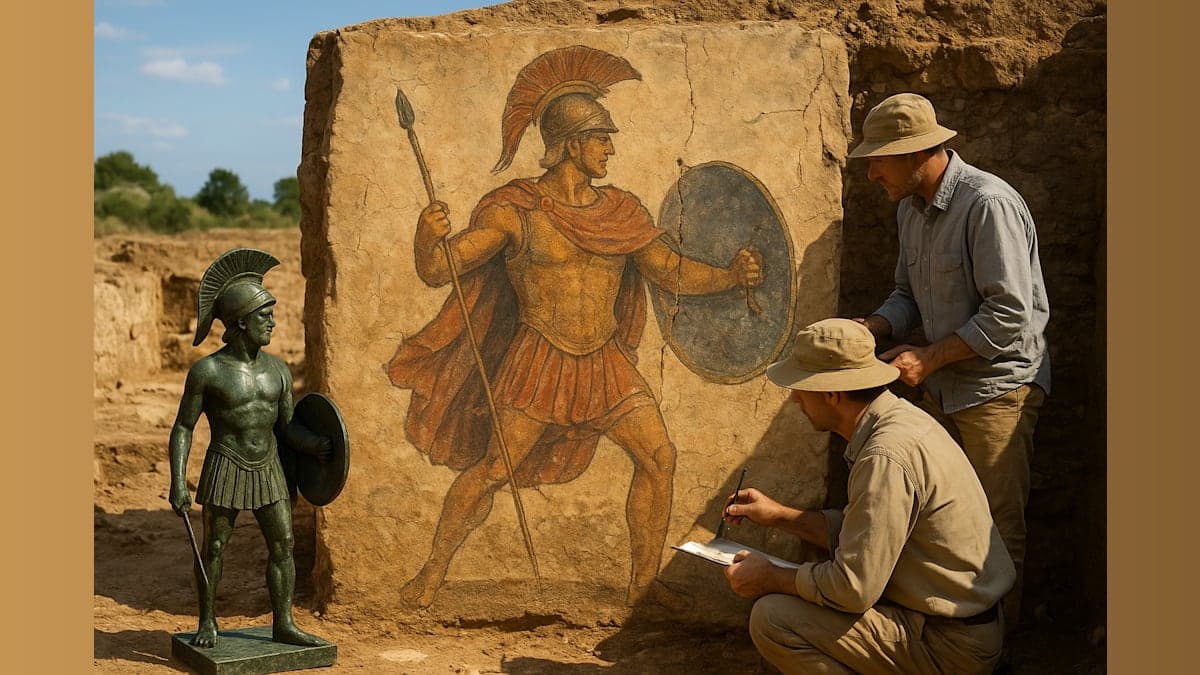
A remarkable archaeological discovery near Reims, France has shed new light on the cultural sophistication of Roman society in the far northern reaches of the ancient empire. Excavations at a Roman villa site have revealed fragments of a life-sized mural depicting Achilles, the legendary hero of Homer's Iliad, alongside several exquisite bronze statuettes and the remains of an elaborate colonnaded facade.
The findings suggest that high artistic expression was not merely the province of Rome's Mediterranean heartland, but flourished even in the empire's northern territories. The presence of such refined artwork in this region indicates that wealthy Romans living near what is now Reims had both the resources and the cultural inclination to commission sophisticated works depicting classical Greek mythology.
The mural fragments depicting the larger-than-life figure from the Iliad represent a significant find for understanding Roman cultural diffusion. Achilles, the greatest warrior of the Trojan War, remained a popular subject for Roman art centuries after Homer composed his epic poem. The choice to depict this particular hero suggests the villa's occupants were well-versed in classical literature and sought to display their cultural refinement through their home's decoration.
The bronze statuettes discovered at the site further underscore the artistic quality available to Roman elites in northern France. Bronze sculpture required significant technical skill and expensive materials, making such pieces markers of both wealth and taste. The colonnaded facade remains indicate the villa itself was constructed with architectural ambition, featuring the classical columns that characterized prestigious Roman buildings throughout the empire.
This discovery near Reims contributes to a growing body of evidence that challenges earlier assumptions about the cultural periphery of the Roman Empire. Rather than viewing distant provinces as culturally impoverished compared to Rome itself, archaeologists increasingly recognize that wealthy provincials actively participated in empire-wide artistic and intellectual traditions. The presence of such sophisticated artwork in northern France demonstrates that access to skilled artisans and classical themes extended far beyond the Mediterranean basin.
The villa site near Reims joins other significant Roman archaeological discoveries in the region, which was known in antiquity as part of Gallia Belgica. The area's strategic importance and agricultural productivity made it home to numerous wealthy landowners who built substantial country estates. These villas served not only as working farms but as statements of status and culture, decorated with the finest art their owners could acquire.
For modern residents of the Reims area, the discovery offers a tangible connection to the region's ancient past and its place within the broader Roman world. The fragments of the Achilles mural and accompanying artifacts will likely contribute to ongoing research into Roman life in northern Gaul and may eventually be displayed for public viewing, allowing contemporary audiences to appreciate the artistic achievements of their distant predecessors.