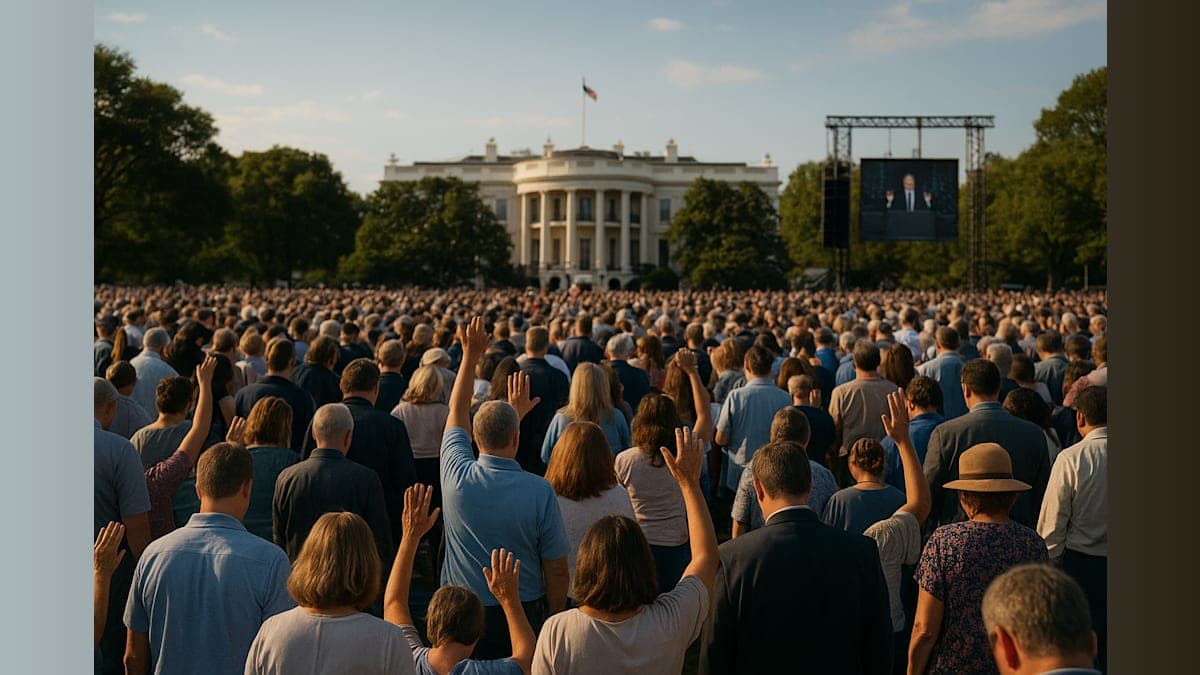
A White House-backed prayer gathering took place on the National Mall on Sunday, marking an unprecedented level of executive branch involvement in organizing a religious event on federal grounds. The gathering, described as an effort to "rededicate America" to God, drew Trump administration members and Christian religious leaders to the nation's symbolic center.
The event's organization by the White House represents a significant departure from traditional boundaries between government and religious activity. Federal involvement in coordinating faith-based gatherings on public property raises questions about the separation of church and state, a foundational principle in American governance.
Participation in the Sunday gathering was predominantly Christian, with pastors and administration officials leading the proceedings. Other faith traditions were notably underrepresented at the event, which focused specifically on Christian prayer and worship practices.
The National Mall has historically served as a venue for diverse public gatherings, from political demonstrations to cultural celebrations. This particular event's explicit religious purpose and government coordination distinguish it from typical Mall activities, which generally maintain secular character or represent grassroots organization rather than executive branch initiative.
The gathering's stated goal of rededicating the nation to God reflects a particular theological and political perspective that views America's founding and identity through an explicitly Christian lens. This interpretation of national purpose has long been debated among historians, constitutional scholars, and religious leaders representing diverse traditions.
The event's timing and White House involvement signal a deliberate effort to elevate religious expression within the public square. For supporters, such gatherings represent an affirmation of faith values in national life. Critics, however, may view government-organized religious events as potentially exclusionary to Americans of different faiths or no religious affiliation.
The limited participation from non-Christian faith communities raises questions about inclusivity in government-backed religious activities. America's religious landscape includes significant populations of Jewish, Muslim, Hindu, Buddhist, and other faith adherents, as well as growing numbers of religiously unaffiliated citizens.