
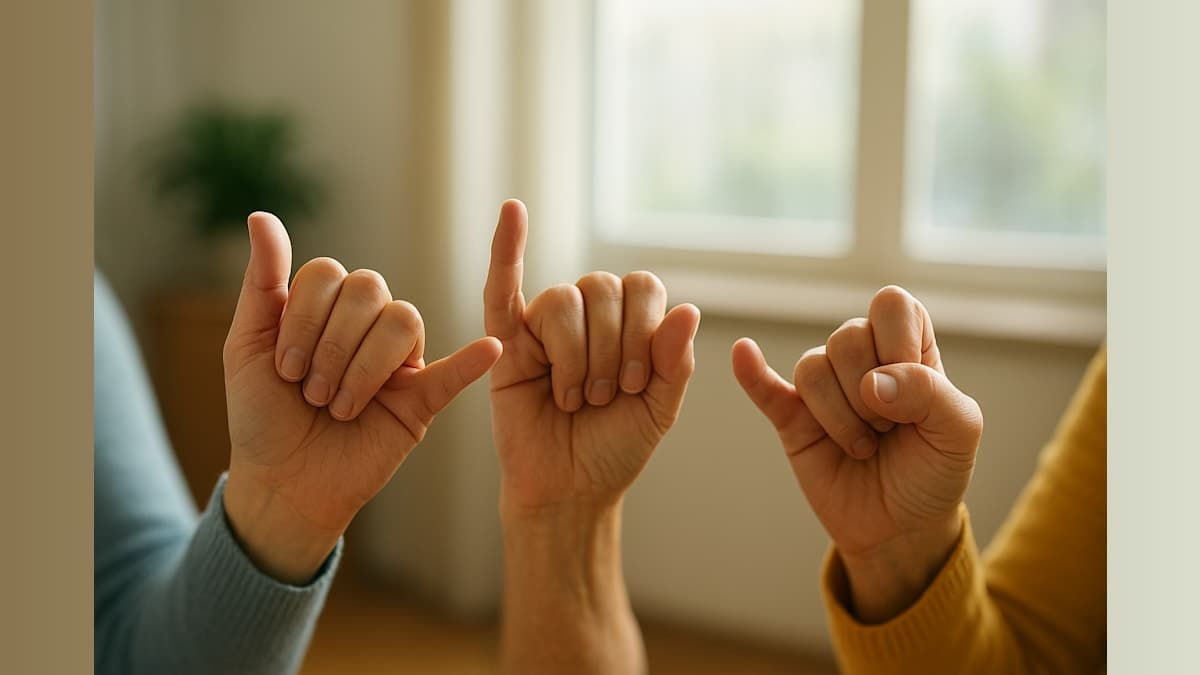
A peculiar new wellness trend is sweeping across social media platforms, encouraging people to pause their daily routines for a brief finger exercise that proponents claim could help preserve brain health. The practice, dubbed 'pinky time,' has garnered millions of views and sparked conversations about accessible methods for maintaining cognitive function as we age.
The viral phenomenon began when TikTok creator Daniela Paez-Pumar shared a video demonstrating the simple exercise. In the clip, participants wrap their middle and pointer fingers together, touch their ring fingers to their thumbs, and move their pinkies up and down for several seconds. Paez-Pumar revealed that she observes this ritual every night at 7:45 p.m., writing in her caption, 'No one is exempt from pinky time — we keep that brain HEALTHY.'
The practice has resonated with viewers concerned about cognitive decline, and mental health professionals acknowledge there is merit to the underlying concept. Dr. Kelly Gonderman, a licensed clinical psychologist, explained the neurological basis for why such exercises may benefit brain health.
'When you pause, concentrate and try a new movement that your body isn't used to, like wiggling your pinky, it lights up your motor cortex, cerebellum and other areas of your noggin,' Gonderman told Bustle. She noted that pinky time falls into the category of fine motor tasks, which require coordination between muscles and joints and become more challenging with age-related mental decline.
The exercise engages both hemispheres of the brain simultaneously, a type of neural activity that researchers have found beneficial for cognitive maintenance. 'That cross-hemisphere coordination is genuinely good for the brain,' Gonderman said.
However, experts caution against viewing pinky time as a standalone solution to preventing dementia or Alzheimer's disease. While the exercise has value, it must be understood within a broader context of brain-healthy behaviors.
'Ten seconds of finger movement a day isn't going to prevent Alzheimer's on its own, but activities that challenge the brain through novelty and coordination are worth doing regularly,' Gonderman explained. The key lies in consistently engaging the brain with new and challenging tasks rather than relying on any single exercise.
Some social media users have taken the trend further, suggesting that difficulty performing the pinky movement could serve as a diagnostic indicator of cognitive decline. Gonderman firmly disputes this interpretation.
'The idea that struggling with it signals poor brain health is where I'd pump the brakes,' she said. 'Difficulty with a novel motor task can reflect lots of things: hand dominance, arthritis, practice, attention in that moment.' She emphasized that making or struggling to make hand positions is not an effective diagnostic tool for assessing brain health.
Nevertheless, the fundamental principle underlying pinky time aligns with established neuroscience research. 'The broader principle behind it — that fine motor activity, learning new physical skills and hand-brain coordination exercises support cognitive health as we age — is supported by research,' Gonderman noted.
For those seeking additional brain-challenging activities beyond pinky wiggling, juggling has emerged as a particularly effective option. A 2024 study found that juggling has 'positive effects on cognitive abilities and postural stability in healthy, physically active older adults.' Research has also demonstrated that juggling promotes neuroplasticity, the brain's remarkable ability to adapt to new stimuli, which may improve cognitive function.
Neurologists maintain that learning something new, whether juggling, a language, or a musical instrument, can trigger the growth of new neural connections in the brain. This process keeps the brain young by activating different areas and reinforcing neural pathways that might otherwise go underutilized. The more the mind is exercised through diverse activities, the stronger these pathways become.
Experts recommend selecting activities that strike a balance between challenge and enjoyment. The task should be complex enough to require effort and concentration, but not so difficult that it becomes discouraging or unpleasant. This sweet spot ensures consistent engagement, which is crucial for long-term cognitive benefits.
The growing interest in accessible brain health practices comes at a critical time. Across the country, approximately one in ten older adults is living with dementia, with Alzheimer's disease being the most common form. As the United States population ages, these numbers are expected to increase dramatically.
Researchers estimate that 42 percent of Americans over 55 will eventually develop dementia, with women and Black adults facing higher risks. By 2060, cases nationwide are projected to double, with roughly one million new diagnoses each year. These sobering statistics underscore the importance of proactive measures to maintain cognitive health throughout the lifespan.
While pinky time may seem like a lighthearted social media trend, it represents a broader cultural shift toward taking personal responsibility for brain health. Whether through finger exercises, learning new skills, or engaging in complex physical activities, the message is clear: keeping the brain active and challenged is essential for maintaining cognitive function as we age. The specific activity matters less than the commitment to regular mental stimulation and the willingness to step outside one's comfort zone to learn something new.