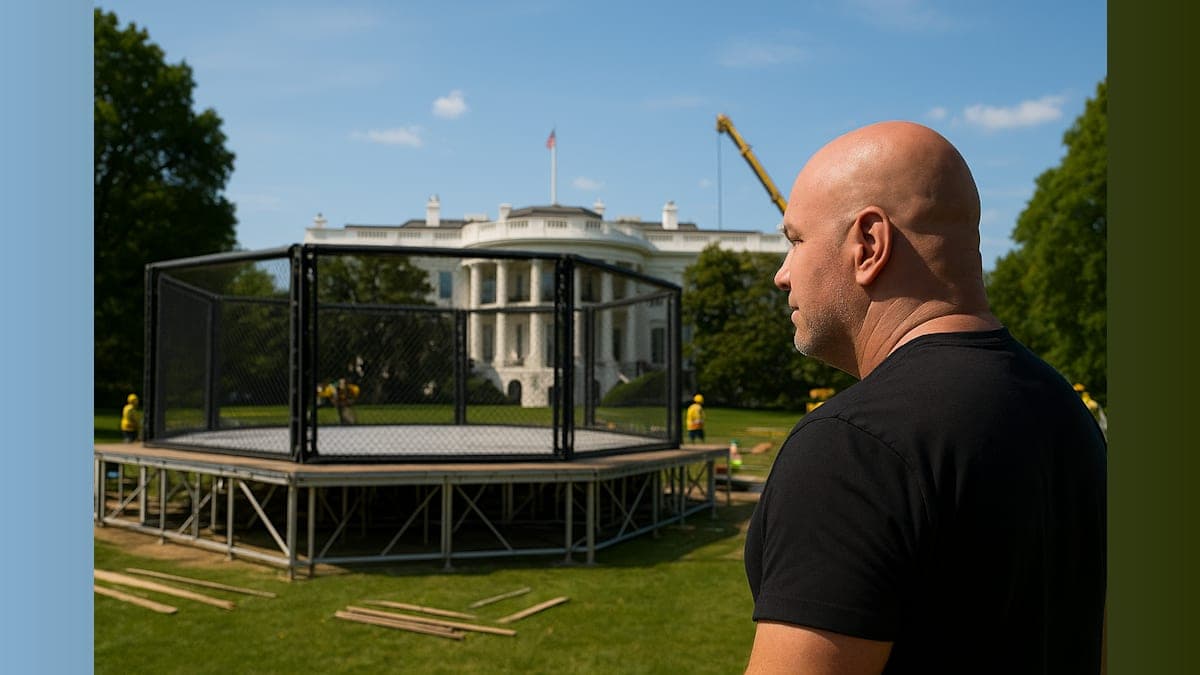
An unprecedented spectacle is taking shape on the White House South Lawn, where the Ultimate Fighting Championship has begun constructing a temporary arena for mixed martial arts cage matches. The event, scheduled for June 14, represents a historic first for the presidential residence and underscores the evolving relationship between combat sports and American political culture.
Dana White, head of the UFC and longtime friend of President Trump, acknowledged the unusual nature of the undertaking in an interview for the NPR video podcast Newsmakers. Despite his reservations about outdoor venues, White expressed pride in the opportunity to stage the event at such a symbolic location.
"There's two things I hate. I hate stadiums, and even worse than a stadium is fighting outside," White said. "There's just so many variables… rain and lightning… bugs."
Nevertheless, White committed to the project, framing it as a patriotic duty. "We're celebrating America's 250th birthday on the lawn of the White House. And, you know, there possibly couldn't be a greater honor than that, especially for me as an American," he stated.
Construction crews have erected bleachers and a giant arch visible to tourists and television cameras. The UFC released renderings showing several thousand spectators surrounding a fenced-in octagon, the organization's trademark fighting cage, where a series of fighters will compete.
A Decades-Long Partnership
The relationship between White and Trump extends back more than two decades. White recounted assuming control of the UFC in 2001, when mixed martial arts fighting faced such widespread disapproval that securing appropriate venues proved difficult. Trump provided crucial support by inviting the UFC to stage events at his Taj Mahal casino in Atlantic City.
That early partnership helped propel the UFC from a disreputable fringe sport to a multi-billion dollar enterprise. White attributes the organization's success not merely to physical combat but to the compelling narratives of fighters overcoming adversity.
"People that are this tough come from some tough backgrounds," White explained. "Who are you and where do you come from? That's what I sell every Saturday night."
Complex Intersections of Sport and Policy
The White House event raises questions about the intersection of entertainment, politics, and immigration policy. Many UFC fighters come from immigrant and refugee backgrounds, creating what some observers view as an ironic juxtaposition given the administration's strict immigration stance. White and NPR discussed this apparent tension during the interview.
The conversation also addressed the sport's most serious concern: head injuries. White acknowledged these injuries as an unavoidable cost of mixed martial arts competition, a frank admission that highlights ongoing debates about fighter safety in combat sports.
Political Significance of the UFC Audience
The White House event carries political significance beyond its novelty. White commands substantial influence among younger men, a demographic that represents a crucial battleground in American politics. While young voters generally lean Democratic, many young men supported Trump in 2024, making them a contested constituency in future elections.
The UFC's core audience consists largely of this demographic, positioning White as an important cultural figure whose platform extends beyond sports entertainment into the realm of political influence.
As construction continues on the South Lawn, the June 14 event promises to generate polarizing reactions, much like the UFC itself. Whether viewed as an innovative celebration of American resilience or an inappropriate use of presidential grounds, the spectacle will undoubtedly mark a distinctive moment in the history of both the White House and professional combat sports.