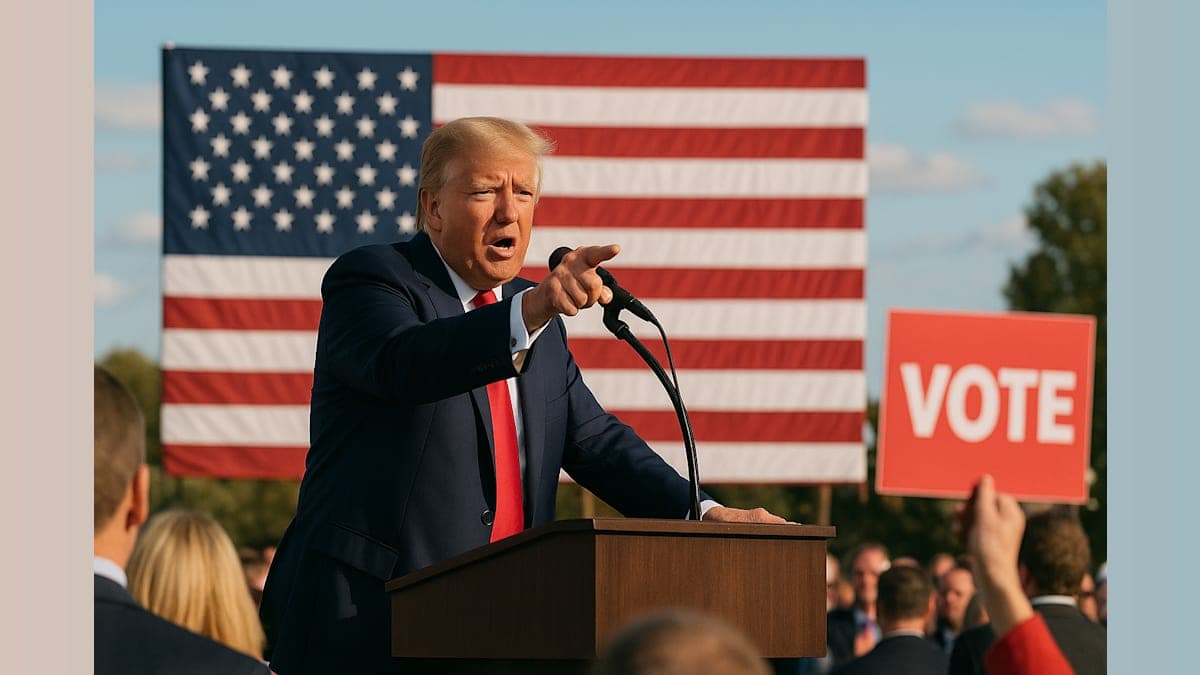
Voters in Ohio and Indiana head to the polls Tuesday for primary elections that will serve as the latest measure of President Trump's political influence and the shifting dynamics of the 2026 midterm landscape. The contests highlight starkly different approaches to redistricting and reveal deep fissures within the Republican Party over state autonomy versus federal party loyalty.
In an unprecedented move, Trump's political operation is actively working to unseat seven Republican state senators in Indiana who opposed efforts to redraw House maps to add more Republican seats. The White House intervention represents a rare instance of Trump endorsing against sitting Republican incumbents, a departure from his typical pattern of supporting party loyalists regardless of their incumbency status.
State Senator Spencer Deery, one of the targeted lawmakers, characterized the federal interference as a fundamental threat to constitutional principles. "What is being set up here is the potential model for any party to raise ridiculous amounts of money in D.C. and then to use that to try to control the states," Deery stated. "That undermines the Constitution without a law. It undermines the 10th Amendment and the ability of states to make their own decisions."
Trump allies defended the primary challenges as necessary accountability measures. Marty Obst, a longtime Republican political consultant in Indiana who led the redistricting push, emphasized the consequences of defying presidential priorities. "This was a top political priority of President Trump's and [he] was very clear about that," Obst said. "And the bottom line is there's consequences and accountability to those actions."
The Indiana primaries also feature competitive challenges to two congressional incumbents. Republican Representative Jim Baird, who is 80 years old and holds Trump's endorsement, faces state Representative Craig Haggard. Despite Baird's presidential backing, Haggard has secured support from state Attorney General Todd Rokita and more than 100 local elected officials. Federal Election Commission data reveals that the conservative Homeland PAC spent $200,000 on digital advertisements opposing Baird over his support for the bipartisan DIGNIDAD Act immigration bill, while the pro-crypto super PAC Defend American Jobs countered with a half-million dollar media buy supporting the incumbent.
Democratic Representative André Carson, Indiana's longest-serving House incumbent since 2009, confronts multiple primary challengers amid calls from some party members for new leadership in the delegation.
In Ohio, the primary elections unfold under newly drawn congressional maps that emerged after years of legal battles. Multiple previous versions were struck down by courts or passed without bipartisan support since 2021. The current map includes minor changes to existing boundaries that do not uniformly favor Republicans, creating competitive dynamics in several districts.
The redistricting has placed additional pressure on Democratic Representatives Greg Landsman and Marcy Kaptur while providing some relief to Representative Emilia Sykes. Kaptur, who has served in the House since 1983 as the longest-serving woman in congressional history, faces the most significant challenge. She won reelection in 2024 by just over half a percent in a district that would have voted for Trump by nearly 11 percent under previous boundaries.
A crowded Republican field seeks to challenge Kaptur, including former state Representative Derek Merrin, who was her 2024 opponent; state Representative Josh Williams; former Immigration and Customs Enforcement Deputy Director Madison Sheahan; Air Force veteran Alea Nadeem; and Anthony Campbell, a healthcare data science executive.
Landsman will face either Trump-backed former CIA officer Eric Conroy or conservative activist Holly Adams in November, while none of the Republican candidates seeking to challenge Sykes has raised more than $100,000.
The Ohio gubernatorial race features former state health director Amy Acton running unopposed in the Democratic primary. On the Republican side, Trump's November 2025 endorsement of Vivek Ramaswamy effectively cleared the field of other candidates. The Senate race presents incumbent Republican Senator Jon Husted, who is unopposed, against former Democratic Senator Sherrod Brown, who faces one opponent with minimal fundraising.
Early voting data from the Ohio Secretary of State's Office indicates heightened Democratic enthusiasm, with more voters casting ballots using Democratic primary ballots than Republican by roughly an 11 percent margin. This pattern aligns with broader national trends showing consistent Democratic gains in nearly every election since Republicans gained control of Washington a year and a half ago.
The primary elections occur one week after a United States Supreme Court decision that weakened Section 2 of the Voting Rights Act, potentially enabling Republican-led states to eliminate majority-minority districts in the South. This ruling could trigger a larger redistricting arms race with significant implications for the 2026 elections and beyond.
Trump's unpopular second-term agenda and record-low approval ratings have created competitive races for governor and United States Senate in Ohio, with Democrats identifying a potential path to regain control of the Senate chamber through the state. The combination of redistricting battles, intraparty Republican conflicts, and surging Democratic turnout suggests Tuesday's primaries will provide crucial insights into the political landscape heading toward the November midterm elections.