
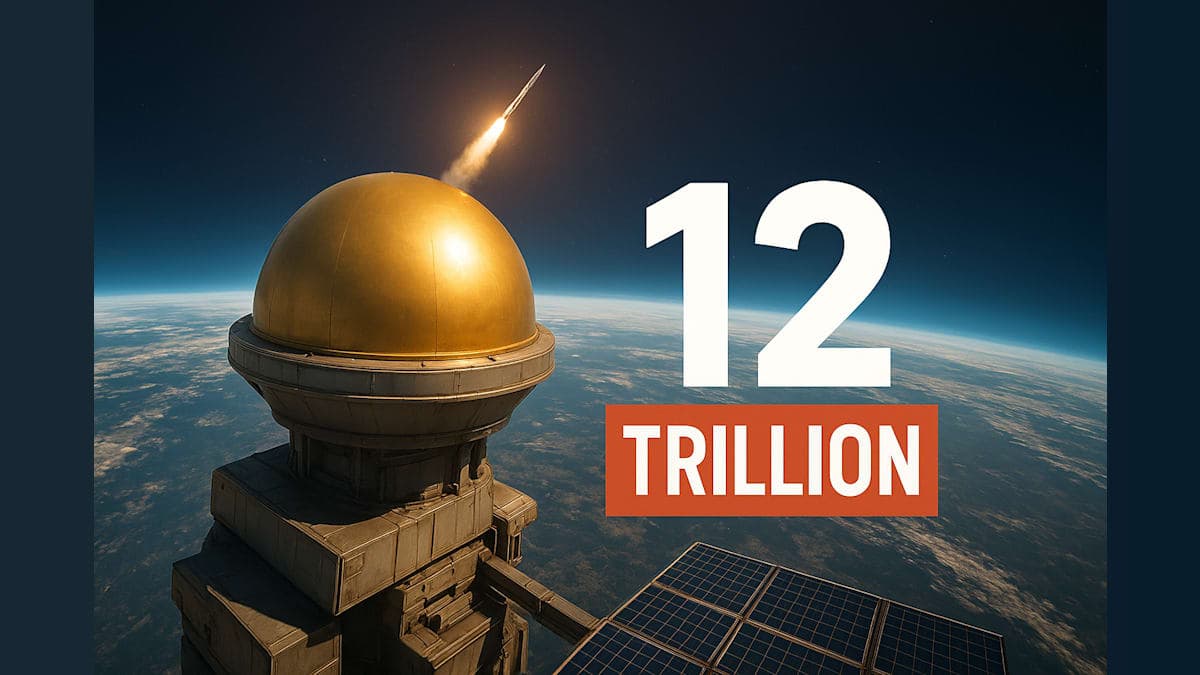
President Donald Trump's proposed missile defense initiative, branded as a "Golden Dome for America," carries a staggering price tag of $1.2 trillion over two decades, according to a Congressional Budget Office analysis released Tuesday. The figure represents a dramatic escalation from the $175 billion cost estimate Trump provided last year when announcing the ambitious space-based weapons program.
The nonpartisan CBO report characterizes its analysis as reflecting "one illustrative approach rather than an estimate of a specific Administration proposal," acknowledging significant uncertainty surrounding the program's ultimate scope and implementation. The substantial cost projection underscores the fiscal challenges facing a defense initiative Trump ordered during his first week in office, with expectations that the system would be "fully operational before the end of my term" in January 2029.
Strategic Rationale and Design Concept
Trump justified the Golden Dome program in his executive order by citing evolving threats from adversarial nations. "Over the past 40 years, rather than lessening, the threat from next-generation strategic weapons has become more intense and complex with the development by peer and near-peer adversaries of next-generation delivery systems," the president stated in the order.
The system draws conceptual inspiration from Israel's multitiered defenses, collectively known as the "Iron Dome," which proved effective in defending against rocket and missile attacks from Iran and allied militant groups during ongoing regional conflicts. The American version envisions a comprehensive defense architecture incorporating both ground-based and space-based capabilities designed to detect, intercept, and neutralize missiles throughout all major phases of a potential attack.
Funding and Cost Uncertainty
Congress has already allocated approximately $24 billion for the missile defense initiative through a comprehensive tax and spending measure enacted last summer under Republican leadership. However, the CBO report highlights substantial uncertainty in long-term cost projections, noting that a lack of detailed specifications from the Defense Department regarding system types and deployment quantities makes precise estimation impossible.
The current $1.2 trillion estimate represents a significant increase from previous projections. Last year, the CBO calculated that space-based components alone could reach $542 billion over 20 years, a figure that has now been incorporated into the broader system-wide assessment.
Military Leadership Defends Affordability Focus
Gen. Michael A. Guetlein, director of the Golden Dome project and a U.S. Space Force general, testified before lawmakers last month to address cost concerns. He disputed methodologies used by external analysts to project expenses, stating that critics "just take the cost of a legacy system and they multiply it out and they get these really large numbers and they say, well, that must be it."
"That is not what Golden Dome is doing," Gen. Guetlein emphasized. "We are laser focused on affordability." His testimony sought to reassure congressional appropriators that the program would employ innovative approaches to cost management rather than simply scaling up existing defense systems.
Political Opposition Intensifies
Sen. Jeff Merkley, D-Ore., who requested the CBO cost estimate, issued a sharp rebuke of the program following the report's release. The senator characterized the missile defense project as "nothing more than a massive giveaway to defense contractors paid for entirely by working Americans," signaling that the initiative faces significant political resistance despite initial congressional funding approval.
The stark disparity between the administration's original cost projection and the CBO's independent analysis raises fundamental questions about program feasibility and fiscal responsibility. As the Defense Department continues developing implementation plans, lawmakers and taxpayers alike will scrutinize whether the Golden Dome can deliver on its ambitious promises within reasonable budgetary constraints, or whether the initiative represents an unsustainable commitment of national resources to an unproven defense concept.