
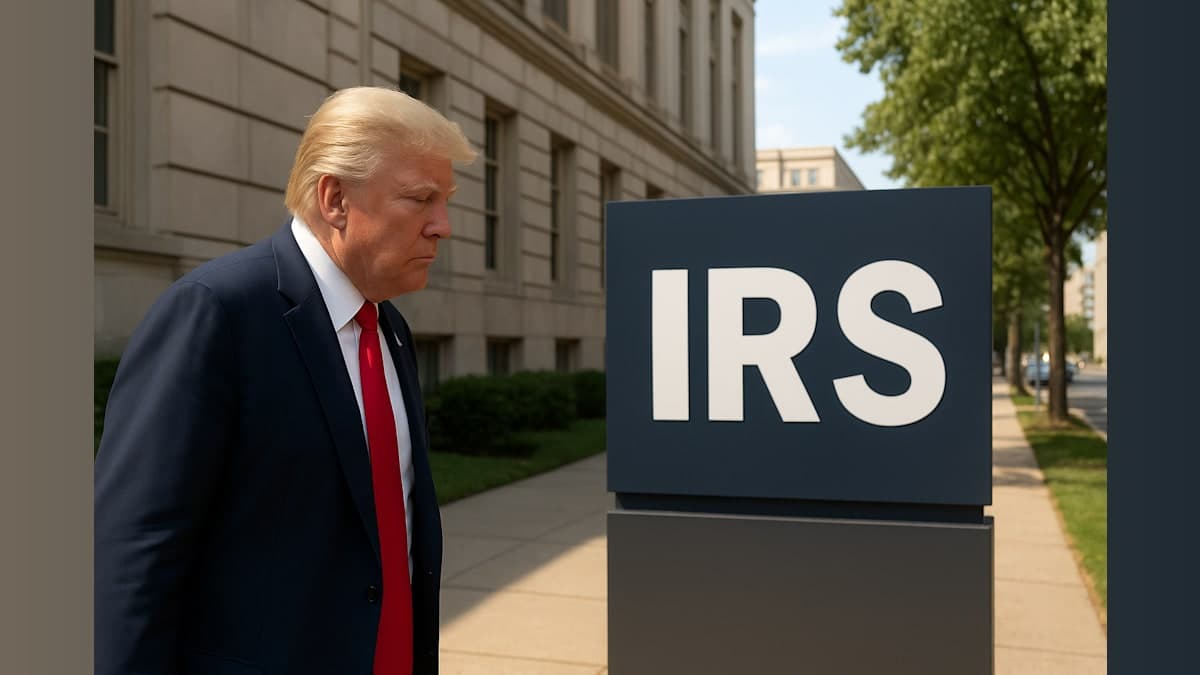
President Trump is moving to dismiss a $10 billion lawsuit he filed against the Internal Revenue Service over the leak of his tax returns, according to a court filing. The development could pave the way for a substantial settlement with the government he currently leads, even as ethics watchdogs and Democrats in Congress attempt to intervene in the matter.
Trump and the Trump Organization initiated legal action against the Internal Revenue Service and the Treasury Department in January, demanding $10 billion in damages over the unauthorized disclosure of his tax returns that occurred several years ago. The lawsuit has drawn scrutiny from legal experts who have questioned both its merits and the unusual circumstances surrounding potential settlement negotiations.
Legal scholars have characterized the case as fundamentally weak, noting that the leak has been attributed to a federal contractor rather than a full-time employee of the United States government. That individual is currently serving prison time for the unauthorized disclosure. Additionally, experts have raised questions about whether the statute of limitations might have expired, given that the leaks of tax information occurred between 2018 and 2020.
The Justice Department recently informed the court that it had entered negotiations to resolve the dispute. This development has raised significant ethical concerns, as any settlement would result in the government Trump leads paying him personally.
U.S. District Judge Kathleen Williams of Miami, who is presiding over the case, has expressed her own reservations about the proceedings. In a ruling issued last month, Judge Williams highlighted the unprecedented nature of the situation, citing Trump's own acknowledgment of the unusual dynamics at play.
"Although President Trump avers that he is bringing this lawsuit in his personal capacity, he is the sitting president and his named adversaries are entities whose decisions are subject to his direction," Judge Williams wrote. "Indeed, President Trump's own remarks about this matter acknowledge the unique dynamic of this litigation. Accordingly, it is unclear to this Court whether the Parties are sufficiently adverse to each other so as to satisfy Article III's case or controversy requirement."
The Justice Department maintains an established process for evaluating claims from individuals who allege they have been harmed by the federal government. Under normal circumstances, these claims are assessed by career lawyers and rarely involve high-profile matters such as those connected to Trump.
Rupa Bhattacharyya, a former Justice Department lawyer who evaluated these types of allegations, provided context for the typical scope of such claims. "Some of them are run-of-the-mill, right?" Bhattacharyya explained. "Postal vehicles get into traffic accidents, Veterans Affairs doctors have malpractice claims brought against them, people slip and fall in federal buildings."
Even in the most serious cases, including those involving injuries to individuals cleaning up after the terrorist attack on September 11, 2001, Bhattacharyya noted that payouts almost never exceeded $10 million. The $10 billion figure Trump is seeking represents an amount one thousand times larger than these precedents.
Edward Whelan, a prominent conservative lawyer and former Justice Department attorney who once clerked for the late Justice Antonin Scalia, suggested that the litigation should be paused until Trump leaves the White House. Whelan emphasized the inherent conflict of interest in the current arrangement.
"There is a glaring conflict of interest with Trump being on both sides of the claim," Whelan stated. "It is outrageous that he and those answering to him would be deciding how the government responds to these extravagant claims."
The case raises fundamental questions about the separation between personal and presidential interests, particularly when the executive branch maintains control over the agencies being sued. As settlement negotiations continue, the matter remains under judicial scrutiny, with Judge Williams maintaining oversight of the proceedings to ensure constitutional requirements are met.