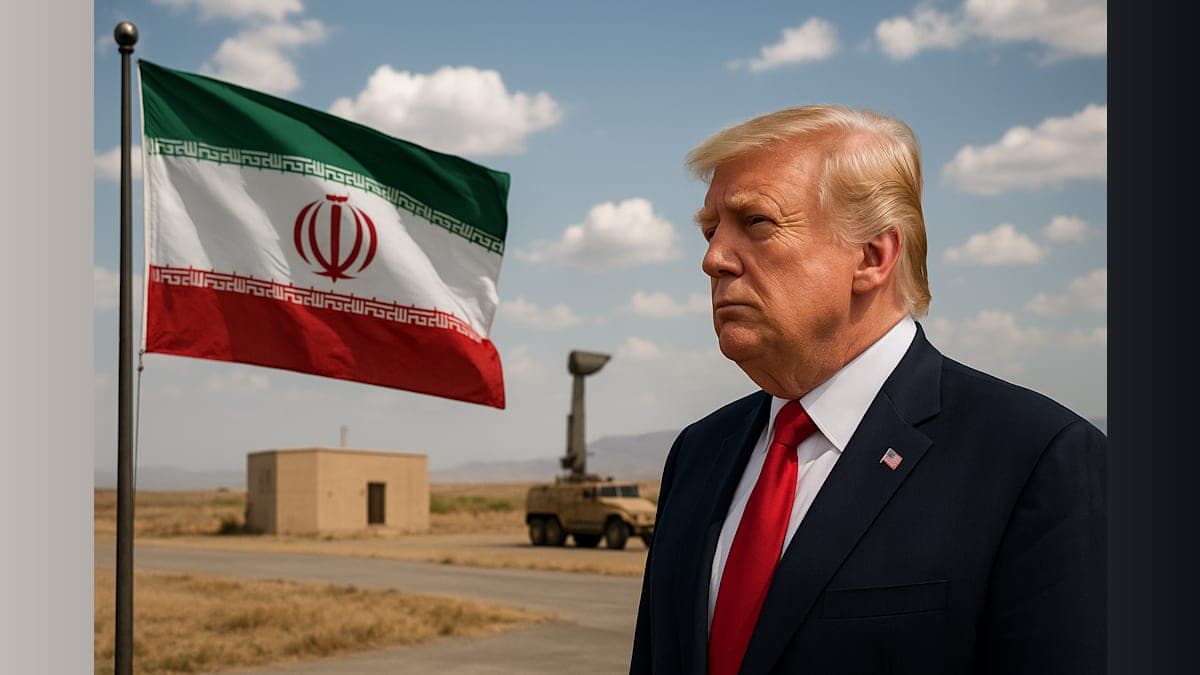
President Donald Trump has built his political identity on dealmaking prowess and the ability to bend adversaries to his will. Yet Iran has proven resistant to that approach, leaving the United States locked in a precarious standoff that has rattled global energy markets and regional stability for more than six weeks.
On Monday, Trump announced he had called off a planned military strike at the request of Gulf Arab allies. He then stated that "serious negotiations are now taking place," adding that multiple regional partners — the United Arab Emirates, Qatar and Saudi Arabia — had told him they believed "a deal will be made, which will be very acceptable to the United States of America."
The announcement represents the latest turn in what has become a recurring pattern during this conflict: a deadline, a threat, a pullback, another threat. Even as Trump declared the pause, he instructed his military commanders to remain on standby for "a full, large-scale assault of Iran, on a moment's notice, in the event that an acceptable Deal is not reached."
The Conflict's Origins and Trajectory
Since the United States and Israel launched military strikes on Iran in late February, a 38-day military campaign has given way to a fragile ceasefire, a mutual blockade centered on the Strait of Hormuz, and a cycle of stalled negotiations punctuated by Trump's repeated threats to resume large-scale attacks.
Three of Trump's core stated war aims remain unmet: Iran abandoning its nuclear program, halting ballistic missile development, and ending support for Iran's proxy forces in Gaza, Iraq, Lebanon, and Yemen. The impasse has left governments, militaries, corporations and communities around the world asking what Trump will do next.
Iran's response to the latest White House pause was hardly conciliatory. "Our armed forces' fingers are on the trigger, while diplomacy is also continuing," Mohsen Rezaei, a military adviser to Iran's supreme leader, said on state television.
The Strait of Hormuz: A Critical Chokepoint
Central to the standoff is the Strait of Hormuz, through which roughly one-fifth of the world's oil and natural gas moved before the conflict began. Iran's effective closure of the waterway, even as the United States continues to enforce its own blockade on Iranian ports, has sent energy prices higher worldwide and created direct consequences for American consumers.
Iran's ability to threaten one of the world's most critical energy chokepoints presents a fundamentally different challenge than other adversaries Trump has confronted. The leverage Iran holds over global energy flows complicates any straightforward application of maximum pressure tactics.
A Waiting Game With High Stakes
Another challenge is that both sides believe that playing the waiting game will ultimately work in their favor. Vali Nasr, a scholar of Iranian politics at Johns Hopkins University's School of Advanced International Studies, told NPR's Morning Edition that the current leadership in Tehran has drawn a sharp distinction between Trump's military threats, which Iranian officials consider sincere, and his invitations to conduct diplomacy, which they do not.
"Iran does not take him seriously when he says he wants to negotiate," Nasr said, adding that Iranian officials have read U.S. diplomatic signals as a strategy designed to buy time and sow internal confusion rather than reach a genuine agreement. On several occasions, the U.S. and Israel have launched attacks against Iran amid negotiations.
On the question of whether the conflict could settle into a prolonged frozen standoff, Nasr expressed skepticism that the current impasse will hold. "The Strait of Hormuz cannot remain closed indefinitely, and the U.S. cannot maintain this blockade indefinitely," he said, citing the toll on the broader global economy as well as the limits of America's naval capabilities. "I don't think we're talking months — maybe a month."
Nuclear Ambitions and Uncertain Outcomes
Despite its battlefield losses, Iran has managed to keep its governing operations mostly intact and its grip on the Strait largely in place. Questions remain over Iran's long-term nuclear ambitions that the country's leaders have long insisted are civilian in nature. Trump has at times threatened to destroy them, but the government in Tehran is insistent on its right to develop peaceful nuclear energy.
The White House maintains that its current posture has been successful. "President Trump holds all the cards and wisely keeps all options on the table," White House spokesperson Olivia Wales repeatedly insisted to reporters this week.
As the standoff continues, the fundamental question remains unanswered: whether Trump's signature dealmaking approach can succeed where traditional diplomacy has failed, or whether Iran's strategic position and willingness to endure pressure will force a different outcome entirely. With both sides dug in and global stakes mounting, the coming weeks will prove critical in determining the trajectory of this high-stakes confrontation.