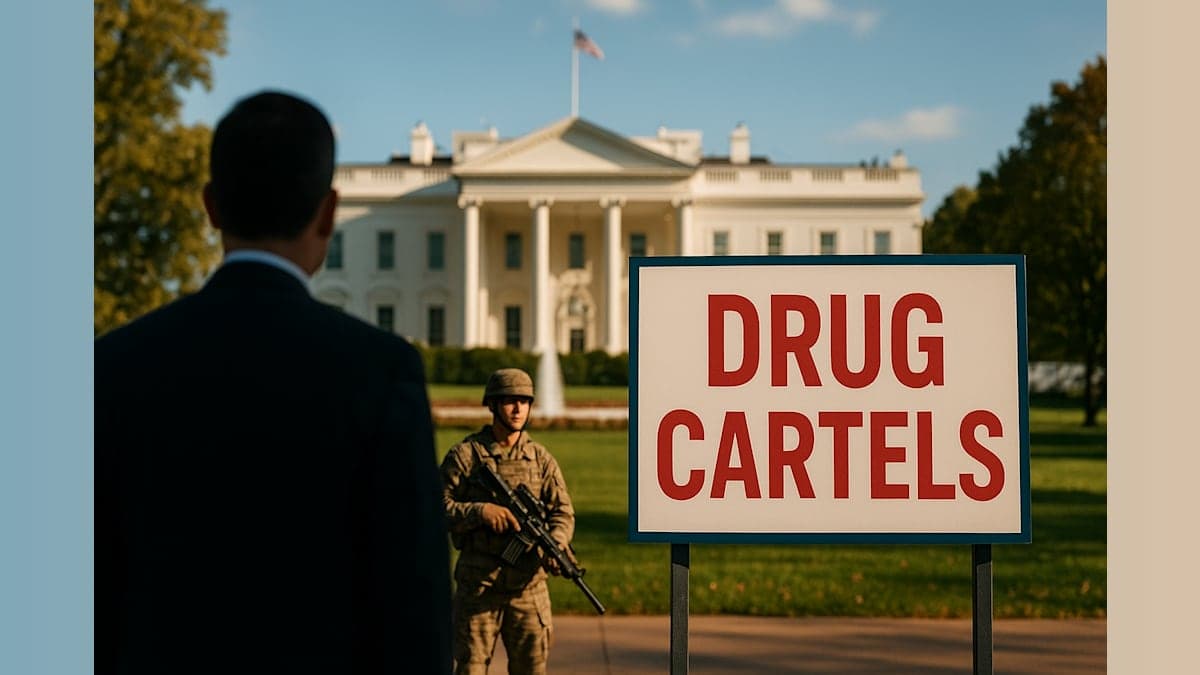
President Donald Trump signed a new United States counterterrorism strategy on Wednesday that fundamentally reorients national security priorities, placing the elimination of drug cartels in the Western Hemisphere at the forefront of American efforts. The announcement represents a dramatic departure from traditional counterterrorism frameworks that have historically focused on overseas threats.
The 16-page document arrives months after the administration released an updated national security strategy identifying the hemisphere as the paramount focus for United States interests. In his written statement accompanying the strategy, Trump declared: "We will not let cartels, Jihadists, or the governments who support them plot against our citizens with impunity. Terrorists of any kind will not be allowed to find safe harbor here at home or attack us from abroad."
Sebastian Gorka, the White House counterterrorism czar who led development of the new strategy, provided stark justification for the policy shift during a telephone briefing with reporters. He noted that drug cartels have killed more Americans through illicit narcotics than the number of service members lost in all conflicts worldwide since World War II. This sobering calculation underscores the administration's rationale for treating cartel operations as a national security emergency rather than solely a law enforcement matter.
"Whether it is strangling their illicit funds, whether it is tracking their drug boats, we will not permit them to kill Americans on a massive scale," Gorka stated, outlining the administration's multipronged approach to dismantling cartel infrastructure and operations.
The strategy announcement comes amid an aggressive campaign of military action in the region. Since early September, the Republican administration has conducted operations targeting alleged drug-trafficking vessels in Latin American waters, resulting in at least 191 deaths. These strikes represent a significant escalation in direct military engagement with cartel operations, moving beyond traditional interdiction and law enforcement cooperation.
The administration has simultaneously pursued diplomatic pressure on regional governments, urging leaders throughout the hemisphere to intensify their own military operations against drug traffickers and transnational criminal organizations. Trump has characterized these groups as posing an "unacceptable threat" to hemispheric security, calling for coordinated multinational action.
Recent administration actions in the region include the ouster of Nicolás Maduro as Venezuela's president, increased pressure on Cuba's communist government, and dozens of military strikes on vessels allegedly operated by cartels. These moves demonstrate the administration's willingness to employ both diplomatic and military tools to reshape regional dynamics.
Beyond the cartel focus, the counterterrorism strategy outlines three additional priority areas. The administration will target and destroy Islamic military groups possessing operational capabilities against the United States. Officials will also work to identify and neutralize what the document describes as violent secular political groups with anti-American ideology, including those characterized as radically pro-transgender or anarchist. Finally, the strategy emphasizes preventing nonstate actors from acquiring weapons of mass destruction.
Gorka indicated that administration officials would convene with allied nations later this week to discuss enhanced counterterrorism cooperation. He emphasized that the United States would evaluate partnerships based on tangible contributions rather than symbolic support.
"As the president made very clear, we will measure your seriousness as a partner and ally by how much you bring to the table," Gorka stated. "So we expect more — from our partners in the Middle East, as well as elsewhere."
The strategy's release underscores the administration's determination to maintain focus on Western Hemisphere security even as global crises demand attention elsewhere. By formally designating cartel elimination as the top counterterrorism priority, the White House signals a fundamental reorientation of resources, intelligence capabilities, and military assets toward addressing threats closer to American borders.