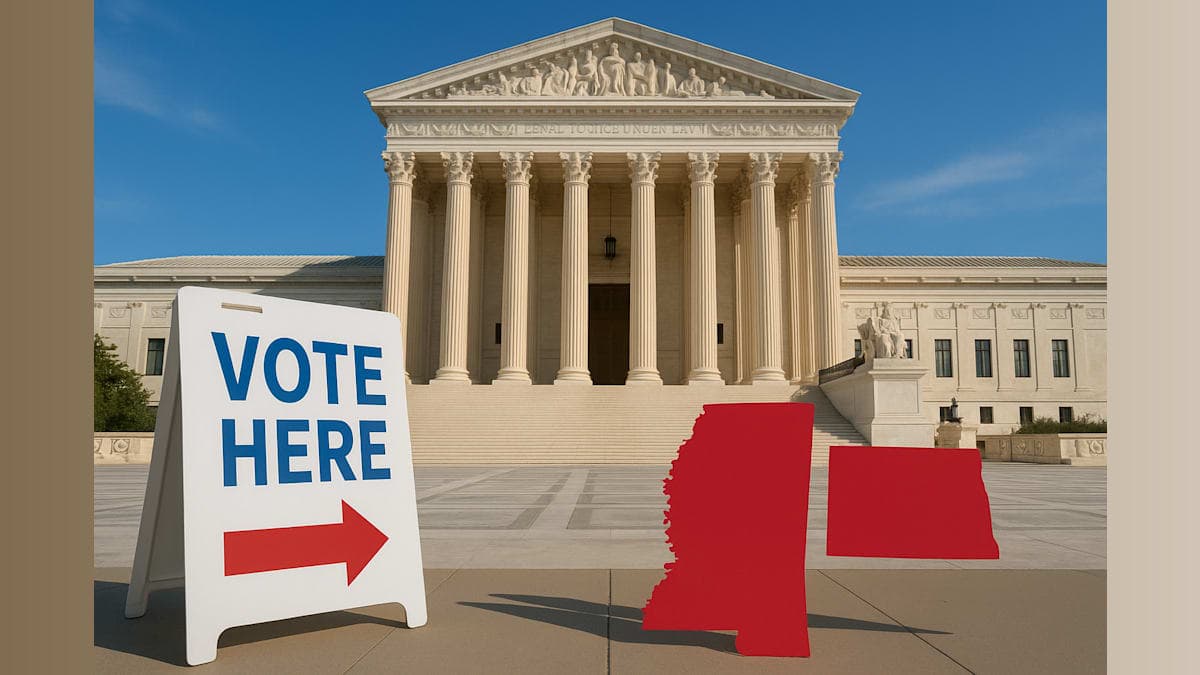
In a brief, unsigned order issued Monday, the United States Supreme Court declined to address a legal question that could fundamentally alter how the Voting Rights Act is enforced, instead returning cases involving Mississippi and North Dakota state legislative maps to lower courts for reconsideration.
The decision represents a strategic retreat from what could have been the next major Supreme Court battle over the landmark 1965 law, coming just weeks after the court significantly weakened the statute in its April ruling in Louisiana v. Callais. That decision diminished protections against racial discrimination in redistricting and reignited the congressional gerrymandering battle sparked by President Trump ahead of the 2026 midterm election to help Republicans keep control of the House of Representatives.
At the heart of the Mississippi and North Dakota cases lies a novel argument advanced by Republican officials: that private individuals and advocacy groups lack the legal authority to sue under Section 2 of the Voting Rights Act, leaving enforcement solely to the United States attorney general. Section 2 has historically been enforced primarily through lawsuits brought by voters and civil rights organizations, who have filed hundreds of challenges to voting district maps and other election procedures over the decades.
Legal experts indicate that such an interpretation would lead to far fewer Section 2 lawsuits. The question of what the legal community refers to as a "private right of action" under Section 2 now remains unresolved at the Supreme Court level, though lower courts will reconsider the cases in light of the Callais ruling.
Justice Ketanji Brown Jackson issued dissents from Monday's order, criticizing the decision to vacate earlier lower court rulings in both cases. Jackson emphasized that the Supreme Court's ruling in the Callais case did not address the legal question of Section 2's enforceability by private individuals and groups. "Thus I see no basis for vacating the lower court's judgment," Jackson stated in her dissent.
The enforcement question extends beyond Section 2. Section 208 of the Voting Rights Act generally allows voters who need help to vote because of a disability or inability to read or write to get assistance from a person of their choice. However, a panel of the 8th United States Circuit Court of Appeals has found that private groups and individuals cannot sue to enforce Section 208 in a case challenging an Arkansas law. The same federal appeals court also ruled against a private right of action under Section 2 in the North Dakota legislative redistricting case.
Chief Judge Steven Colloton, a nominee of former President George W. Bush, dissented from the 8th Circuit's decision not to review the panel's decision in the Arkansas case. In his opinion, Colloton wrote that the 8th Circuit continues on a "regrettable path of rendering unenforceable, in this circuit alone, the voting rights law that many have considered 'the most successful civil rights statute in the history of the Nation.'"
A Supreme Court brief on the Arkansas case is due Monday as the justices prepare to decide whether to take it up. The outcome could determine whether the enforcement mechanisms that have sustained the Voting Rights Act for decades will remain available to those most directly affected by voting discrimination.