
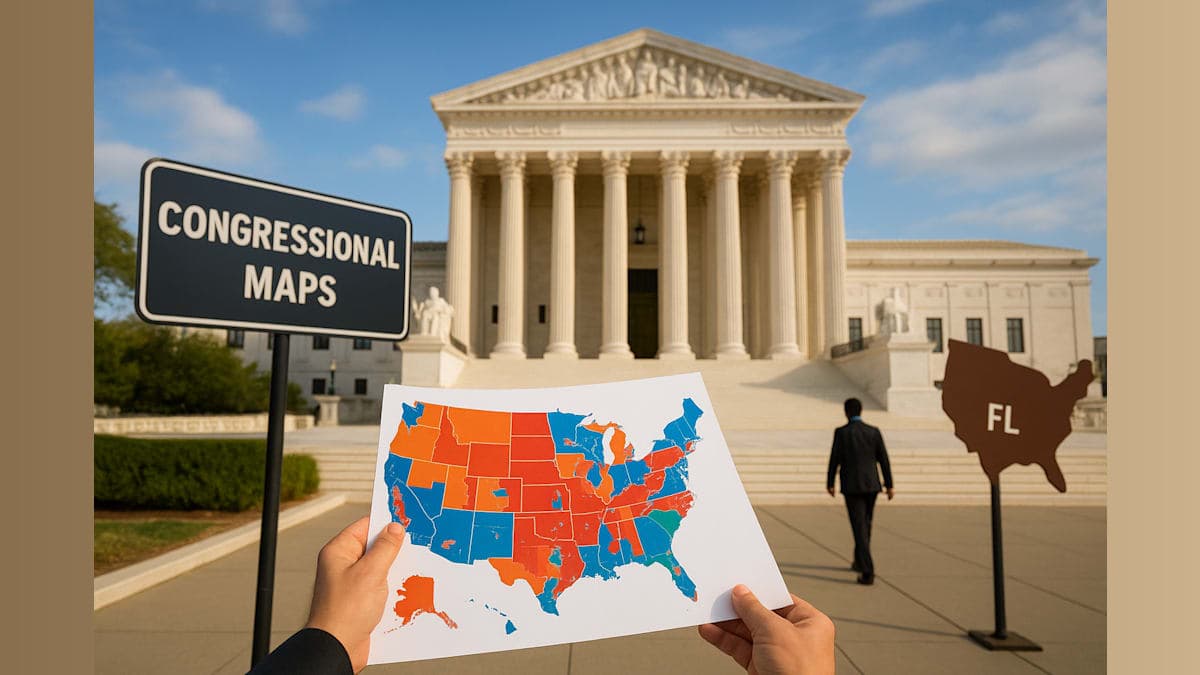
A tumultuous week of court rulings has dramatically altered the congressional redistricting landscape, dealing Democrats a significant blow while empowering Republican-led states to redraw voting maps in ways that could determine control of the U.S. House of Representatives this fall.
On Friday, the Supreme Court of Virginia delivered a major setback to Democrats by nullifying the results of an April 21 special election in which 1.6 million Virginians approved a redistricting measure. The 4-3 ruling determined that the legislature followed improper procedures for placing the constitutional amendment on the ballot. Democrats had anticipated the redistricting would yield four additional House seats.
The Virginia decision came amid a broader redistricting upheaval triggered by the U.S. Supreme Court's April 29 ruling in Louisiana v. Callais, which weakened voting rights protections for minority communities. The decision has prompted Republican-controlled Southern states to rapidly redraw congressional maps, fundamentally reshaping the electoral battlefield President Trump initiated last year to maintain Republican control of the House.
Southern States Move Swiftly on Redistricting
The response to the Louisiana v. Callais ruling has been swift and dramatic. In Louisiana, Republican Governor Jeff Landry took the extraordinary step of suspending the May 6 congressional primaries, even after early votes had already been cast. Republican-led legislatures in Alabama and Tennessee convened special redistricting sessions within four days of the Supreme Court decision, while South Carolina Republicans have initiated steps toward redrawing their maps.
The rapid redistricting efforts have sparked widespread protests, with demonstrators flooding capitol buildings in Montgomery, Alabama and Nashville. Civil rights activists and Democratic lawmakers have condemned the redistricting as an attempt to dilute the voting power of Black voters, invoking the South's history prior to the civil rights movement.
Tennessee Republicans have already granted fast-track approval to a map that could flip the state's only Democratic-held seat. Alabama lawmakers have approved redistricting measures, though implementation remains pending court approval. Voting rights organizations have responded by preparing and filing lawsuits aimed at halting these redistricting efforts.
Unprecedented Mid-Decade Redistricting
The current redistricting wave represents an unprecedented mid-decade shuffle. Traditionally, states redistrict only after the decennial census, when congressional seats are reapportioned among states. While gerrymandering—the practice of drawing districts to favor one party—is common during those periods, mid-decade redistricting remains highly unusual.
President Trump initiated this extraordinary redistricting push last summer, successfully persuading Texas Republicans to pass a new map potentially yielding five additional seats. Democrats in California countered with their own map designed to flip five seats. Republicans responded to Trump's call in Missouri and North Carolina for one seat each, and last month in Florida for four seats. Redistricting efforts in Kansas and Indiana failed to gain sufficient support.
Prior to the recent Supreme Court ruling, Republicans had positioned approximately 13 House seats in their favor through redistricting. Democrats had secured about 10 seats, but the loss of four anticipated seats in Virginia—barring a successful court reversal—significantly alters the calculus. Before the ruling, Republicans held a redistricting advantage of perhaps three seats over Democratic efforts. Following the Virginia loss, that lead could expand to around 10 seats, though the full extent of redistricting in some states remains uncertain.
High Stakes for House Control
The redistricting battle carries enormous implications for the balance of power in Washington. The House currently stands at 217 Republicans to 212 Democrats, a narrow margin that makes every seat critical. Historical patterns suggest the party controlling the White House typically loses ground in midterm elections, making Republican retention of the House far from guaranteed without strategic redistricting.
Republican control of the House remains essential to President Trump's legislative agenda. Trump himself has stated that a Democratic House would pursue impeachment proceedings against him, underscoring the political stakes of the redistricting efforts.
With several states having already conducted their primaries, Democrats face limited options for drawing new maps. Maryland's Democratic Governor Wes Moore has called for redistricting in that state, and pressure is mounting on a powerful Democratic Senate leader to abandon opposition and permit redistricting efforts. However, time is running short as the fall midterm elections approach, leaving the ultimate impact of this redistricting wave still to be determined.