
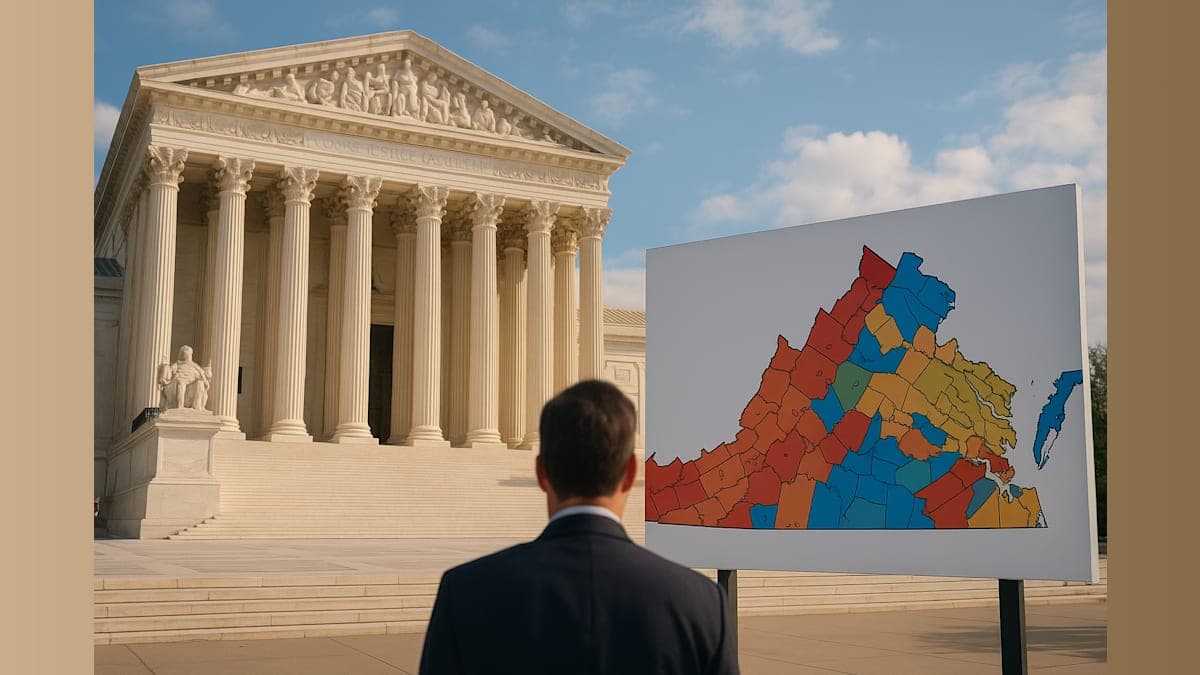
The U.S. Supreme Court delivered a significant blow to Virginia Democrats on Friday, refusing to allow the state to use new congressional maps that would have favored Democratic candidates in all but one of Virginia's U.S. House seats. The decision represents a critical setback in the Democratic Party's efforts to counter Republican redistricting initiatives across the nation.
The contested map had been drawn by Democrats and subsequently approved by Virginia voters in an April referendum. However, the Supreme Court of Virginia declared both the referendum and the new map null and void on May 8 in a 4-to-3 decision. The state's highest court determined that lawmakers had failed to follow proper constitutional procedures when placing the issue on the ballot, thereby violating the state constitution.
Virginia Democrats and the state's attorney general mounted an emergency appeal to the U.S. Supreme Court, seeking to implement the voter-approved map that would have created four additional likely Democratic congressional seats. In their application, they argued the Virginia Supreme Court was "deeply mistaken" in its decision on "critical issues of federal law with profound practical importance to the Nation." They further contended the ruling "overrode the will of the people" by ordering Virginia to "conduct its election with the congressional districts that the people rejected."
Republican legislators countered that federal court intervention would be inappropriate in what they characterized as a purely state law controversy. They emphasized that Democrats had not raised any federal claims in the lower court proceedings, making Supreme Court involvement unwarranted.
The U.S. Supreme Court ultimately sided with Republicans without providing an explanation, leaving the state court ruling intact and effectively killing the Democratic-friendly maps.
This decision continues a pattern of high-stakes redistricting interventions by the nation's highest court. In December, the Supreme Court permitted Texas to use a gerrymandered map that could help the Republican Party win five additional seats in the U.S. House. The following February, the court allowed California to implement a voter-approved, Democratic-friendly map designed to offset the Texas redistricting. In March, the court blocked the redrawing of a New York map that was expected to flip a Republican congressional district to Democratic control.
Perhaps most significantly, the Supreme Court ruled in April that a Louisiana congressional map constituted a racial gerrymander and must be redrawn. That decision immediately triggered a wave of redistricting efforts, particularly across the South, where Republican legislators began redrawing congressional maps to eliminate long-established majority Black and Hispanic districts.
The Virginia decision underscores the critical role redistricting plays in determining congressional control and the extent to which both parties are willing to pursue aggressive legal strategies to secure electoral advantages. With the Supreme Court demonstrating a willingness to intervene in some redistricting disputes while declining involvement in others, the legal landscape surrounding congressional maps remains highly uncertain and politically charged.
For Virginia voters, the ruling means the state will conduct its next congressional elections using the existing district boundaries rather than the voter-approved alternative. The decision effectively nullifies the will of the electorate as expressed in the April referendum, raising questions about the balance between procedural requirements and direct democracy in the redistricting process.