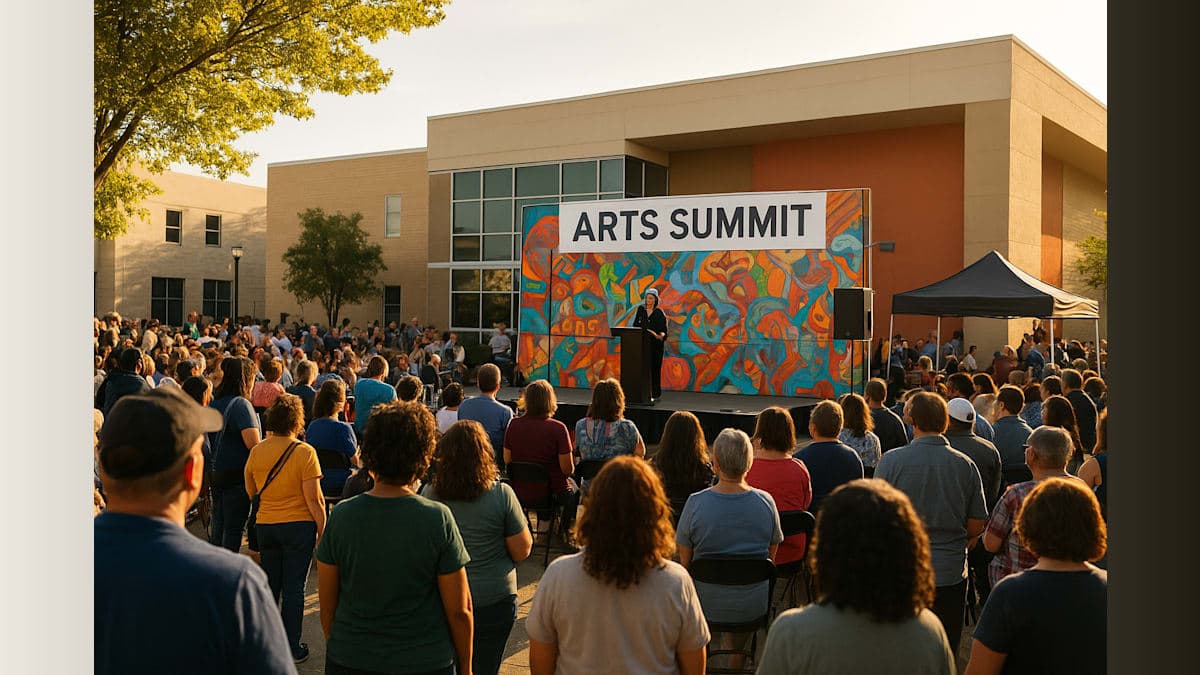
Our community witnessed the transformative power of public art this month as more than 200 people gathered for Stockton University's third annual Arts and Culture Summit. The event, held April 9 and 10 across the university's Galloway and Atlantic City campuses, marked a significant expansion from previous years — growing from a single-day gathering to a two-day celebration of creativity and community engagement.
Jane Golden, founder and executive director of Mural Arts Philadelphia, served as the summit's keynote speaker and delivered this year's 17th annual Paul Lyons Memorial Lecture on April 9 in the Performing Arts Center. Her message resonated deeply with attendees: the arts aren't just decoration — they're catalysts for genuine community transformation.
Golden leads the nation's largest public arts program, which has created more than 4,000 works through collaborations with community organizations, city agencies, schools, nonprofits and the private sector. The numbers tell a compelling story: more than 25,000 Philadelphia residents have participated in Mural Arts programs or tours, and more than 250 artists have found employment through the initiative.
"It's about impacting individuals. It's about impacting the community and by extension there is a huge impact on the civic life of the city of Philadelphia because we have turned our city into an outdoor museum," Golden explained. "But it's a museum that values and respects the citizens. We're creating work that has true resonance with the people who live here."
The summit's expansion reflects its growing importance to our region. New Jersey State Rep. Antwan McClellan welcomed Atlantic City attendees on April 10, emphasizing the vital role cultural organizations play in strengthening communities.
"Arts and cultural organizations play a critical role in strengthening our communities, and that creates spaces where people can come together and engage one another and participate in something meaningful," McClellan said. "And right here at Stockton University, that happens every day. Stockton is not just educating students; they're actively shaping cultural ecosystems. That reaches beyond the campus and beyond Atlantic County."
This year's theme, "Culture, Community & Care," shaped panel discussions throughout the summit, including "Public Art as Civic Voice," "Culture as Community Care" and "Creative Practice and Public Health." President Joe Bertolino connected the theme to his Ethic of Care philosophy, which emphasizes treating everyone with dignity, respect, kindness, compassion and civility.
"The arts play a local role in that work because the arts are a language that goes across all peoples," Bertolino said. He noted that art uniquely connects us across different experiences and perspectives, inviting us to see the world through someone else's eyes and recognize our common humanity.
"Artists help us make sense of the world. They illuminate stories that might otherwise go unheard, and they create spaces where dialogue can happen, where empathy can grow and where a new idea can take root," he said. "And where better to do that than at a university."
The summit was originally created as part of Bertolino's inauguration three years ago, but its continued success demonstrates its value to the local arts community. The president emphasized Stockton's role as an Anchor Institution, deeply connected to Atlantic County and committed to creating meaningful change.
Golden's journey with Mural Arts Philadelphia offers lessons for our own community. When she started the program 40 years ago, community planners were skeptical about prioritizing outdoor art over housing and jobs. Today, Philadelphia completes more than 140 public arts projects annually, covering more than 141,000 square miles with murals.
"They were not interested in art. They wanted housing. They wanted jobs, and rightfully so," Golden recalled. "But now, people see art as extremely invaluable in the city of Philadelphia. I'm not saying that everything we do is a panacea for issues that cities struggle with, but I am saying that I've been a witness to the powerful catalytic world of art in the life of the city."
The summit concluded with a vibrant new addition: the Hip Hop Block Party in O'Donnell Park, directly across from Stockton's Atlantic City campus. Presented by Professor Donnetrice Allison's "Intro to Hip Hop Culture" class, the event featured live music, breakdance performers, games and activities — all free and open to the public.
Allison, who also presented a workshop titled "From Jazz to Hip Hop" during the summit, explained the significance of hosting the block party in a public park rather than a ticketed venue.
"A lot of early hip hop was about parks and free spaces that you can use rather than people having to pay to get into a club," she said. "There were mobile DJs who would bring their stuff out and then people could celebrate for free. So, we wanted to re-create that, and the students encouraged the idea of going back to the roots of hip hop in the parks."
As our region continues to grow and evolve, events like the Arts and Culture Summit remind us that investing in creativity isn't a luxury — it's essential to building the kind of community where everyone can thrive. The expansion to two days signals that our appetite for meaningful cultural engagement is only growing stronger.