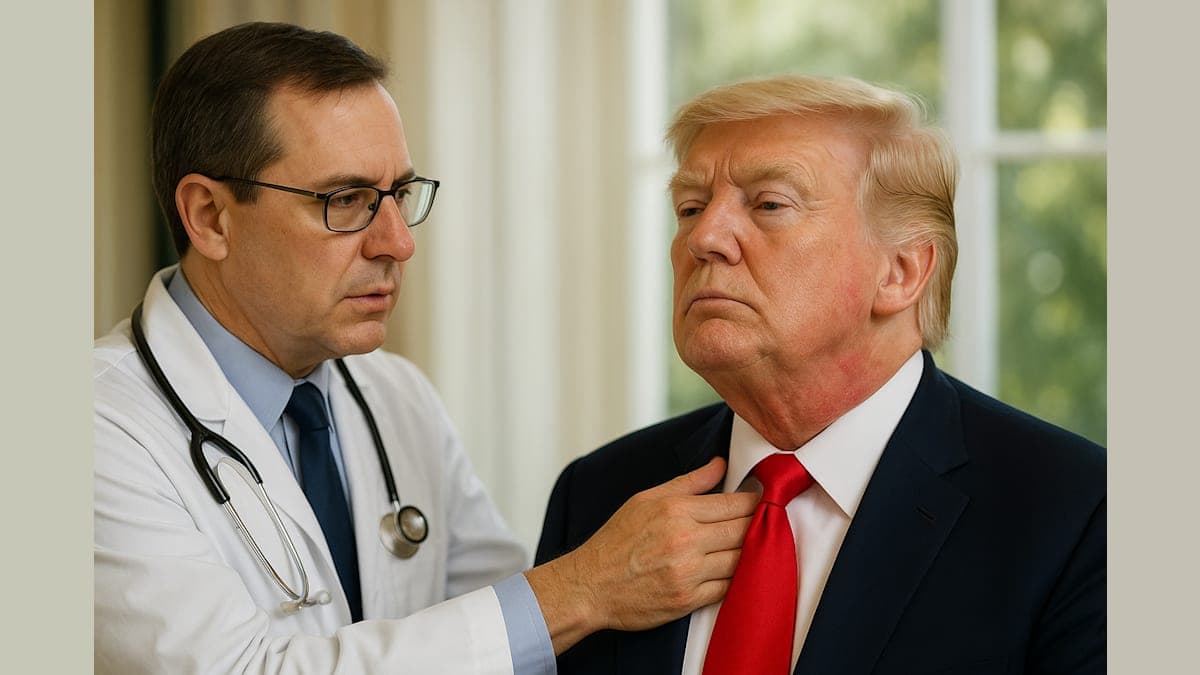
President Donald Trump's physician has addressed questions surrounding a visible skin condition that has appeared on the president's neck in recent weeks, confirming that the commander-in-chief is utilizing a preventative dermatological treatment.
Dr. Sean Barbabella, the president's physician, issued a statement to media outlets on Monday, March 2, explaining that the president is applying a commonly prescribed topical cream to the right side of his neck. The medical professional characterized the treatment as preventative in nature, though he did not elaborate on the specific condition being addressed or the medical rationale behind the intervention.
According to Dr. Barbabella's statement, the treatment regimen is scheduled to continue for one week, with the associated redness anticipated to persist for several weeks following the completion of therapy. The physician's disclosure follows public observation of what appeared to be a red rash with visible scabbing on the posterior right side of the president's neck during Monday's Medal of Honor Ceremony at the White House.
The skin condition was notably visible near the president's hairline and extended downward to the collar of his shirt during the ceremonial proceedings. The White House has not issued additional commentary regarding the matter beyond the physician's medical statement.
Pattern of Health Disclosures
This development represents the latest in a series of health-related disclosures concerning the 79-year-old president, who holds the distinction of being the oldest individual to assume the office of the presidency. Previous instances have included visible bruising on the president's hands, which White House officials have attributed to various causes.
White House Press Secretary Karoline Leavitt addressed the hand bruising during a February 2025 press conference, stating that the discoloration resulted from the president's extensive schedule of public engagements and frequent handshaking with constituents and officials. Leavitt characterized the bruising as evidence of Trump's commitment to direct engagement with the American public.
In a subsequent disclosure in July 2025, Dr. Barbabella revealed that President Trump had been diagnosed with chronic venous insufficiency following reports of mild swelling in his lower legs. The condition, which affects the proper functioning of leg veins, was characterized by the physician as benign and relatively common among individuals over the age of 70. Dr. Barbabella emphasized at that time that the president remained in excellent overall health despite the diagnosis.
Medication Regimen Disclosed
President Trump himself has provided insight into factors contributing to his bruising. During a January 2026 interview with the Wall Street Journal, the president disclosed that he takes 325 milligrams of aspirin daily, a dosage that falls within the standard range for aspirin therapy as defined by medical guidelines from the Mayo Clinic, which recommends between 75 and 325 milligrams per day.
The president explained his rationale for the aspirin regimen in characteristically direct terms, stating that the medication serves to thin the blood and promote cardiovascular health. Medical professionals widely recognize aspirin therapy as a preventative measure for certain cardiovascular conditions, though the medication is known to increase susceptibility to bruising due to its blood-thinning properties.
In a separate incident later in January, Press Secretary Leavitt addressed bruising that appeared on the president's left hand rather than his customary right hand, which he typically uses for handshaking. This particular bruise was attributed to an accidental impact with the corner of a table, according to the White House spokesperson.
Presidential Health Transparency
The ongoing attention to President Trump's health matters reflects broader public interest in the wellbeing of the nation's chief executive, particularly given his status as the oldest sitting president in American history. While the White House has provided explanations for various visible health indicators, the lack of comprehensive detail in some instances has generated continued scrutiny from medical professionals and political observers.
The current neck treatment, described as preventative by Dr. Barbabella, represents a proactive approach to dermatological care. However, the absence of specific information regarding the underlying condition being treated or prevented leaves questions about the medical necessity and nature of the intervention.
As the treatment continues and the associated redness gradually subsides over the coming weeks, the White House has indicated no immediate plans to provide additional medical details beyond the physician's initial statement. The administration maintains that the president continues to fulfill his duties without impairment and remains in good health overall.