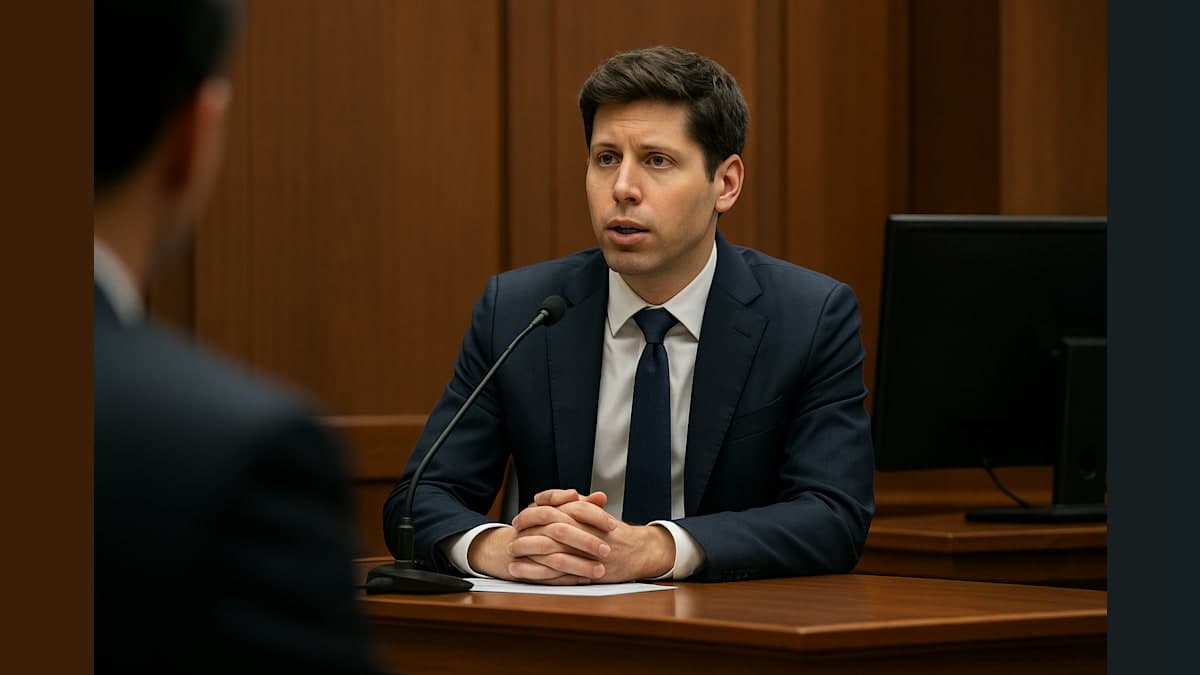
OpenAI Chief Executive Officer Sam Altman took the witness stand on Tuesday to defend himself against explosive accusations from co-founder-turned-adversary Elon Musk that he "stole a charity" by transforming the maker of ChatGPT into a for-profit powerhouse.
The trial, now in its third week at the federal courthouse in Oakland, California, represents a high-stakes confrontation between two of the technology industry's most prominent figures. The outcome could fundamentally alter the structure of one of the world's leading artificial intelligence companies and potentially reshape the broader AI landscape.
Musk's legal team has constructed a narrative alleging that Altman, OpenAI president Greg Brockman, and their partner Microsoft abandoned the company's founding mission. Originally established as a nonprofit focused on creating advanced AI for the benefit of humanity, OpenAI allegedly transformed into a vehicle for personal enrichment through a for-profit subsidiary that now effectively controls the nonprofit parent organization.
OpenAI's defense team has countered that Musk's motivations stem from competitive jealousy and a desire to damage a rival enterprise. During his testimony Tuesday, Altman directly challenged the notion that Musk genuinely cares about OpenAI's mission.
"Mr. Musk did try to kill it," Altman testified, detailing how Musk launched a competing venture called xAI, attempted to recruit OpenAI talent, and allegedly engaged in "business interference."
The conflict traces its origins nearly a decade back, when OpenAI's founders—including Musk—determined that establishing a for-profit entity was necessary to attract top-tier talent and secure substantial funding for competitive AI technology development. Musk, who contributed $38 million to OpenAI in its early stages, sought control of the for-profit structure. The other founders opposed this arrangement.
Altman testified that the co-founders believed no single individual should control AGI, or artificial general intelligence, and that Musk was not an appropriate fit for the organization. Musk departed the board in 2018, a move Altman characterized as a morale boost for employees who objected to his "hardcore" management approach.
The proceedings have provided an unprecedented glimpse into the internal deliberations of Silicon Valley's most ambitious technology entrepreneurs as they debated artificial intelligence's future and contested investment strategies and organizational control. OpenAI subsequently emerged as a global AI leader following the 2022 launch of ChatGPT.
OpenAI's legal team has leveraged previously private text messages and emails to portray Musk as power-hungry and initially supportive of plans for the for-profit structure to attract substantial investments. The defense also attempted to undermine Musk's credibility by presenting messages suggesting he attempted to recruit OpenAI talent before departing the board, and was kept informed of company decisions after his departure by then-board member Shivon Zilis, who is the mother of four of Musk's children.
Musk's attorneys have argued that Altman and Brockman were determined to extract personal profits from OpenAI despite its original nonprofit mission. While OpenAI's nonprofit entity still exists and owns the for-profit subsidiary—now valued in the hundreds of billions of dollars—Musk contends it has been marginalized.
During cross-examination, Musk's attorney Steven Molo questioned Altman's trustworthiness. "I believe so," Altman responded when asked if he was trustworthy. When Molo inquired whether Altman always told the truth, Altman replied: "I'm sure there are some times in my life when I did not." Asked if business associates had called him a liar, Altman acknowledged: "I have heard people say that."
If the United States District Court for the Northern District of California finds Altman, Brockman, and Microsoft liable for Musk's two civil claims—"breach of charitable trust" and "unjust enrichment"—Musk has requested they "disgorge" up to $150 billion to the nonprofit entity.
Musk is also seeking the dissolution of the for-profit structure and the removal of Altman and Brockman from their leadership positions. Such remedies could fundamentally restructure OpenAI and potentially compromise its artificial intelligence development initiatives.
Closing arguments are scheduled for Thursday, with a decision from an advisory jury and the presiding judge, Yvonne Gonzalez Rogers, possible next week.