
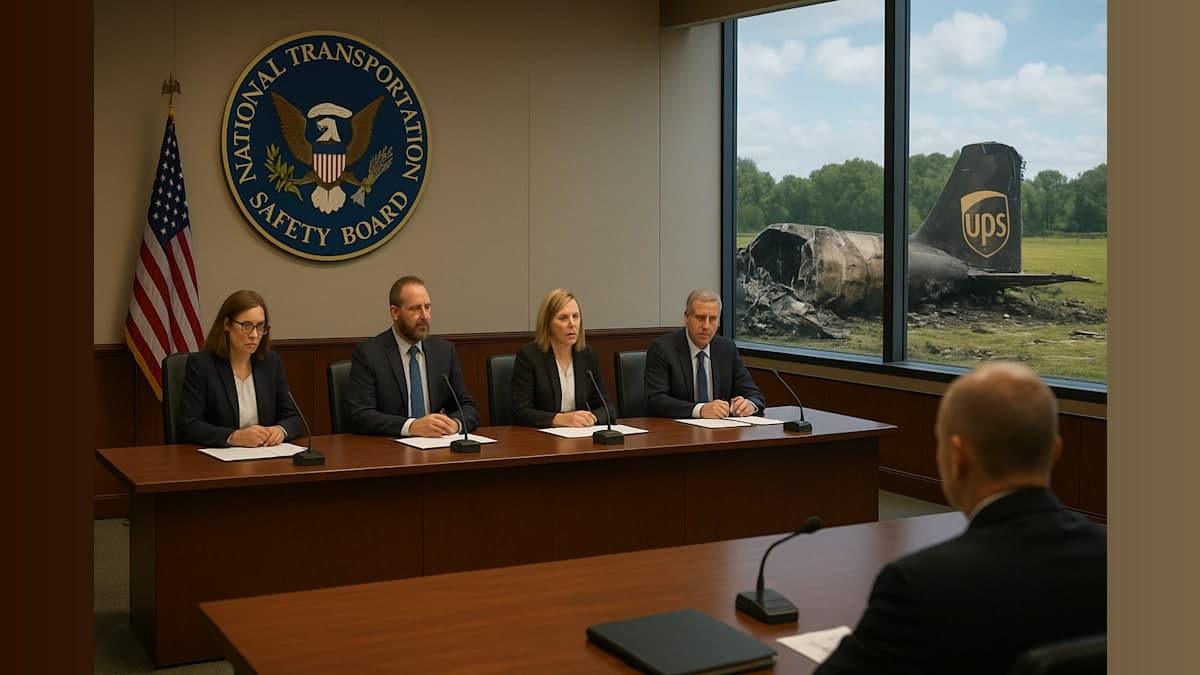
The National Transportation Safety Board will commence a comprehensive fact-finding hearing Tuesday morning to investigate the catastrophic crash of UPS Flight 2976 that occurred last November at Louisville Muhammad Ali International Airport in Louisville, Kentucky. The incident resulted in fifteen fatalities, including all three pilots aboard the cargo aircraft.
The McDonnell Douglas MD-11 cargo plane achieved an altitude of merely thirty feet before crashing shortly after takeoff, according to preliminary findings released by the NTSB. The aircraft was bound for Honolulu carrying a full load of jet fuel when disaster struck. Dramatic photographic evidence released by investigators captured the left engine separating from the wing and flying overhead as the plane rolled down the runway, moments before the aircraft crashed and exploded in a massive fireball.
The two-day hearing at NTSB headquarters will feature testimony from witnesses representing UPS, the Federal Aviation Administration, and Boeing. The MD-11 was originally manufactured by McDonnell Douglas, which Boeing subsequently acquired.
Focus on Engine Mounting System
While NTSB investigators have not yet announced a definitive cause for the crash, an investigative update issued in January directed particular attention to the mounting system that secures the engine to the wing of the MD-11. Investigators revealed that a spherical bearing which had cracked on Flight 2976 had previously failed four times on other aircraft.
According to the NTSB, Boeing issued a warning to aircraft owners in 2011 regarding this specific problem. At that time, Boeing did not assess the issue as a threat to flight safety, investigators noted. However, the company did revise the service manual for the MD-11 to incorporate a visual inspection of the spherical bearing that had failed.
A Boeing spokesperson stated in an email to NPR: "We continue to support the investigation led by the NTSB, including the upcoming investigative hearing. We extend our deepest condolences to those who lost loved ones in this accident."
Grounding and Return to Service
The Federal Aviation Administration grounded all MD-11 aircraft shortly after the crash pending further investigation. Earlier this month, the FAA authorized the planes to return to service following Boeing's issuance of updated instructions to operators.
"After extensive review, the FAA approved Boeing's protocol for safely returning MD-11 airplanes to service," the agency stated last week.
FedEx resumed flying MD-11 jets earlier this month. The company issued a statement noting: "Over the past several months, our airline safety, engineering, and maintenance teams have conducted rigorous safety inspections, maintenance, and planning to prepare our MD-11 fleet to return to service."
According to FedEx, the protocol developed by Boeing includes a new bearing in the engine mount on each side of the aircraft. The company reported that two MD-11s have returned to revenue service thus far, with additional jets scheduled to resume flying after completion of repairs and inspections.
UPS Retires Entire MD-11 Fleet
UPS has taken a different approach, announcing that its MD-11 fleet will remain permanently grounded. CEO Carol Tomé addressed the decision during the company's fourth quarter earnings call in January.
"We made the decision to accelerate our plans and retire all MD-11 aircraft in our fleet," Tomé stated. The company will replace the remaining twenty-six MD-11s in its fleet with more efficient Boeing 767 planes, she explained.
The NTSB hearing represents a critical step in understanding the sequence of events that led to one of the deadliest cargo aircraft accidents in recent years. The findings from this investigation may have significant implications for aviation safety standards and maintenance protocols for aging cargo fleets across the industry.