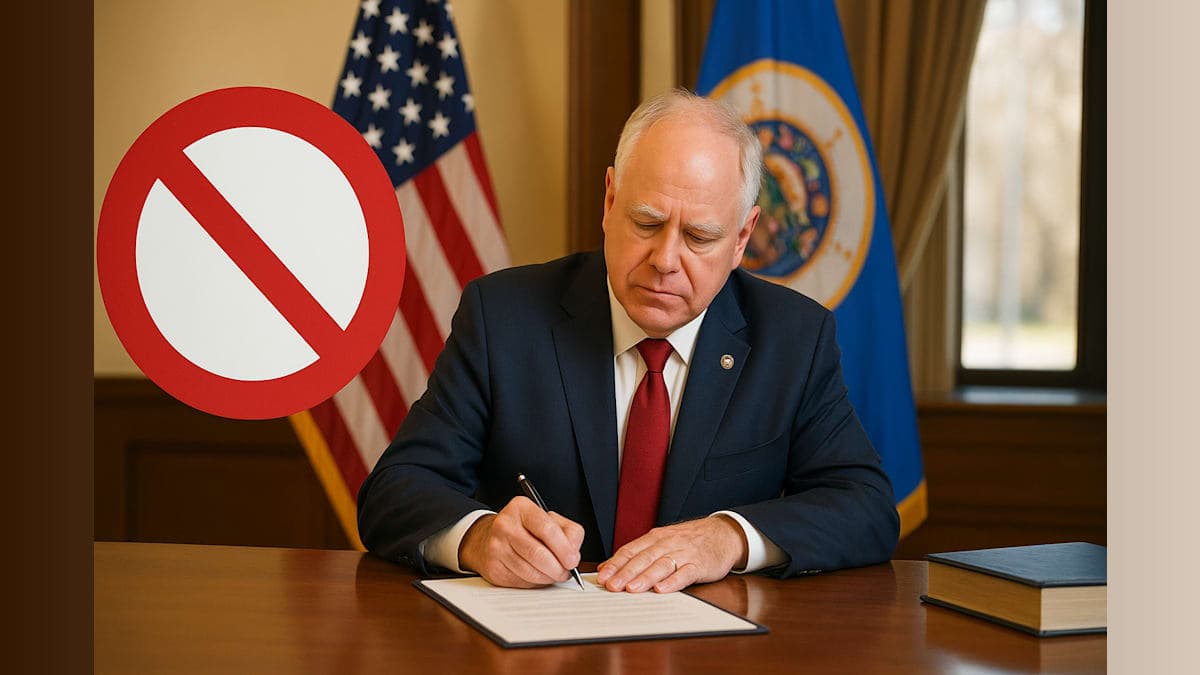
Minnesota has become the first state in the nation to enact a comprehensive ban on prediction market platforms, marking a significant escalation in the ongoing regulatory battle over these rapidly growing betting services. Governor Tim Walz signed the legislation into law, establishing the most far-reaching crackdown on massively popular platforms like Kalshi and Polymarket.
The new state law, set to take effect in August, makes it a criminal offense to host or advertise a prediction market within Minnesota. The legislation defines prediction markets as systems that allow consumers to place wagers on future outcomes, encompassing a broad range of subjects including sports, elections, weather events, live entertainment, word choice, and world affairs.
The prohibition extends beyond the platforms themselves to include supporting services such as virtual private networks that could enable consumers to disguise their location and circumvent the ban. Prediction market operators like Kalshi and Polymarket will be forced to cease operations in Minnesota or face potential felony charges.
Minnesota Representative Emma Greenman, the Democrat who introduced the measure, defended the state's authority to regulate these platforms. "We as a state should decide how best and what regulations we think should attach to gambling, to protect public safety, to protect our kids," Greenman stated.
The legislation does include specific exemptions. Event contracts that function as insurance policies in the event of harm or loss sustained, as well as the purchase of securities and other commodities, remain permissible under the new law.
Broader National Movement
Minnesota's action represents the leading edge of a broader movement. According to the National Conference of State Legislators, bills targeting the prediction market industry have been introduced in seven other states. Hawaii and North Carolina currently have pending legislation seeking statewide bans similar to Minnesota's approach.
Despite the mounting legal uncertainty, experts observe that prediction market applications continue to experience rapid growth. Melinda Roth, a professor at Washington and Lee University's School of Law who studies the industry, noted the strategic positioning of these companies. "The states are using any tactic they can to go after the prediction market companies," Roth explained. "But they've embarked on a too big to fail strategy and have become quite mainstream. It will be hard to put that genie back in the bottle."
Federal-State Jurisdictional Conflict
The Minnesota ban arrives amid an intensifying jurisdictional dispute between state and federal authorities. Questions over whether states or the federal government should oversee the prediction market industry have already generated more than 20 lawsuits nationwide. In Nevada, a judge ruled that Kalshi's offerings were "indistinguishable" from state-regulated sports gambling, prompting the company to pause its sports betting operations in that state.
The Commodity Futures Trading Commission has filed federal lawsuits against five states, including Arizona, Wisconsin, and New York, in an effort to override state regulatory attempts to control the betting platforms. The CFTC maintains it possesses exclusive jurisdiction over prediction markets, despite objections from former CFTC members and legal experts who argue that wagers on football games, words President Trump might say during a press conference, and whether Ricky Martin will make an appearance at the Super Bowl fall far outside the commission's traditional regulatory scope.
Kalshi spokeswoman Elisabeth Diana issued a strong rebuke of the Minnesota legislation. "Minnesota banning prediction markets is like trying to ban the New York Stock Exchange," Diana stated, characterizing the ban as a "blatant violation" of the law. She argued that the prohibition "actively harms users because it reduces competition and drives activity offshore."
A Polymarket spokesman similarly contended that Minnesota's ban contradicts the federal government's "established framework" for regulating prediction markets.
Minnesota's Gambling Landscape
The new law reflects Minnesota's existing approach to gambling regulation. While tribal-owned casinos operate within the state, online gambling and sports betting are not currently legal. Prediction markets like Kalshi and Polymarket have effectively provided access to sports betting for residents in states where such activity is prohibited, as the Trump administration regulates these platforms as a type of "event contract" rather than gambling, which typically falls under state gaming authority oversight.
Sports gambling constitutes the primary driver of activity on these platforms. On Kalshi, more than 85 percent of trading activity relates to sporting events, with some trades involving "parlays"—high-risk wagers that multiple specific outcomes, such as points scored, fouls, and passes, will all occur as predicted.
Bettors on these platforms are conducting billions of dollars in trades every week. However, concerns regarding insider trading and the potential for markets to create perverse incentives for individuals to manipulate real-world outcomes continue to challenge the companies and regulators alike.
Legal challenges to the Minnesota ban are anticipated as the industry and state authorities prepare for what promises to be a protracted battle over regulatory authority and consumer protection in the rapidly evolving prediction market sector.