
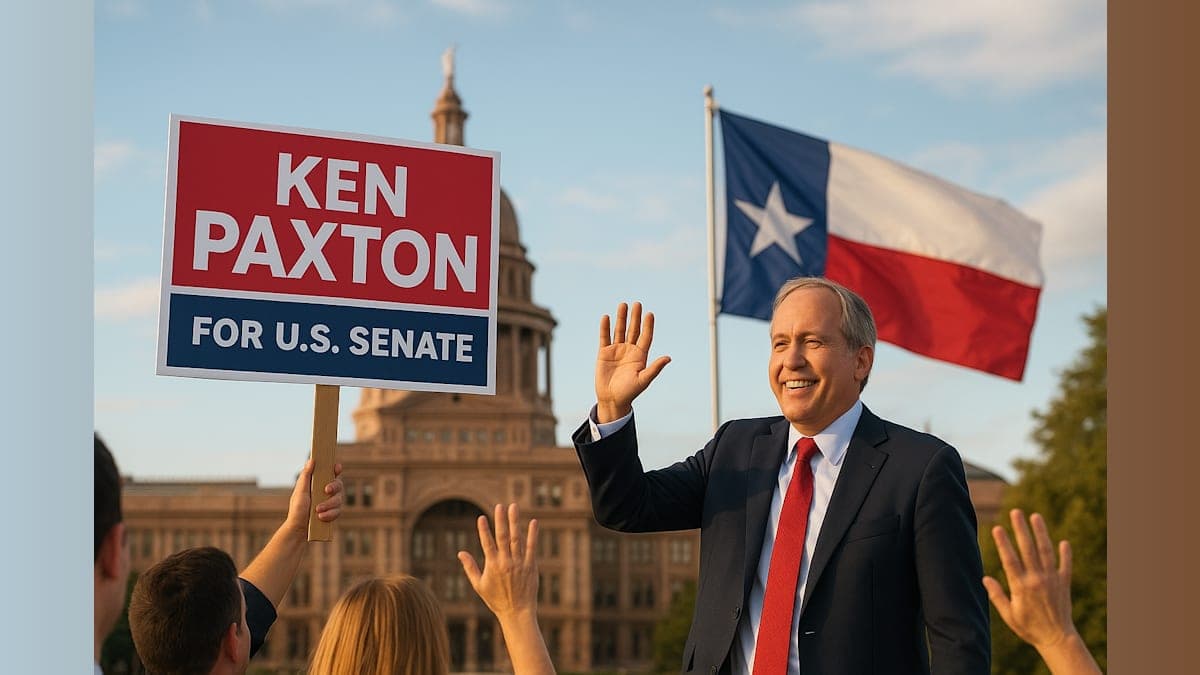
Texas Republicans have nominated Attorney General Ken Paxton for the United States Senate following a contentious primary runoff that concluded Tuesday, May 26, 2026, according to a race call by the Associated Press. The result effectively ends Senator John Cornyn's nearly quarter-century tenure in Washington and marks a decisive shift in the state's Republican establishment.
The race became the most expensive primary in Senate history, with Republicans spending $100 million as the party's establishment wing clashed with its MAGA-aligned base. Cornyn, 74, and Paxton, 63, advanced to Tuesday's runoff after neither candidate secured a majority in the March primary.
President Trump's endorsement of Paxton last week during early voting proved decisive in a race that political analysts had already suggested was tilting toward the attorney general. The endorsement energized Paxton's supporters and dealt what observers described as a fatal blow to Cornyn's bid for a fifth term.
Speaking to voters in Katy, Texas the day after receiving Trump's backing, Paxton emphasized his relationship with the president. "Whenever I'm around him, good things happen," Paxton told supporters. "Good things happen to me and good things happen for Texas. So I love Donald Trump."
A Controversial Nominee
Paxton enters the general election carrying substantial legal and personal baggage accumulated over more than a decade in state office. He has faced criminal indictments, whistleblower allegations, and impeachment by the Texas House, though he was ultimately acquitted by the Texas Senate. His estranged wife, state Senator Angela Paxton, filed for divorce last summer on what she described as "biblical grounds."
However, Paxton's supporters view these controversies as evidence of his willingness to fight establishment forces, drawing parallels to Trump's own legal battles. They criticized Cornyn for working with Democrats on bipartisan gun legislation following the 2022 school shooting in Uvalde, Texas, and for failing to support efforts to end the Senate filibuster to advance the Trump-backed SAVE Act, which would install new voting restrictions.
Cornyn's Establishment Credentials
Cornyn, once considered a contender for Senate majority leader, built a distinguished political career spanning four decades. He began as a state district judge in the 1980s, won election to the state Supreme Court, and served as Texas attorney general in the late 1990s before winning his first Senate seat in 2002. He became Senate majority whip approximately a decade later, though current majority leader John Thune, a Republican from South Dakota, assumed that role in 2019.
Speaking to NPR from a North Texas campaign stop last week, Cornyn defended his approach to governance and warned of the consequences of Paxton's nomination. "I've always believed in the politics of addition, not subtraction," Cornyn stated. "And that's what's allowed us to build the Republican Party in Texas and across the nation. And I don't think we should turn our backs on that."
Cornyn made clear his concerns about his opponent's character and fitness for office. "Look, if there were some honorable person … who would do a good job, it would be far different," Cornyn told NPR. But Ken Paxton is "unrepentant for all the scandals he's been involved in and who doesn't really care about anything else other than himself."
Democratic Opportunity in November
Democrats nominated state Representative James Talarico in the March primary, avoiding a runoff and allowing the party to focus on the general election. Party strategists believe the Republican divisions exposed during the primary campaign could create an opening in a state that has not elected a Democrat to statewide office since 1994.
Democratic leaders argue that a blue wave could materialize as Trump administration policies face backlash over rising prices, the Iran war, and other issues. The party views both this Senate seat and the broader Senate majority as potentially attainable given the Republican infighting.
Brandon Rottinghaus, a political science professor at the University of Houston, suggested the primary battle may have lasting consequences for Republican unity. "The stain of the fight has left a lasting problem for unity among Republicans," Rottinghaus observed. "There's a concern among Republicans that the rank and file are either abandoning the party by voting for Democrats … to switch an election or they're simply not participating. If either of those things happen, then it's a real liability for Republicans trying to get unity going forward in November."
Paxton's victory reaffirms Trump's continued influence over the Republican Party despite declining poll numbers and ongoing political turbulence. The November general election will test whether Texas Republicans can overcome their internal divisions and whether Democrats can capitalize on the opportunity to break their three-decade statewide losing streak.