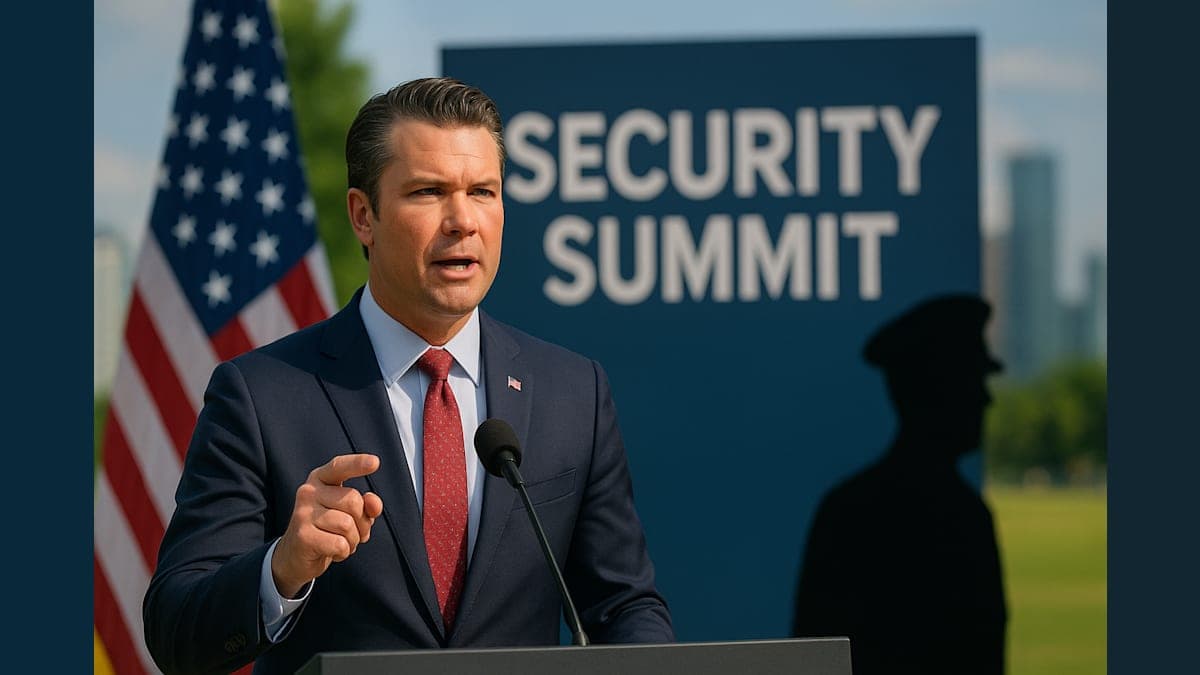
Defense Secretary Pete Hegseth called on allies in Asia to ramp up military spending to counter China's "historic military buildup" during his address Saturday at the Shangri-La Dialogue, a key annual regional defense summit in Singapore. However, the defense secretary notably did not mention Taiwan in his speech, marking a significant shift in tone from his previous appearance at the forum.
The appearance comes just over two weeks after President Donald Trump held a summit with Chinese leader Xi Jinping in Beijing that both sides hailed as a success. Hegseth acknowledged that U.S.-China relations are "better than they've been in many years" but emphasized there is "rightful alarm" about China's military activities in the region and beyond.
"A Pacific dominated by any hegemon would unravel the regional balance of power and undermine the equilibrium we all seek to preserve," Hegseth said to a room full of military, defense officials and diplomats.
This marks the defense secretary's second appearance at the defense forum in Asia. Last year he said China "seeks to be a hegemonic power in Asia" that "hopes to dominate and control too many parts of this vibrant and vital region." He also notably struck a more defiant tone in criticizing Beijing's harassment on Taiwan, a self-governing island Beijing claims as its own.
"Every day you see it. China's military harasses Taiwan," he said in his previous speech.
The omission of Taiwan from Saturday's remarks comes amid heightened concern following Trump's recent trip to Beijing. The president sparked alarm when he commented that arms sales to Taiwan is a "very good negotiating chip" with China. Days later, a senior U.S. official said arms sales to Taiwan have been paused due to the war in Iran.
Regional observers found the speech lacking in critical details. People in the region wanted clarity on Taiwan and Iran but "[Hegseth's speech] was really light on substance," according to Ankit Panda, senior fellow in the nuclear policy program at the Carnegie Endowment for International Peace who was in the audience listening to Hegseth's speech.
When asked by the audience to comment on Taiwan, Hegseth downplayed concerns and said the U.S. had enough weapons in stock. He said future arms sales to Taiwan rests solely with President Trump but that "there has been no change in our status."
On the Middle East conflict, Hegseth repeated what President Trump had said earlier, that the U.S. would not make a deal unless it is a good one that ensures Iran does not get a nuclear weapon. Hegseth said the U.S. is ready to resume strikes on Iran if no deal is reached. There were some U.S. strikes last week.
While Hegseth touted better U.S.-China relations, longer term the two countries are still strategic competitors. Countries in the rest of the region, especially smaller ones in Southeast Asia, feel caught between the two big powers.
In a keynote speech at the forum on Friday, Vietnam's President To Lam said one of the biggest risks is "unchecked competition" where "might makes it right."
"I think the pathway to avoiding conflict between these two countries remains entirely unclear, especially when so much of the secretary's speech leans into themes like lethality, dominance," Panda said. He noted that Hegseth did not offer a clear vision on how the U.S. expects to arrive at "what he's called a decent peace with China."
China did not send its defense minister for the second year in a row to the forum. Instead it sent a lower level delegation of military experts and scholars.
The defense secretary's speech was "more moderate" on U.S.-China relations compared to his first one at last year's Shangri-La Dialogue, according to Zhou Bo, a retired senior colonel of the Chinese air force and senior fellow at the Center for International Security and Strategy at Tsinghua University in Beijing.
Zhou, who has attended many of these forums, noted that it was important that Hegseth reiterated what Trump and Xi agreed to at their recent summit: to build a "constructive, strategic partnership."
"That was the first time, I believe, for the United States to officially recognize the equal strengths of China, as a peer power," Zhou said.