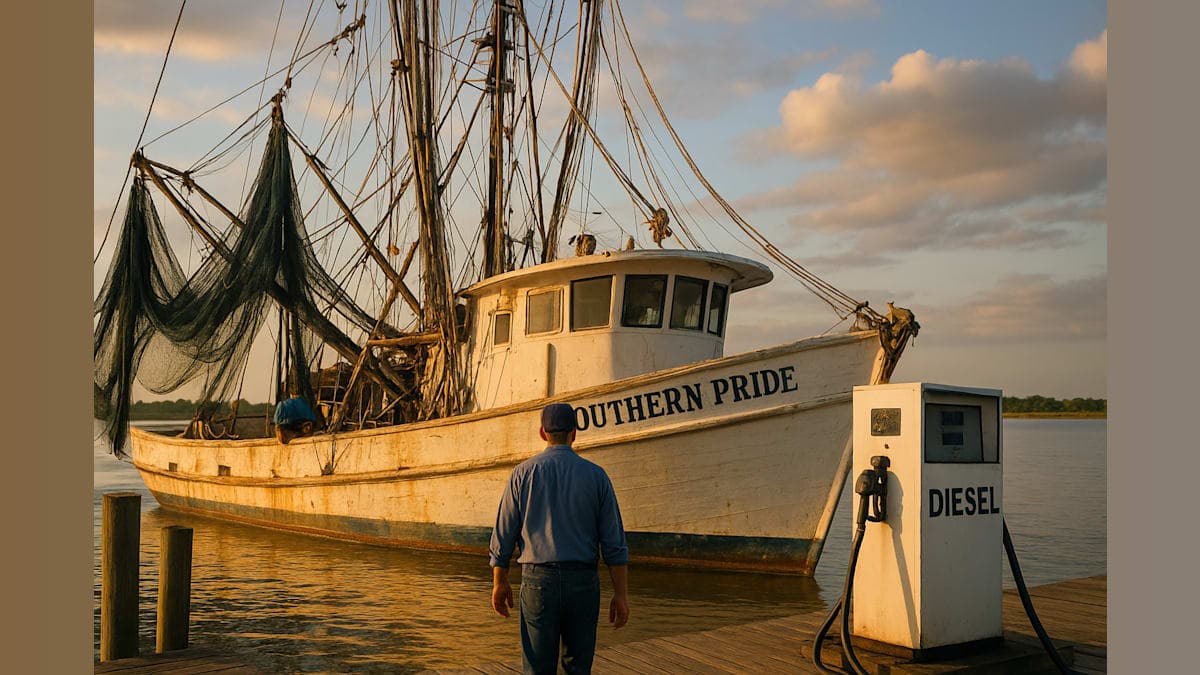
The Lacy Kay, a 31-foot trawler that has hauled thousands of pounds of shrimp from the Gulf of Mexico for more than four decades, now sits idle at a dock in Venice, Louisiana. Her owner, veteran shrimper Acy Cooper, has been forced to take work ferrying oil rig workers instead of fishing the waters he has worked since age 15.
Cooper represents a vanishing breed. Louisiana's shrimping fleet has collapsed from nearly 20,000 vessels in the mid-1980s to fewer than 1,400 today. The latest blow came this spring when diesel prices jumped from roughly $3.50 per gallon to more than $5, driven by the war with Iran and the closure of the Strait of Hormuz. For an industry already operating on razor-thin margins, the fuel spike has proven catastrophic.
"You can't make enough money during this shrimp season in order to make it all here," Cooper said on Friday, May 15, 2026, eating lunch from his pickup truck at the Myrtle Grove Marina in Port Sulphur. "So we have to supplement our way of life."
A Perfect Storm of Economic Pressures
The fuel crisis compounds decades of economic decline for Gulf shrimpers. Imported shrimp, predominantly farm-raised in countries like India and Ecuador, has systematically displaced domestic production. By 2023, imports accounted for more than 90 percent of American shrimp consumption, according to NOAA data. The U.S. Gulf fleet's market share plummeted from nearly 30 percent in 1984 to just 4.5 percent in 2023.
The financial toll has been severe. Adjusted for inflation, dockside prices have collapsed from over six dollars per pound four decades ago to under two dollars in 2023, an all-time low. Gulf shrimp revenue was cut by more than half between 2021 and 2023, falling from $489 million to $221 million.
Cooper now requires at least a thousand pounds of shrimp per trip just to break even. This season, achieving that threshold has proven difficult. A May cold front pushed shrimp into open water, and with decades of coastal erosion eliminating protective marshland, the shrimp population has not returned to traditional fishing grounds.
Industry Seeks Congressional Action
Blake Price, director of the Southern Shrimp Alliance, which represents commercial shrimpers from North Carolina to Texas, said the industry was already struggling before fuel prices spiked. "This industry could absorb an increased fuel cost a lot better if our markets were strong and hadn't been flooded with foreign, farm-raised product," Price stated.
The fuel increase has hit large operations particularly hard. For offshore freezer boats operating in the Gulf, a single 30-day trip requires between 9,000 and 12,000 gallons of diesel. Price reported that one Alabama operator spent $47,000 on fuel before leaving the dock, $20,000 more than the previous year.
The industry is pressing Washington for relief through multiple channels. The Save Our Shrimpers Act, which would prohibit U.S. taxpayer dollars from subsidizing foreign shrimp aquaculture operations that compete with American fishermen, has passed the House with broad support and awaits Senate action.
The USDA recently established a new Office of Seafood, which Price hopes will extend assistance programs long available to land-based farmers to the fishing industry. "We're not asking for checks or a payout," Price emphasized. "We just want a level playing field."
A Personal and Political Calculation
Cooper, who voted for President Trump and supports the administration's broader agenda, including the war with Iran, finds himself caught between political loyalty and economic survival. He praised Trump as "the only one that's had the balls" to confront Iran's nuclear ambitions after decades of presidential rhetoric.
Yet the consequences of that confrontation have directly impacted his livelihood. The vessel he named by combining his newborn daughter's first name with his wife's middle name in 1983 remains docked, a symbol of an industry in crisis.
Cooper's message to Washington is straightforward: "Help us with these fuel prices. We're farmers of the sea. We want something to fall back on when something like this happens, so we can be taken care of also."
Until market conditions or federal policy shifts, the Lacy Kay will remain tied to the dock in Venice, a testament to the precarious state of American shrimping and the men and women who have built their lives on the Gulf's waters.