The battle for Maine's Senate seat has crystallized into a fundamental debate about political power and its practical value. Republican Senator Susan Collins is staking her reelection campaign on her ability to direct federal dollars to the state, while Democratic challenger Graham Platner argues that such incremental gains pale in comparison to the systemic economic struggles facing working-class Mainers.
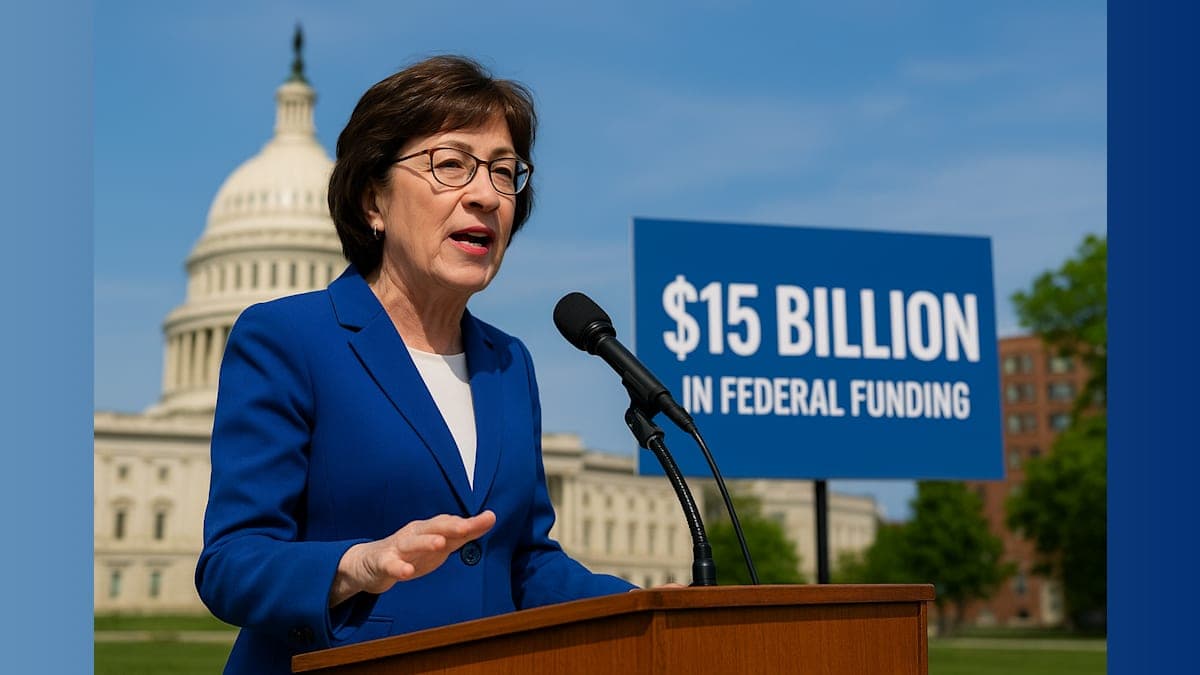
Collins has made her chairmanship of the Senate Appropriations Committee the centerpiece of her sixth-term bid. The position, which she described as a "once in a century" opportunity, represents the first time a Maine senator has held the key budgeting post in more than 90 years. According to her office, she has secured $1.5 billion in congressional spending over five years for nearly 700 local projects across the state.
The incumbent senator's first campaign advertisement highlighted her role in winning federal money for a breakwater dock in Eastport, Maine, a community with a population of just over 1,000. During a recent manufacturing conference in the state, Collins emphasized the importance of her seniority. "And that will go away with a freshman senator," she said. "It took me years to climb the ladder of seniority."
In her 25-minute keynote address at the manufacturing summit, Collins detailed numerous instances of federal funding she had secured or influenced. She pointed to federal cash for the state's community colleges and an incubator system for trade professions. She also highlighted a recent appropriations bill that reversed administration cuts to biomedical research, an industry with a foothold in Maine. Even funding to control the spruce budworm, a caterpillar that periodically ravages the state's softwood timber stock, received mention.
Collins has also positioned herself as a vocal opponent of President Trump's tariffs on Canadian products. She told the audience that she lobbied senior Trump administration officials to keep tariffs off products that would have hurt a paper mill on the Canadian border that uses pulp and steam from a neighboring facility on the other side of the border. "But think how devastating that would have been for northern Maine," she said.
Platner, who became the likely Democratic nominee after Governor Janet Mills suspended her campaign last month, has attempted to reframe Collins' federal funding achievements as inadequate. "I was told — essentially my entire life actually — that one day Susan Collins was going to get the gavel on Appropriations, and when that came, Maine was going to see a boon of riches," he said during a town hall at Bowdoin College in April. "Well, that never materialized."
The combat veteran and oyster farmer has criticized Collins for what he characterizes as insufficient use of her political clout. Ben Chin, Platner's campaign manager, said during a press call in April that Collins "owns" the federal budget and, by extension, Mainers' financial struggles. "Every time Sen. Collins leverages a little bit of an earmark to build a bridge or a road, that just does not make up for the fact that Mainers right now are hemorrhaging money left and right because she has backed the Trump administration's agenda to bleed people dry," he said.
Platner has also criticized Collins for providing a key vote advancing Trump's One Big Beautiful Bill before ultimately voting against it. The new law includes a range of cuts to Medicaid, the health insurance program for low-income Americans. Roughly 30 percent of the state's 1.4 million people receive benefits through the program.
He has repeatedly described Collins as providing "symbolic opposition" to Trump's agenda, part of what he calls "performative politics" typical of a Congress that enriches the wealthy at the expense of working-class Mainers. "And for that reason, it really isn't a representative system. It's a performance. It's a theater that's conducted by elites," he said during the Bowdoin town hall.
The electoral dynamics have shifted significantly since Collins' landslide victory in 2014, when she won with nearly 70 percent of the vote. In 2020, she secured reelection with just 51 percent, reflecting erosion in her Democratic support. Dan Shea, a professor of government and politics at Colby College, noted that Collins wins through split-ticket voters and independents. "I'm old enough to remember when pork barrel projects kept incumbents in office. Boy, we're seeing that in Maine," he said.
Independent voters will likely be a determining factor in November, just as they were in 2020. Vice President Vance acknowledged the delicate balance during an event in Bangor, Maine, last week. "Sometimes I get frustrated with Susan Collins. I almost wish that she was more partisan," he said. "But the thing I love about Susan is she is independent, because Maine is an independent state."
President Trump has also moderated his stance on Collins in recent months, a sharp reversal from declaring in January that Collins and several other Republicans "should never be elected again." During an interview on Fox News' The Five in late March, he said, "I hope she wins. She's a good person, actually, but we have to win. We have to keep the majority, otherwise all of the things we've done are going to go down the tubes."
The contest represents one of several pivotal Senate races that could determine whether Republicans maintain control of the chamber or if Democrats can overcome a difficult path to a majority. The outcome may ultimately hinge on whether Maine voters prioritize Collins' institutional power and proven ability to secure federal funding over Platner's call for systemic political change.