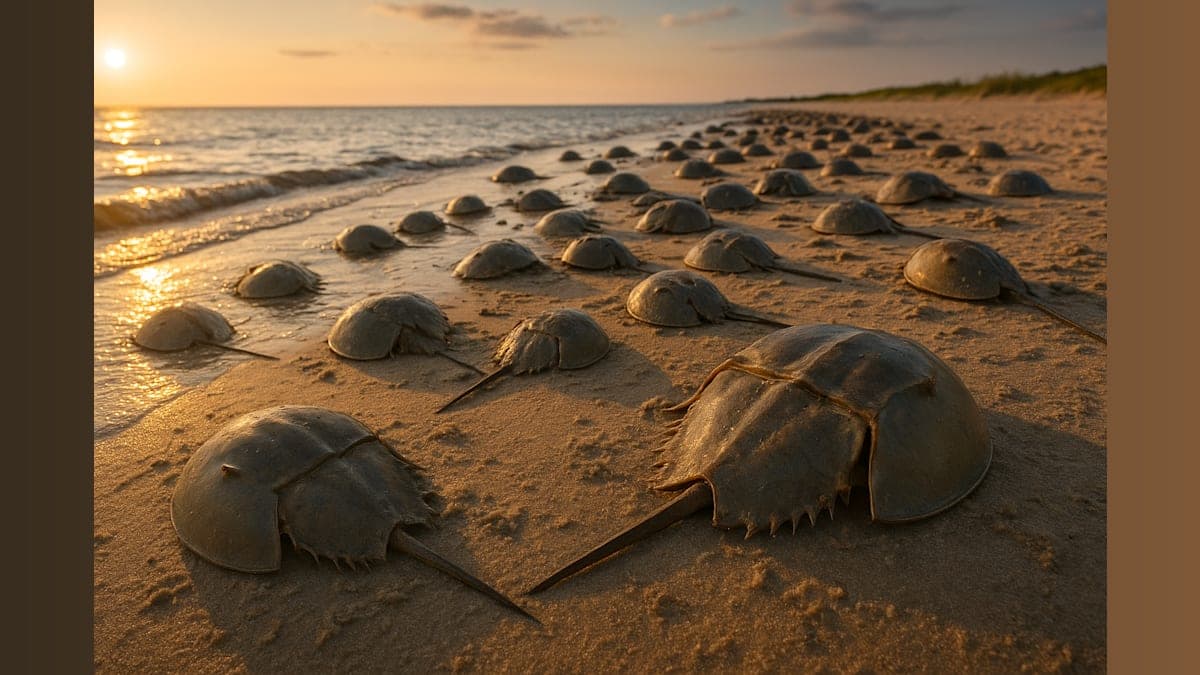
Our community is witnessing one of nature's most ancient spectacles this season, as thousands of horseshoe crabs crawl onto Delaware Bay beaches in Cape May County for their remarkable mating ritual — a tradition that's been unfolding for 400 million years.
The Delaware Bay hosts the world's largest concentration of these fascinating creatures, which despite their name aren't actually crabs at all. According to the New Jersey State Park Service, they're ancient cousins of the scorpion, earning them the nickname "living fossils."
Every year during May and June, female horseshoe crabs return to our shores to lay up to 100,000 eggs each. This spawning activity intensifies during new moon and full moon cycles, creating dramatic scenes along our beaches as countless crabs emerge from the water.
A Critical Food Source for Migrating Birds
The timing of this annual event isn't coincidental — it's perfectly synchronized with another natural phenomenon. Shorebirds migrating from South America to the Arctic make a crucial stopover at the Delaware Bay to feast on horseshoe crab eggs, fueling up for their long journey north.
According to reTURN the Favor, a group dedicated to saving stranded horseshoe crabs, this relationship means only a very small number of eggs will survive to hatch. Even fewer will reach adulthood, making each horseshoe crab that completes its life cycle all the more remarkable.
Protected for Good Reason
Because shorebirds depend so heavily on horseshoe crab eggs, New Jersey doesn't allow the harvesting of these creatures — with one important exception. According to the Department of Environmental Protection, horseshoe crabs may be collected for the biomedical industry, where their blood is used to detect contaminants in medications and injectable drugs.
The process involves taking about one-third of their blood before returning the crabs to the water, allowing them to continue their vital role in our coastal ecosystem.
Experience It Yourself
Residents and visitors interested in witnessing this ancient ritual or participating in horseshoe crab conservation events can find more information through reTURN the Favor. It's a unique opportunity to connect with a living piece of natural history right here in our own backyard — a reminder that some of nature's most extraordinary events happen along our local shores.