
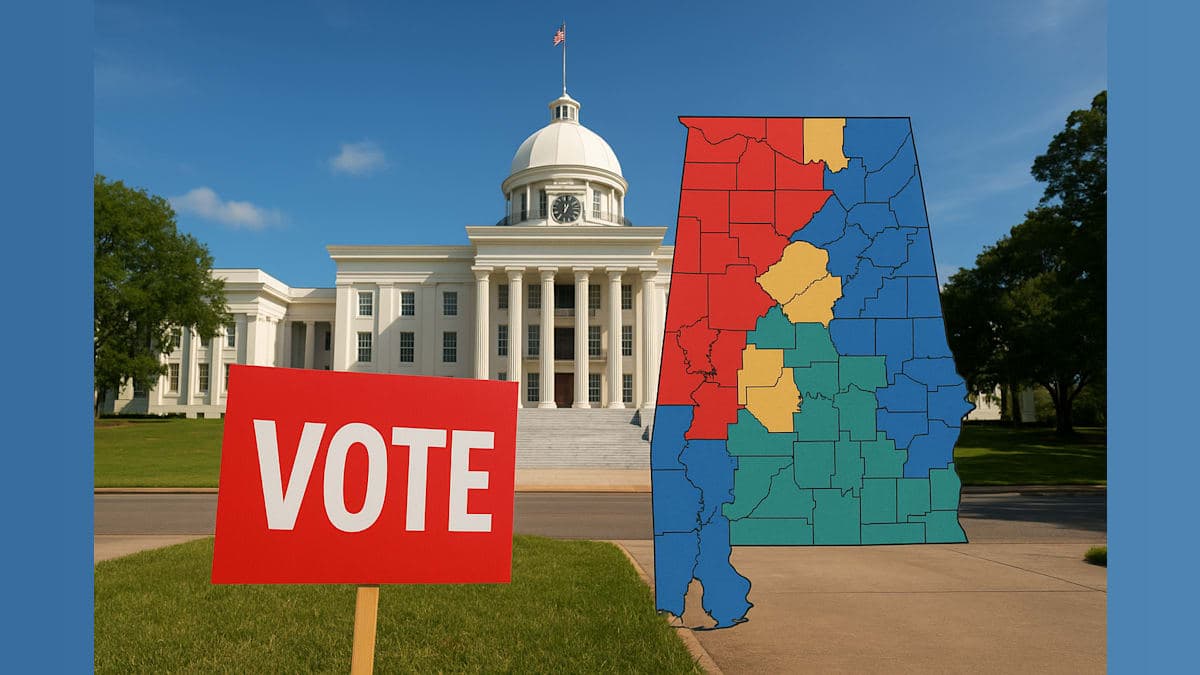
Alabama's electoral landscape has become significantly more complex following a U.S. Supreme Court decision that allows the state to implement a controversial congressional redistricting map. The ruling has prompted state officials to schedule an unprecedented split primary system that will divide voting across different dates for various congressional races.
The Supreme Court's conservative majority vacated a lower court decision on Monday that had blocked a 2023 congressional map proposal. The lower court had required Alabama to include a second largely Black district in its redistricting plan. The high court's order, which drew opposition from the court's three liberal-leaning justices, followed a recent ruling in a Louisiana redistricting case that effectively weakened protections under the Voting Rights Act.
Governor Kay Ivey announced Tuesday that the state will proceed with a special primary election scheduled for August 11 for four congressional districts affected by the redistricting change: the 1st, 2nd, 6th, and 7th districts. This extraordinary measure became necessary because Alabama's regular primary election is set for next Tuesday, May 19, with absentee voting already underway for other races.
"I will continue to say: Alabama knows our state, our people and our districts best," Ivey stated in her announcement. "The United States Supreme Court's decision is plain common sense and enables our values to be best represented in Congress."
The governor urged voters to participate in both elections, emphasizing the importance of maintaining representation aligned with state values. "Alabamians now have another opportunity to send strong voices to Washington to fight for our values, and I encourage them to get out and vote in this special primary election on August 11," Ivey said. "I also urge them to head to the polls this coming Tuesday, May 19 to vote in all other races."
The redistricting decision carries significant political implications. Following the Louisiana Supreme Court decision, Alabama's Republican leaders successfully moved to revert to the 2023 map proposal that maintains only one largely Black, Democratic-held congressional district rather than two. Political analysts suggest this configuration increases the likelihood of Republicans securing an additional U.S. House seat from Alabama.
Voting rights organizations have mounted legal challenges to the map change, filing court documents arguing against the implementation of the 2023 redistricting plan. In their filing, these groups contended that reverting to a map that has never been implemented while an election is already in progress represents a disruption to the democratic process.
"Alabama's attempt to revert to its 2023 map—a map that was never implemented and under which no one has ever voted—when this election is already underway, absentee ballots have been mailed, and every relevant deadline under state and federal law has long since passed, is contrary to the public interest," voting rights groups wrote in their court filing.
The split primary system creates an unusual voting scenario for Alabama residents. Voters in the 1st, 2nd, 6th, and 7th congressional districts will cast ballots for their House representatives in the August 11 special primary, while all other primary races will proceed as scheduled on May 19. This bifurcated approach adds logistical complexity to the electoral process and requires voters to remain informed about which races appear on which ballot.
Alabama's situation reflects a broader national trend following the Supreme Court's recent Voting Rights Act decision. Other Republican-led states, including Louisiana and South Carolina, are now considering similar actions to dismantle majority-Black districts. These developments represent a significant shift in how congressional districts are drawn and could reshape political representation across multiple states in the coming election cycles.
The legal and political battles over Alabama's congressional map underscore ongoing tensions between state redistricting authority and federal voting rights protections. As the special primary approaches, both supporters and opponents of the redistricting plan are preparing for continued legal challenges and mobilizing voters for what has become one of the most closely watched electoral processes in the nation.