
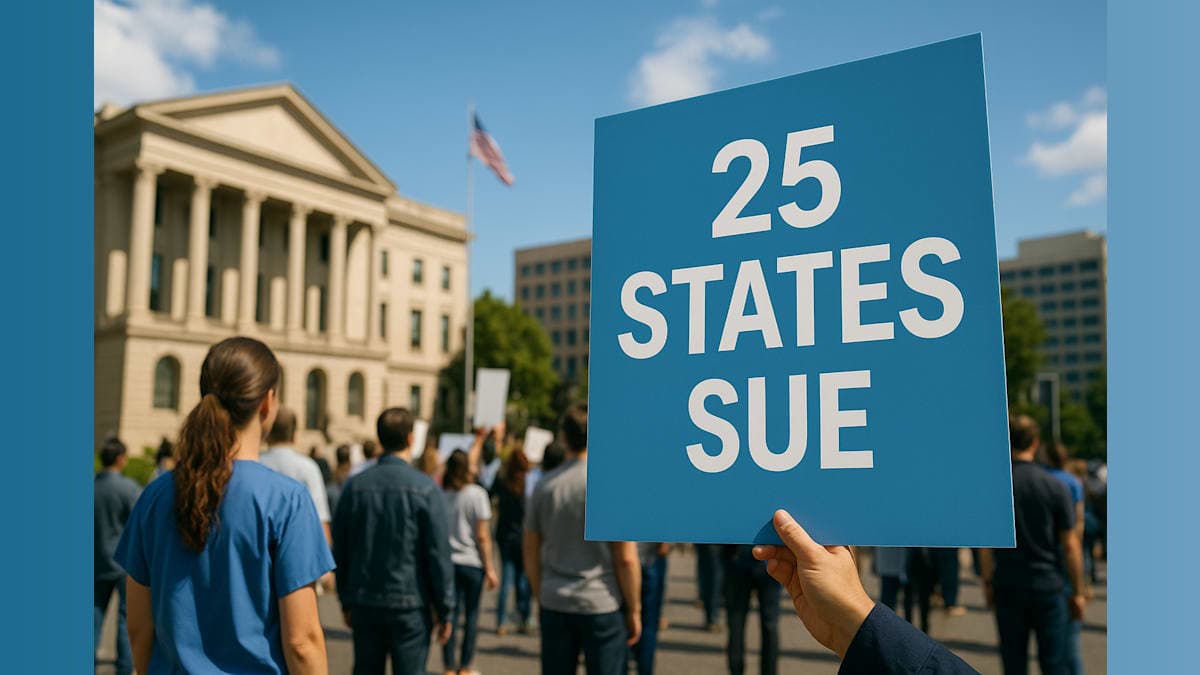
A multistate coalition launched legal action Tuesday against the Trump administration over new federal student loan restrictions that significantly limit borrowing capacity for graduate students pursuing nursing and other healthcare-related degrees.
The lawsuit, filed in federal court by 24 states and the District of Columbia, challenges a rule that excludes nursing, physical therapy, and nurse anesthesia programs from higher loan limits available to other professional degree programs. New York Attorney General Letitia James articulated the coalition's concerns in a statement released Tuesday.
"Higher education is expensive, and our health care system is already under immense strain," James said. "This rule will shut talented people out of critical professions and leave communities with fewer health care providers they desperately need."
The legal challenge centers on implementation of borrowing restrictions enacted through last year's One Big Beautiful Bill Act. While undergraduate nursing programs remain unaffected, the legislation dramatically reduced graduate student borrowing capacity. Previously, graduate students could borrow up to the full cost of their programs. The new framework caps annual borrowing for most graduate students at $20,500, with a lifetime limit of $100,000.
The Professional Degree Exemption Controversy
The lawsuit specifically targets how the Trump administration defined which graduate programs qualify as "professional" degrees eligible for higher borrowing limits. Under the department's rule, only 11 categories receive exemption status, allowing students to borrow up to $50,000 annually with a $200,000 total cap: chiropractic, clinical psychology, dentistry, law, medicine, optometry, osteopathic medicine, pharmacy, podiatry, theology and veterinary medicine.
Notably absent from this list are numerous healthcare professions experiencing documented workforce shortages. The plaintiffs argue in their legal filing that the Education Department based its professional degree categories on regulations unchanged since the 1950s, an era when graduate nursing and many healthcare programs barely existed.
States joining the legal action include Arizona, California, North Carolina, Kentucky, and Nevada, among others. Their lawsuit contends the administration "issued a final rule unlawfully narrowing" the pre-existing federal definition of professional degrees, imposing "new restrictions not enacted by Congress."
Healthcare Industry Responds
The American Nurses Association expressed strong opposition when the Trump administration finalized its rule last month. Jennifer Mensik Kennedy, president of the organization, characterized the decision as deliberately obstructive to nursing career advancement.
"This Department of Education has chosen to make it harder for nurses to advance their education and their careers," Kennedy stated. "Make no mistake, this is not a technicality or a footnote. This rule will be felt in real communities, for example, in rural areas where nurse practitioners, midwives, and nurse anesthesiologists are often the only providers of core care services."
The American Association of Colleges of Nursing issued a February fact sheet warning that affected nursing students "could be forced to seek high-interest private loans or abandon advanced practice education."
However, analysis from Preston Cooper of the American Enterprise Institute offered a contrasting perspective, suggesting the impact may be overstated. "The rhetoric around new loan limits for nursing programs does not match the reality," Cooper wrote. "The new caps will affect only a small number of programs charging exorbitant prices."
Administration Defense and Congressional Scrutiny
Education Secretary Linda McMahon faced bipartisan questioning during a House education committee appearance last week. Republican Representative Randy Fine of Florida challenged the policy's logic, asking whether it made sense to restrict access to education in fields experiencing documented workforce shortages.
McMahon defended the restrictions on two grounds. First, she maintained that most advanced nursing degree costs would fall within or near the new caps, and that undergraduate nursing programs remain unaffected. The Education Department noted in a late 2025 fact sheet that 80 percent of the nursing workforce does not hold graduate degrees.
Second, McMahon argued the caps serve a broader cost-containment strategy. "It is our overall goal to bring down the cost of college and education," she told Fine. "And I do think that, relative to the shortages we're having, if we can bring down the cost for nurses in schools, we can get more students to apply."
The administration's approach represents a calculated gamble that institutions will respond to reduced federal loan availability by lowering tuition rather than maintaining prices and forcing students toward private lending markets. Whether colleges will adjust their pricing models as the secretary anticipates remains uncertain, leaving both borrowers and policymakers in a period of watchful waiting as the legal challenge proceeds through federal courts.